



Executive Summary
Digital experience (DX) platforms are intended to develop, coordinate, manage, and optimize the volume and complexity of customer interactions across digital touchpoints. They provide a means of managing web, mobile, and digital content, can evaluate customer behaviors, predict customer journeys, and personalize and contextualize content and communications. Adding to the complexity of this loosely defined category is the ever-evolving toolset that increasingly includes generative and agentic AI capabilities to create, iterate and personalize digital engagement. A DXP should not be confused with a content management system. While a headless CMS often sits at the center of a DXP, not all CMS solutions should be considered a DXP. In reality, no uniform, universally accepted definition exists for this category, but the promise of a unified pane of glass to manage the digital experience is. But for Constellation, the true value of a DXP lies in how effectively and efficiently the solution can bridge consistency gaps across the totality of digital touchpoints.
Modern DXPs are increasingly focused on optimizing digital experiences across all functions of the customer experience ecosystem, including marketing, customer service, commerce, and sales engagement. They analyze customer behavior and identify key or distinctive patterns, often using artificial intelligence (AI). AI is increasingly applied to dynamically serve personalized, highly contextual content to customers. Increasingly, DXPs are splitting into two similar, but crucially different camps: composable suites of best-of-breed tools that together function as a platform, or comprehensive platforms that collectivize headless delivery tools atop a composable architecture, typically via a single vendor. For this list, only solutions delivered via a single vendor as a comprehensive toolset or platform have been considered.
Threshold Criteria
Constellation considers the following criteria for these solutions:
- Decoupled, headless content management system (CMS)
- AI and machine learning capabilities
- API availability, microservices architecture
- Native integrations with critical systems, including CRM and ERP
- Marketing campaign automation
- Commerce functionality from the digital storefront through to transaction
- Data management
- Interfaces for developers and business users, especially those tied to content, asset, and experience management
- Robust developer resources, including modern frameworks for frontend (React, Vue, etc.) and backend
- Digital asset management (DAM)
- Digital feedback loops
- Display management
- Experimentation, testing, and real-time automated optimization
- Mobile app platform and responsiveness
- Journey orchestration
- Personalization and targeting
- Reporting and analytics
- Data security, governance, and compliance controls
The Constellation ShortList
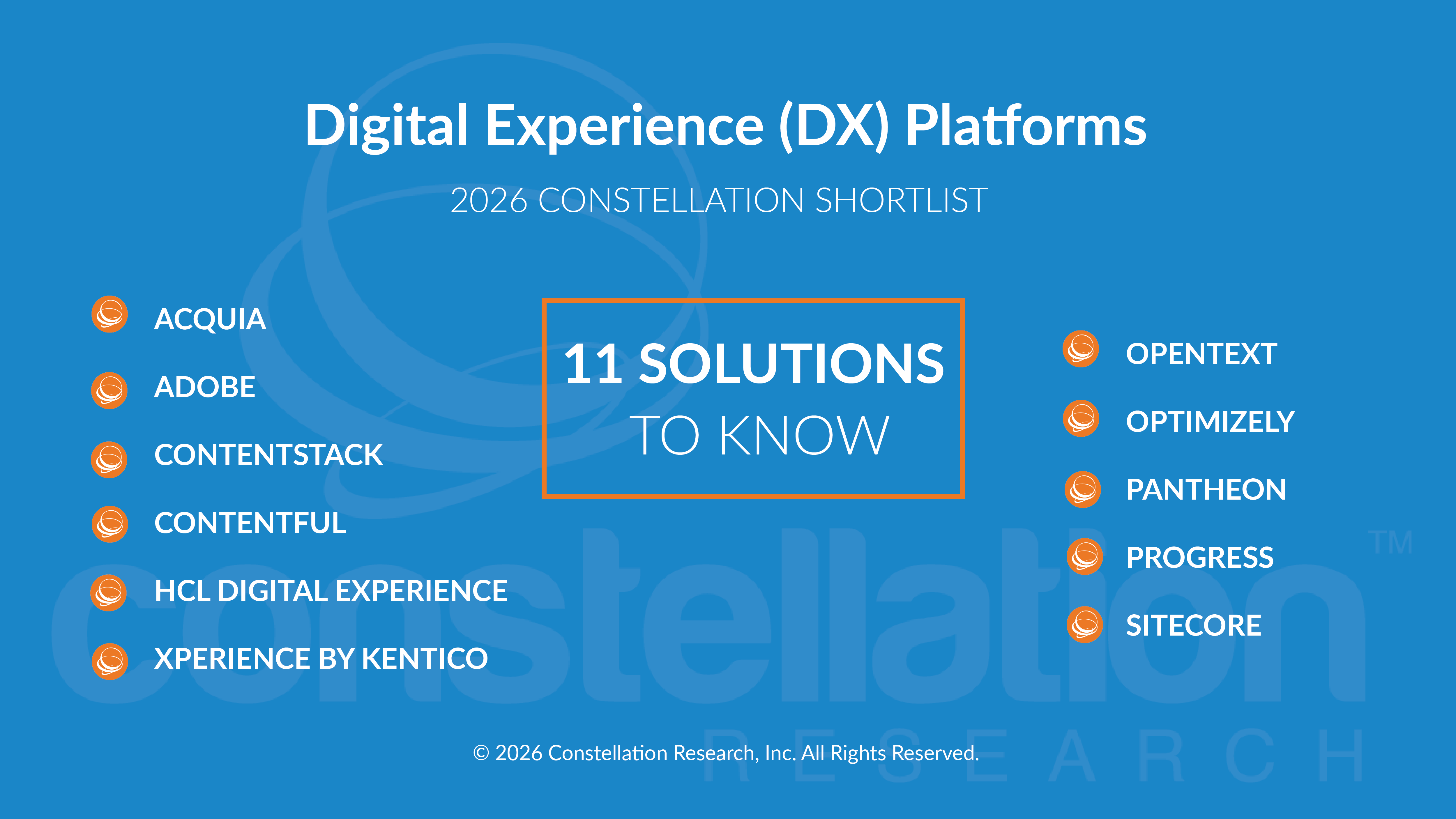
Constellation evaluates more than 50 solutions categorized in this market. This Constellation ShortList is determined by client inquiries, partner conversations, customer references, vendor selection projects, market share, and internal research.
- Acquia
- Adobe
- Contentstack
- Contentful
- HCL Digital Experience
- Xperience by Kentico
- OpenText
- Optimizely
- Pantheon
- Progress
- Sitecore
Frequency of Evaluation
Each Constellation ShortList will be updated at least once per year. There could be an update after six months, should the analyst deem it necessary.
Evaluation Services
Constellation clients may work with the analyst and research team to conduct a more thorough discussion of this ShortList. Constellation can also provide guidance in vendor selection and contract negotiation.