Go Ahead and Talk AI IPOs and Stealing Cars…OR Come Talk about Chestnuts
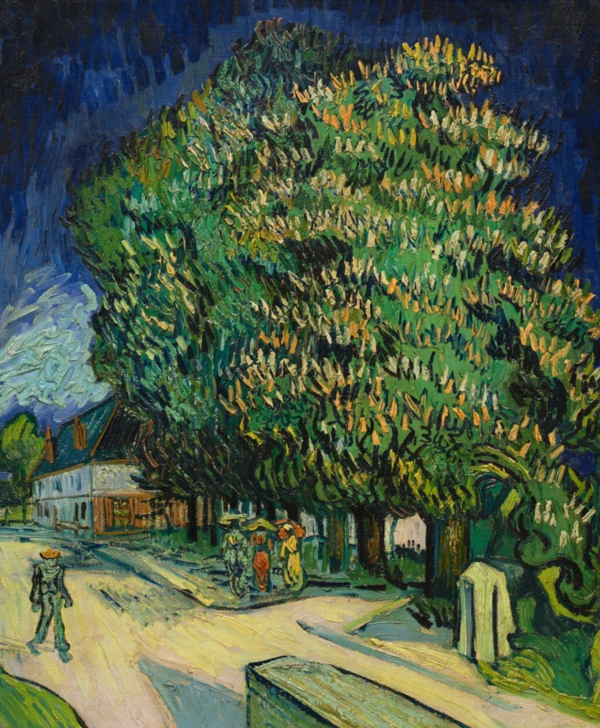
The news on the morning of Thursday, November 19 had most people crushed between Grand Theft Auto 6 and Anthropic’s IPO in a mind-bending proclamation that digital emersion existed a world led by artificial intelligence. But I can’t stop being fascinated by something that happened on the eve of this digital rapture: A painting sold for millions. Châtaigniers en fleurs…Chestnut tree in flowers.
This work was painted at the end of Vincent van Gogh’s life and had not been viewed publicly in over 50 years, part of a near mythical collection of Impressionist and Post-Impressionist works owned by a single family who never loaned their pieces to museums. The full collection up for auction at Sotheby’s in New York included works by Edgar Degas and Claude Monet. On the hammer, the collection sold for $412 million with the Van Gogh breaking records at $190.4 million.
Yet in the art world, this was all under value and the $778 million night was “thin”. An example: a Cézanne valued at $120 - $150 million hammered at $99 million. Yet other works surprised as an Aaron Douglas piece, Harriet Tubman, painted in 1931, was estimated to range between $2.5 - $3.5 million sold for $14.5 million.
November is lining up to be a massive haul in art as all the major auction houses are expected to generate north of $2.4 billion in sales. A Kandinsky recently sold by Christie’s brought in $85.8 million and a Lichtenstein hammered for $24.7 million. So why can I not stop thinking about chestnuts?
This is a work that has not been viewed in over 50 years, yet the most voracious consumer of the piece could very well be an LLM named Claude that just completed the largest IPO in history with a $1.5 trillion offer price and $2 trillion open.
Why Would Claude be Hungry for Chestnuts?
In 2017 an NVIDIA blog excitedly reported that a firm had used an NVIDIA DGX-1 and trained a Generative Adversarial Network (GAN) model on 8,000 paintings. Called Vincent, it was able to understand painting styles, forms and edges to turn a basic sketch into paintings in the style of Van Gogh to Picasso. At the time, GANs like Vincent captured fascination and some murmurs of concern about authorship, but no mass outcry over job displacements or theft of intellectual property. But we live in a different time where controversy swirls while models hung the web for more.
While model companies like Anthropic do not disclose training dataset detail, open-weight image generation models have noted leveraging between 800 million and 5 billion image-text pairs for training. To improve generations over time, these models need even more datasets to improve quality, especially around style. The models are not regurgitating replicas, instead they are acting as a tool to recreate the work by reversing the process of creation, training on textures, colors, light and shapes. It creates a statistical correlation between the prompt and the literal stacking of patterns pixel by pixel. These models don’t comprehend the “mood” or concept…they correlate the request to how the pixels come together based on all it has compiled about HOW an artist created a work or what is a photograph.
The other thing we know about AI, she doesn’t like to sit still with what she’s already consumed in training: she’s hungry and constantly wants more all in the name of “fine tuning”. So yes, models could eagerly scoop up a scraped glimpse of this rarely seen Van Gogh work and train on this aesthetic to understand the difference in strokes, the depth of colors or the bend of light captured by a master. It is also not unreasonable to wonder what is more eager to view newly uncovered works, the models or the auctioneers.
The Bigger Picture Beyond AI
But there is something even more telling about the sale of the Van Gogh work— something that should be noted in the staggering sale prices of art in recent months: The desire to own art, to pay millions for a single piece painted by someone long reconciled to history, is distinctly human. While models want a fleeting glance at its pixels, humans want to sit, stare and marvel at these pieces. That is something no AI boom or bubble can change. No matter how record-breaking Anthropic’s IPO is…and how that record could be broken by an AI company in the future…it will be a fleeting fancy compared to the human desire to create and to consume the output of creativity.
There is a drive to dive into the craft of creation. But there is also a distinctly human drive to consume the creative. Museums, auction houses and art galleries exist for a reason. I’ll use myself as an example: There is a painting that, any time I am in London, I feel an inexplicable need to sit in front of. It is called The Execution of Lady Jane Grey by Paul Delaroche. It is a painful scene of a young girl tossed into the middle of a political melodrama that cost her life. While the story being told in this massive canvas is compelling, I find myself sitting on level 2 of the National Gallery in London captivated by her hands.
Hands, as generative AI models have showcased, are incredibly difficult to capture in art because they are ridiculously complex. But Delaroche not only masters Jane’s hands, but uses light, brush strokes and color to turn her hand searching for the block on which her head will be chopped into one of the most delicate and heart wrenching few inches on canvas, capturing Jane’s documented last words, “What shall I do? Where is the block?” In my amateur art-critic stoop, it is the most incredible generation of hands I’ve seen to the point I can’t stop staring at them, wondering how Delaroche managed to capture so much in a gesture.
AI can pick each stroke, each color, each texture and technique from this work and it still can’t get hands right. With each round of training, models can get better in making the connection between the text that describes the work and the text that describes the scene and the scenario. The metadata carries all the detail from how it was created, the tools used and colors across the canvas to the artist name, creation era and history of works. These models can soak in all the context from every angle. And, over time, these models can and will get better. The generations humans create using these models as tools will keep getting better. And THOSE creations, those works, may cause people to stop and stare, appreciate and wonder because humans are intensely curious.
We will wonder about the craft and be curious about the provenance. But nobody talks about Delaroche’s brush brands or attributes the $190 million selling price of a Van Gogh to the pigment brands he mixed. Those are the tools. The price tag is attributed to the human behind the craft.
Who is the Star of Grand Theft Auto?
As of November 18, an estimated 17 million digital copies of Grand Theft Auto VI were pre-ordered across Playstation 5 and Xbox platforms, predicting revenues exceeding $3 billion. Some media outlets have theorized that 3.9 billion people could call out sick on GTA6 release day. Estimates note that this installment of a massively beloved game franchise took over a decade and $1 billion to make.
And yes, the art and design of GTA6 is also making headlines, being analyzed pixel by pixel, noting everything from its dynamic color palette to what an architecture journalist called “unprecedented urban realism” and what Rockstar Games has called a “human-led creative craft” built on top of their proprietary Rockstar Advanced Game Engine. This platform has long been touted as a fundamental differentiator for the developer, giving game developers control over everything from world streaming and scripting to graphics rendering. Game players spend hours in discussion over the superior character rendering and details from body proportions to how cloth shifts and moves in the animations. They marvel at the detail in a way I understand: they are sitting in front of their Jane Grey.
And just like I stare in envy and wonder at Delaroche’s talent and craft, gamers marvel over every strand of hair and the quality of the world they can spend hours immersed in. At no point does everyone start delving into the details of Adobe Photoshop or wonder what 3D rendering platform was deployed. Instead, the truly faithful get to know the game designers and watch endless YouTube videos about Rockstar’s human-led creative approach. The behind-the-scenes artist capture videos become iconic almost overnight, with the artists and creators becoming legend. Limited edition lithographs from GTA releases have sold for hundreds. The artist Steven Bliss, responsible for the original artwork for the GTA franchise and a legend in Rockstar Game lore, has left the game world to focus on fine art, selling canvases and murals that exist in the distinctly non-digital and tactile world.
Headlines Will Fade; The Art Will Live On
So yes, marvel at the IPO. Spend the weekend stealing cars in GTA VI. But long before and long after these moments, there will be the art. People will want to create it, view it, and yes, pay millions to own it. AI is a powerful tool, but tools always have a way of slinking back into a list of artifacts used by humans to let their thoughts, ideas, taste, judgement and creativity spill out onto the substrate of their choosing. Some will excitedly reminisce about the tools and even the substrate as footnotes and passing fancies. The art and the story will remain.
About Liz Miller: Liz Miller is Vice President and Principal Analyst at Constellation, focused on the org-wide team sport known as customer experience. While covering CX as an enterprise strategy, Miller spends time zeroing in on the functional demands of Marketing and Service and the evolving role of the Chief Marketing Officer, the rise of the Chief Experience Officer, the evolution of customer engagement, and the rising requirement for a new security posture that accounts for the threat to brand trust in this age of AI. With over 30 years of marketing experience, Miller offers strategic guidance on the leadership, business transformation, and technology requirements to deliver on today’s CX strategies. She has worked with global marketing organizations to transform everything from…...
Read morePublished
Author