Experience Data Is Getting a New Job: From Measurement to Decision Context
As a serial CMO/CPO, like many CX executives, I used experience management solutions for years to understand what happened after an interaction.
A customer bought something. A shipment arrived late. Someone called support. An employee had a poor experience. We collected feedback, analyzed it, and figured out what to fix.
AI is flipping that script. Feedback still matters, but in a new way.
As AI moves from answering questions to recommending and increasingly taking actions, that human experience data has a new job. It can become part of the growing set of context data being promised to help decide what should happen next.
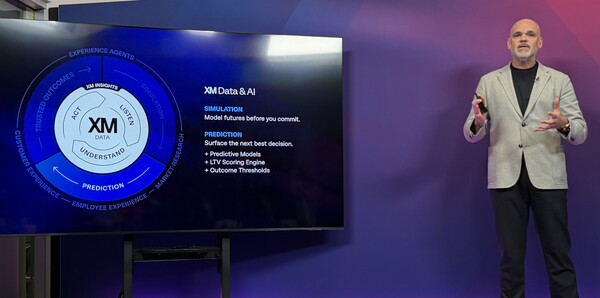
That was my biggest takeaway from Qualtrics' latest launch, XM Data & AI.
The headline announcement was the new platform, built around simulation, prediction, and what Qualtrics calls trusted outcomes. The takeaway for data and AI leaders is that human experience intelligence is moving upstream in the decision cycle.
And that matters well beyond customer experience.
From measuring the experience to informing the decision
To date, enterprises have had enterprise applications and reporting systems that do a good job of telling us what happened: a CRM knows what the customer bought, a digital platform knows what they clicked, a service system knows they called, a product platform knows usage dropped, and a data platform is increasingly bringing all of those signals together.
The uncomfortable gap for CMO/CX leaders alike is what those systems don’t know: how the real person on the other side of that transaction feels about or perceives their experience. Was the customer frustrated? Did they feel ignored? Were they confused about value? What matters enough to them that a particular intervention might change the outcome?
Those questions have historically been the domain of experience management.
Qualtrics built its category around listening at scale and helping companies understand those signals. The new platform Qualtrics just announced extends that model toward simulation, prediction, and action.
While Qualtrics’ launch strategy reads like a product expansion, my takeaway for business leaders is that the shift is architectural.
Let me break it down:
- Experience data used to be collected and used after an interaction: Interaction → feedback → analysis → action
- Increasingly, experience data can/should be used in front of a decision: Signal → experience context → decision → action → outcome → learning
While “context” has become an overused word, many architects in the industry are just starting to map what feeds into context and how to manage it. As context rises to a central role in both guided and automated decisioning, human experience data is becoming increasingly important. When AI only summarizes what happened, missing context can give you a mediocre answer, and the human can still make a good decision. When AI starts acting, missing context can give you a bad decision … at scale.
Simulation shows what changes
Simulation was probably the clearest example Qualtrics showed of what human experience intelligence can enable.
Qualtrics used the age-old example of quiet customer churn. In its demonstration evaluating a hotel chain’s customers, Qualtrics showed an experience context-powered system identify a customer cohort at risk of disappearing, evaluate several potential interventions, compare expected response and cost, and recommend an action before the company committed.
Ken Hoang, Qualtrics' new SVP of Products, demonstrates how synthetic cohorts and simulation can test multiple interventions before acting—moving some experimentation ahead of execution.
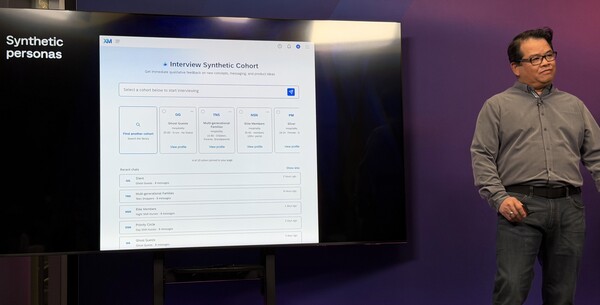
Ken Hoang, Qualtrics' new SVP of Products, demonstrates how synthetic cohorts and simulation can test multiple interventions before acting—moving some experimentation ahead of execution.
-
The fun part was that the gut-reaction answer, to offer loyalty points, was not the best answer. By connecting the dots on perceived experience, connected outcomes, and policy constraints, a room upgrade was projected to have more impact on customer lifetime value at a lower cost.
OK, interesting hotel example, but there is a bigger point. Over the last decades, most companies run experiments, measure results, and learn after they act. That means launching the campaign, changing the price, modifying the service policy, sending the offer, and then measuring what happened.
Simulation can move what used to be experimentation/panel-driven learning to something you can do before execution.
- Traditional model: Decide → act → discover
- Simulation allows: Test → decide → act → verify
Wearing my CMO hat, simulation can change the economics of experimentation. Synthetic populations and digital twins can let organizations evaluate far more alternatives before spending money or putting an experience at risk. Ultimately, as a business leader, if I can take 10 moves for each of your 1, I will win.
“This is not AB testing. This is A through Z testing.” - Qualtrics CEO, Jason Maynard
More importantly, simulation can improve the new business KPI of decision velocity by helping compress the distance between strategy and execution.
Of course, a simulation is only valuable if it represents reality well enough to trust. In that sense, Qualtrics believes its accumulated experience data matters.
The differentiator is not the ontology … or even “outcomes”
The current AI market has spent a lot of time making ontology itself the story. It’s not.
Ontologies, semantic models, and knowledge graphs are increasingly table stakes for enterprise AI architectures. They help establish relationships and give data meaning. Important, but decreasingly unique or differentiating.
The more interesting question is what populates that structure.
During our discussions with Qualtrics, I posed a simple test: if Salesforce already has operational customer data, Adobe has interaction data, and the enterprise has brought it all into Databricks, what does Qualtrics know that those systems do not?
The answer is not simply "outcomes." Every major platform wants to understand outcomes.
According to Qualtrics, the difference is the experience intelligence attached to those outcomes: the human signals that help explain why an outcome occurred and how someone might respond to the next action. The human intelligence around common friction/failure points, perception of the experience, expectations, intent, and likely response.
The need to really understand the inputs that determine the outcome, the different sets of context that impact the business metrics to explain “the why” an outcome moved, only gets more important as enterprises automate more decisions. That means combining operational context, which tells an agent what happened, with experience context, which can help tell the agent what that event meant to the person involved.
Together, they give the organization a stronger foundation for predictions and interventions it can trust.
Experience data starts becoming decision infrastructure
The ability to include human experience context to ground customer-facing experiences is why Qualtrics’ launch extends beyond CX teams.
CIOs, CDAOs and CAIOs are all wrestling with some version of the same question: what context does an AI system need before we trust it to make a decision? That means mapping context from the federated set of enterprise systems by process: operational state from Salesforce, inventory from SAP, policy from a governance system, interaction history from Adobe, and Workflow status from ServiceNow.
That is where experience data moves from an analytics asset to part of enterprise decision infrastructure.
In our post-event discussion, I framed the problem from the CDAO perspective this way. As AI moves from chatbot to decision-maker, the bottleneck increasingly becomes assembling enough context to make a precision decision that the organization will actually trust and scale.
Qualtrics has had vision before. Execution is the test now.
One important caveat: much of the XM Data & AI Platform is a preview for 2027, not generally available production capability today. That deserves scrutiny, as Qualtrics has been ahead of the market in vision many times. At the same time, Qualtrics moved early to separate experience data from operational data. They did so well before that distinction was obvious to most enterprises, and then built the XM category around it.
What's different this time is the team charged with turning the next vision into product. Jason Maynard became CEO earlier this year after three decades across enterprise software, investing, and operating roles. In July, Qualtrics added Ken Hoang to lead product management and design, bringing decades of experience across AI, master data management, enterprise applications, analytics, and infrastructure software.
Qualtrics' new CEO Jason Maynard and Founder Ryan Smith discuss how they are pairing an ambitious 2027 product vision with a new leadership team charged with turning it into execution.
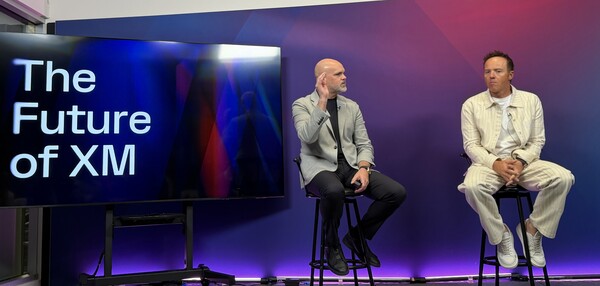
Qualtrics' new CEO Jason Maynard and Founder Ryan Smith discuss how they are pairing an ambitious 2027 product vision with a new leadership team charged with turning it into execution
-
So I am watching three things.
First, can Qualtrics’ simulations prove accurate enough to influence real business decisions rather than simply generate convincing synthetic responses?
Qualtrics argues that its simulations can be grounded and back-tested against real human-response data. That is the right test. Enterprises will need evidence that simulated responses correlate with what customers subsequently do.
Second, does experience context materially improve decisions that impact business KPIs compared with the operational and behavioral signals enterprises already have?
The ontology itself won't create that advantage. Differentiation has to come from the data, the learned relationships, and the resulting lift in decisions. Examples abound, including in the healthcare space with their Press Ganey Forsta acquisition, but I would like to see those learnings broadened.
Third, can Qualtrics close the learning loop when the action happens somewhere else?
That last may be the most important test of all.
Qualtrics does not have to own the final action
On the above point, Qualtrics talks about trusted outcomes and decisioning, but that doesn’t mean Qualtrics has to become the system that executes every decision. During the launch, Qualtrics repeatedly talked about pushing actions into downstream, often distributed systems: marketing automation (Adobe), CRM (Salesforce), loyalty platforms, and operating applications (Epic, etc).
Replacing those systems is a very different problem from improving the decisions inside them. Of course, we are adding agentic AI solutions atop as yet another interface for execution.
That implies Qualtrics may be sitting in the more interesting position: supplying the human context, simulation, and prediction to the systems making and executing decisions.
In that architecture, systems like Qualtrics don’t have to own every action, but they still need to stay inside the learning loop. That means knowing what decision was recommended, what interventions were executed, how the person responded, and what outcome followed. That lets the next decision not just improve NPS, but also business metrics like retention and customer lifetime value.
So … Experience data gets a new job
For years, the CX industry focused on collecting more customer data.
With AI, the constraint increasingly becomes whether an organization has the right context when it makes a decision.
In my other articles, I've shown that context components matter. Transactions matter. Behavior matters. Operational state matters. Policies matter.
Human experience matters too.
Experience data moves from helping explain the last interaction TO helping shape the next decision. That would move experience management from the edge of the analytics stack to something much closer to the center of how enterprises decide and act.
Michael Ni is Vice President and Principal Analyst at Constellation Research, covering the evolving Data-to-Decisions landscape—where CDOs, CIOs, and CPOs must modernize data infrastructure, integrate AI into decision-making, and scale automation to improve business outcomes. Ni’s research examines how enterprises operationalize AI, automate decision-making, and integrate data management and analytics into core business processes. He focuses on the challenges of scaling AI-driven decision systems, aligning data strategy with business goals, and the growing role of data and decisioning “products” in enterprise ecosystems. With 25+ years as a product and GTM executive across enterprise software, AI platforms, and analytics-driven technologies, Ni brings a practitioner’s perspective to…...
Read morePublished
Author