



Executive Summary
About This Constellation ShortList
Conversational AI platforms simulate human conversation, enabling self-service and intelligent digital interactions between humans and machines. In early applications, rudimentary chatbots were the earliest use cases and limited to basic information delivery (e.g.: self-service FAQ responses) utilizing natural language processing (NLP) to understand and process human language. As Generative AI advances, these conversational agent, copilot and assistant interfaces not only interact to solve problems but can engage with personality —and even empathy—to create dynamic bi-directional experiences between humans and machines. As LLMs and foundation models continue to evolve and become more sophistacted, Constellation expects to see rapid advancements in voice, multi-threaded conversations and group dialogue understanding and multi-person conversation analysis.
Conversational AI uses a combination of AI technologies and techniques from machine learning (ML), natural language understanding (NLU), and NLP to establish robust sentiment and tone analysis, intent understanding, and cognitive analysis. Generative AI models continued to push the adoption and popularity of AI agents and assistants to better understand and respond to natural language, generate personalized responses and create content that is more resonant to a user’s specific questions, situation or needs. The maturity curve has rapidly advanced well beyond simple conversational bots as users and developers both expect greater flexibility with rapid comprehension and conversation generation.
Enterprise Conversational AI systems are used in many applications including chatbots, virtual personal assistants, Intelligent Virtual Agents (IVA), Interactive Voice Response (IVR) systems, voice assistants, virtual concierge, and intelligent copilots. Expect to see added pressure put on this space as enterprise technology leaders continue to voice concerns around shifting conversational experiement into widely deployed and widely valued business processes and applications. Also expect to see more vendors within functional segments (i.e. service, contact center, sales, IT service management, etc.) include conversational AI into their offerings as internal and external engagement through voice increasingly becomes the new user interface and expected user experience.
The biggest disruption to the conversational AI market are new players entering the field with robust conversational experiences applied in new ways that shed the legacy of chatbots and enter a new phase of conversational experiences. As these new robust and visually rich experiential conversations take hold, expect to see leaders take note to offer enhanced graphics, visual templates and advanced voice and avatar like enhancements.
This shortlist does not review the foundation models on which many conversational AI platforms are built. In fact, many of the solutions listed in this report rely on access to multiple open source LLMs to drive right-sized value depending on process or application. Further the tools included in the review criteria are those deemed most appropriate and suitable for enterprise use.
Threshold Criteria
Constellation considers the following criteria for these solutions:
- Context awareness and management to track and maintain conversation history
- Capabilities and support for multiple languages
- Automated reinforcement learning to improve outcomes
- Capacity to understand user intents and needs, personalizing conversations based on real time customer context
- Automated workflows including case escalation to smoothly transition conversations to an available human agent or employee
- Customizable workflow management
- Natural Language Processing (NLP) capabilities to understand and interpret conversation input
- Natural Language Understanding (NLU) capabilities to comprehend meaning, intent and conversation context
- Generative AI capabilities powered by native, closed or open source LLMS
- Integration with backend systems (ERP, HR, etc)
- Integrations with front end CX systems (CRM, Service, Contact Center, Knowledge and content management systems)
- Security, Privacy, Authentication and Compliance
- Governance models to manage data, models and workflows
- Options to understand accents, pronunciation, emotions, sentiment, sarcasm, idioms, and colloquialism
- Advanced systems increasingly understand cross-conversations, multiple speakers, interruptions and multi-threaded conversations for multiple topics or needs
- Advanced capabilities will also include voice recognition and voice generation for robust voice interactions
- Robust conversational analytics and reporting to track impact, effectiveness and deliver intelligence on user behavior and sentiment
- Scalability to seamlessly manage increasing and seasonally fluxuating conversations
- Omnichannel capability
- Industry specific enhancements
The Constellation ShortList
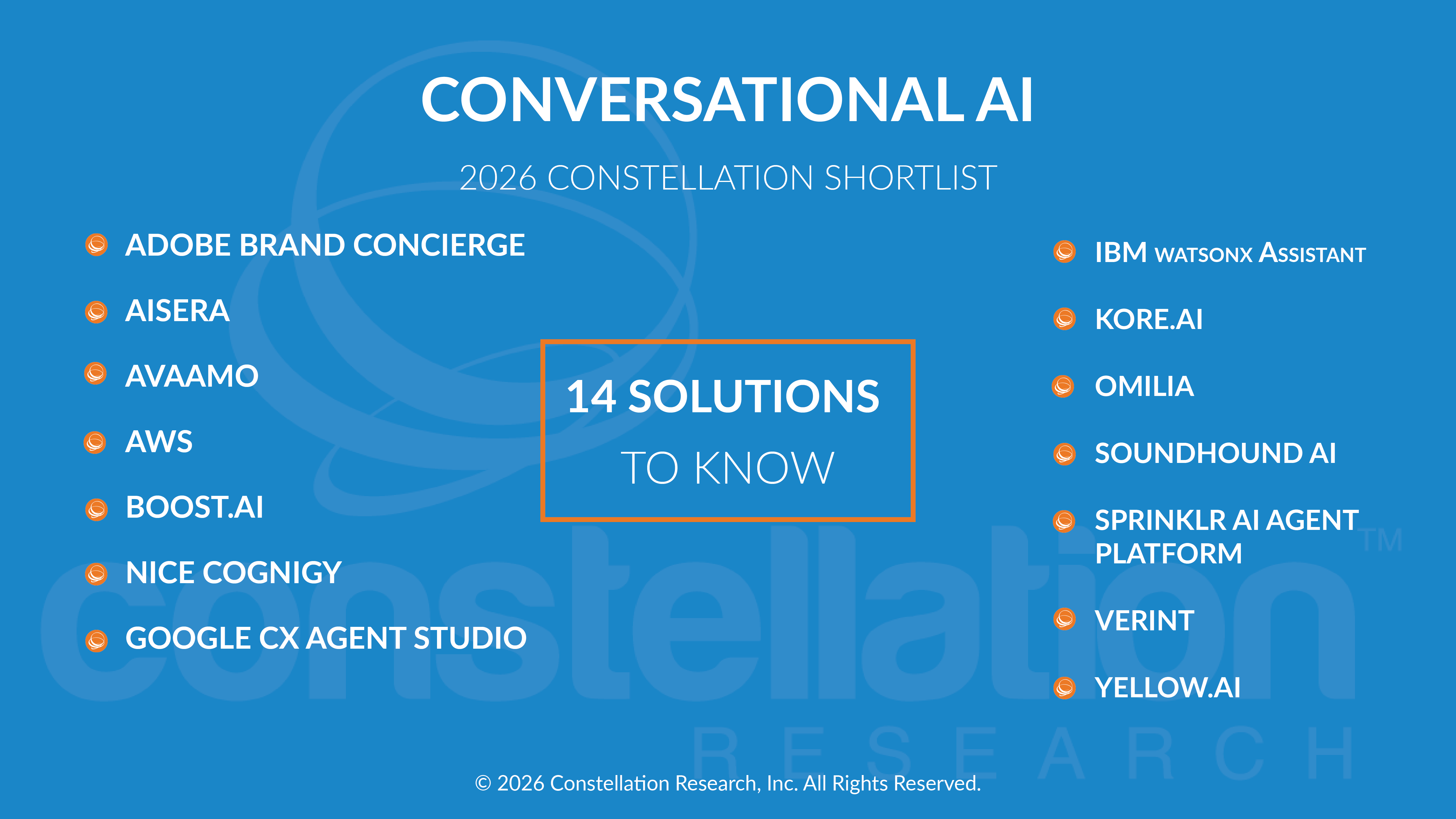
Constellation evaluates more than 45 solutions categorized in the Conversational AI market. This Constellation ShortList is determined by client inquiries, partner conversations, customer references, vendor selection projects, market share, and internal research.
- ADOBE BRAND CONCIERGE
- AISERA
- AVAAMO
- AWS
- BOOST.AI
- NICE COGNIGY
- GOOGLE CX AGENT STUDIO
- IBM watsonx Assistant
- KORE.AI
- OMILIA
- SOUNDHOUND AI
- SPRINKLR AI AGENT PLATFORM
- VERINT
- YELLOW.AI
Frequency of Evaluation
Each Constellation ShortList is updated at least once per year. Updates may occur after six months if deemed necessary.
Evaluation Services
Constellation clients can work with the analyst and the research team to conduct a more thorough discussion of this ShortList. Constellation can also provide guidance in vendor selection and contract negotiation.