


Palantir’s Q3 highlights enterprise inflection point due to sovereign AI, LLM disillusionment
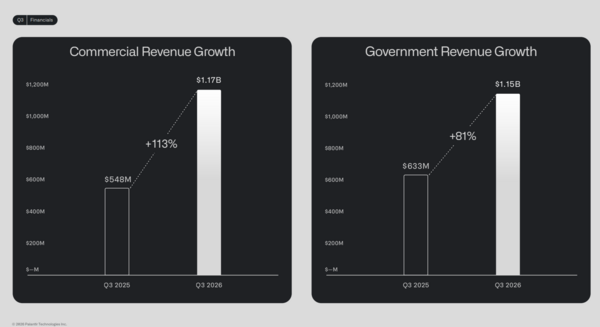
Palantir has hit its enterprise inflection point as its US commercial revenue topped US government revenue for the first time.
The company easily topped Wall Street expectations with third quarter revenue growth of 96% compared to a year ago.
Palantir reported third quarter earnings of $1.13 billion, or 44 cents a share, on revenue of $2.31 billion, up 96% from a year ago.
Wall Street was expecting Palantir to report third quarter non-GAAP earnings of 41 cents a share on revenue of $2.18 billion.
Key figures from Palantir's third quarter include:
- US revenue was $1.94 billion, up 119% from a year ago.
- US commercial revenue was $984 million, up 148% from a year ago.
- US government revenue was $953 million, up 96% from a year ago.
- Palantir closed 64 deals of at least $10 million in the quarter.
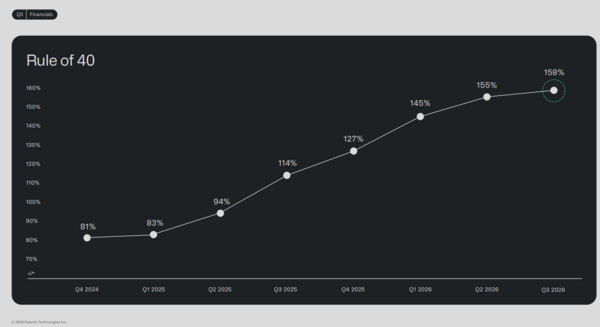
- The rule of 40 score was 158%.
- Palantir ended the quarter with $10.4 billion in cash, cash equivalents and US Treasury holdings.
As for the outlook, Palantir projected revenue between $2.65 billion and $2.653 billion with adjusted income from operations between $1.64 billion to $1.644 billion. For 2026, Palantir projected revenue of $8.53 billion to $8.534 billion. US commercial revenue will top $3.56 billion. Palantir expects to deliver adjusted free cash flow of $4.8 billion to $5 billion.
CEO Alex Karp said the following in his shareholder letter:
- "We have been at this for more than two decades now, and none of us has ever seen a business at this scale growing at this pace and with this level of sustained ferocity. Indeed, our sequential growth in U.S. commercial of 29% would be an astonishing annual growth rate of any public software company in America."
- "Every industry in the world—from banks to insurers to hospitals and even once-storied law firms—will either be remade or set briskly aside. The outcomes will increasingly be binary, with winners and losers, and nothing in between. The lonely middle will be little more than a barren wasteland filled with those who were once legacy players who failed to heed the word and paid the ultimate price. The crowded bottom will be occupied by those who long ago lost their chance to build on what might once have been an insight or an edge, now marching inexorably toward irrelevance, their fate sealed, the envelope unopened."
- "The demand for our sovereign AI solutions that we began building long before the language models arrived has been absolutely ravenous and remains far from sated in the United States; indeed, its lifespan can be measured in quarters, not years. Our advantage has only expanded with this demand. A sales cycle that once had been more akin to a long, unproductive, and unsatisfying flirtation has been condensed. What may have taken months and years—a slow, coy, and theatrical dance towards a contract—can now take days and weeks. Consummation happens quickly."
- "The questions surrounding the adoption of large language models force the world and its leaders to confront both a promise and peril that is totally unlike anything that has come before. In the best case, these models on their own generate limited value. In the far more likely outcome, they become agents of chaos. Lacking a grounding in the means of interfacing with the labyrinth of datasets, people, business units, use cases, and critical safeguards scattered across the modern enterprise, the LLM agent is a virtually unlimited liability, possessing a nearly unbounded destructive potential and a blast radius that tends towards infinity."
Sovereign AI momentum
On a conference call with analysts, Ryan Taylor, chief revenue and chief legal officer of Palantir, said sovereign AI has momentum. He cited customers including Optum Serve, L3Harris, Nvidia, Tampa General and others as customers scaling up AI efforts with trained open models.
"The market is only beginning to recognize the full force of sovereign AI. It's pervasive in the conversations I'm having with customers," said Taylor.
Palantir CTO Shyam Sankar laid out why sovereign AI is taking off. He said:
"It's clear that the vast majority of economically valuable problems that LLMs can solve can be solved with intelligence at or below the frontier. So what's preventing this from happening? On one end, you have the model makers who can't conceive of solving any problem except through model improvement. So they aren't even trying. And on the other end, you have the hard work of diffusion, which sounds passive, but is anything but. All the value comes from the elegant integration of AI, software and humans. And this requires not a harness for the model, but something closer to a harness for the enterprise, which is exactly what AIP is.
Most profoundly, the conceit that the labs have wrong is the belief that the atomic unit of the enterprise is the individual knowledge worker. It is not. The fundamental unit of the enterprise is the workflow. You can make any set of workers more productive and generate no actual ROI."
A few use cases such as coding are a perfect fit for what the frontier AI labs produce. The vast majority of enterprise use cases don't fit, said Sankar.
Sankar added that sovereign AI projects are driven by more than cutting costs. "There's a clear pattern emerging amongst our customers who are most successful at getting value from AI. They have enormous ambition. Their goal is not something lame like OpEx reduction. It's market domination. And the opposite is true. Customers that struggle the most are narrowly focused on reducing cost. AI is a new type of intelligence. Simply trying to shoehorn it to replacing the human misses the moment completely. The error of conflating human and machine intelligence locks you into a poorly chosen goal, one that limits your ambition and still remains out of reach," said Sankar.
Karp said this detour for AI and the ensuing disillusionment is what is driving Palantir sales. "Everybody basically comes in on the spectrum of what I have doesn't work now, and I've heard what you have does work. That's usually where it starts," said Karp. "They also strongly believe and are quite tired of what they believe the reality is, my IP is in danger, and I'm getting no value. But they didn't know how to articulate. Now it's something they articulated and they've gone from anger to action. It's like they've gone from thinking, hey, I'm not in a great marriage, to I'm at the divorce. The timeline from interaction to them buying pilots or going into production is completely shifted."
The Palantir CEO added that enterprise customers are moving quickly to deployment with a short duration contract that has the ability to expand dramatically.
Anthropic: Symbiotic Frenemy
Sankar cited the Anthropic S-1 and an example of AIG using its models to process complex claims and how Palantir was the harness making it all work.
Karp noted that Anthropic is also selling Palantir. Talk about an odd relationship. Karp explained:
"Dario is someone I get along very well with. I think he's one of the most important businesspeople of my generation, if not multiple generations. They are also selling our product because people interact with them."
"And again, some people want that approach. But a lot of people are super concerned about their alpha being transferred to them. Even the results they talk about are often already in our application layer. We work very effectively with Anthropic and the Department of War and at AIG and all over the place. But again, the primary -- what they are doing is increasing the size of the market. What we're doing is servicing the market that's gotten real."
"We are actually in a symbiotic relationship with them commercially because they're growing a market that's probably much bigger than it is today."
Karp said Palantir's approach is to work with everyone. "In commercial, our real approach is, hey, enjoy the one you're with until you find out it's not the one you want. There are very, very, very few times where we're trying to go and compete and take their customer away. It really is not happening. And conversely, once you go Palantir, you don't go back. And that's just -- that's how it is," he said.
Larry Dignan is Editor in Chief of Constellation Insights at Constellation Research, where he leads editorial coverage focused on enterprise technology, digital transformation, and emerging trends shaping the future of business. He oversees research-driven news, analysis, interviews, and event coverage designed to help technology buyers and vendors navigate complex markets with clarity and context. ...
Read morePublished
Author
