


Palantir’s Q3 highlights enterprise inflection point
Palantir has hit its enterprise inflection point as its US commercial revenue topped US government revenue for the first time.
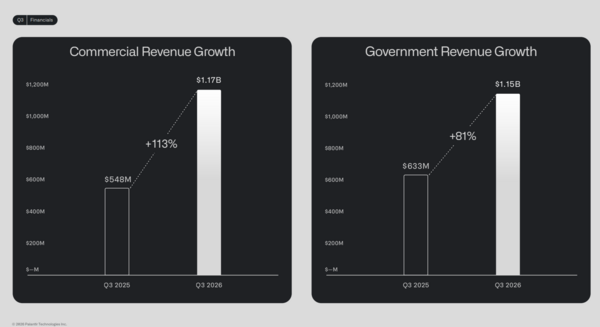
The company easily topped Wall Street expectations with third quarter revenue growth of 96% compared to a year ago.
Palantir reported third quarter earnings of $1.13 billion, or 44 cents a share, on revenue of $2.31 billion, up 96% from a year ago.
Wall Street was expecting Palantir to report third quarter non-GAAP earnings of 41 cents a share on revenue of $2.18 billion.
Key figures from Palantir's third quarter include:
- US revenue was $1.94 billion, up 119% from a year ago.
- US commercial revenue was $984 million, up 148% from a year ago.
- US government revenue was $953 million, up 96% from a year ago.
- Palantir closed 64 deals of at least $10 million in the quarter.
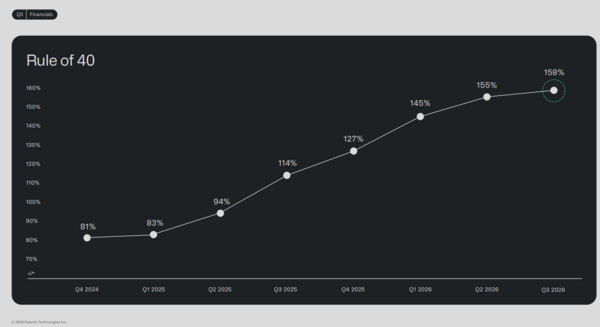
- The rule of 40 score was 158%.
- Palantir ended the quarter with $10.4 billion in cash, cash equivalents and US Treasury holdings.
As for the outlook, Palantir projected revenue between $2.65 billion and $2.653 billion with adjusted income from operations between $1.64 billion to $1.644 billion. For 2026, Palantir projected revenue of $8.53 billion to $8.534 billion. US commercial revenue will top $3.56 billion. Palantir expects to deliver adjusted free cash flow of $4.8 billion to $5 billion.
CEO Alex Karp said the following in his shareholder letter:
- "We have been at this for more than two decades now, and none of us has ever seen a business at this scale growing at this pace and with this level of sustained ferocity. Indeed, our sequential growth in U.S. commercial of 29% would be an astonishing annual growth rate of any public software company in America."
- "Every industry in the world—from banks to insurers to hospitals and even once-storied law firms—will either be remade or set briskly aside. The outcomes will increasingly be binary, with winners and losers, and nothing in between. The lonely middle will be little more than a barren wasteland filled with those who were once legacy players who failed to heed the word and paid the ultimate price. The crowded bottom will be occupied by those who long ago lost their chance to build on what might once have been an insight or an edge, now marching inexorably toward irrelevance, their fate sealed, the envelope unopened."
- "The demand for our sovereign AI solutions that we began building long before the language models arrived has been absolutely ravenous and remains far from sated in the United States; indeed, its lifespan can be measured in quarters, not years. Our advantage has only expanded with this demand. A sales cycle that once had been more akin to a long, unproductive, and unsatisfying flirtation has been condensed. What may have taken months and years—a slow, coy, and theatrical dance towards a contract—can now take days and weeks. Consummation happens quickly."
- "The questions surrounding the adoption of large language models force the world and its leaders to confront both a promise and peril that is totally unlike anything that has come before. In the best case, these models on their own generate limited value. In the far more likely outcome, they become agents of chaos. Lacking a grounding in the means of interfacing with the labyrinth of datasets, people, business units, use cases, and critical safeguards scattered across the modern enterprise, the LLM agent is a virtually unlimited liability, possessing a nearly unbounded destructive potential and a blast radius that tends towards infinity."
Larry Dignan is Editor in Chief of Constellation Insights at Constellation Research, where he leads editorial coverage focused on enterprise technology, digital transformation, and emerging trends shaping the future of business. He oversees research-driven news, analysis, interviews, and event coverage designed to help technology buyers and vendors navigate complex markets with clarity and context. ...
Read morePublished
Author
