


Elastic's bets on context pay off as AI agents need to be more accurate, cost effective
Elastic is benefiting from the need to make AI agents more accurate and cost effective.
The company reported better-than-expected fiscal first quarter results and raised its outlook. Why Elastic is doing well is more interesting. As previously noted, Elastic bet big on being a context layer last year and now is reaping the rewards.
Ash Kulkarni, CEO of Elastic, highlighted why the company is seeing demand pick up and is landing more deals with annual contract value over $100,000.
The company is combining search and AI, security and observability into a context layer flywheel.
"The focus is no longer on token maxing. It is on building agentic applications that leverage the reasoning and influencing power of LLMs on a business's proprietary data. This requires the highest possible retrieval accuracy at the lowest possible cost," said Kulkarni.
He added that Elastic's goal is for "Elasticsearch to be the best store for all data that our customers care about, enabling text, vector and hybrid search across structured and unstructured data, spanning text, vectors, images, audio, video and more."
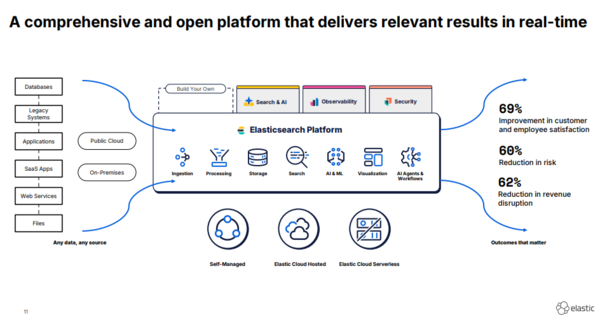
Indeed, Elastic had a busy quarter with the general availability of Prometheus and PromQL support, Kubernetes agentic investigations, automated migration features, Columnar Mode in technical preview for Elasticsearch, Jina AI embedding and reranker models for on-premises deployments and observability and security tools. The company also released its Vector DB index mode and autocalibration.
In addition, Elastic just completed its acquisition of Deductive AI, which features an AI investigation platform designed for engineering teams. The purchase of Deductive AI is designed to accelerate Elastic Observability.
- Constellation ShortList™ Autonomous IT Platforms
- Constellation ShortList™ Security Information and Event Management (SIEM)
The bet on context
Elastic's business ties together search and AI, security and observability in a set of businesses that previously looked disconnected. Today, those moving parts are fused together due to the need for context.
Kulkarni explained that Elasticsearch is designed as the context layer that extends into multiple categories, including observability. Here's how Elastic is putting it together in the context layer.
"As you think about what people are building with harnesses and so on, the most important element is the data retrieval or the context layer and when you are trying to get that context for your LLM, for your agent, you have to worry about accuracy. You have to worry about speed and you have to worry about cost. And what that means is you really want to try and precompute as much of that context ahead of time as possible so your model isn't just constantly trying to sift through all of the data every single time, which is a very expensive, very inefficient, very slow approach.
And that's what we do. That's where we fit in. That's the reason why customers turn to us because we're able to make their agents perform better. We are able to make their agents more secure in how they operate, we are able to provide just the right context to their agents, and we are able to reduce cost and give them that balance of both using proprietary models where it makes sense, using open models where that's the best approach."
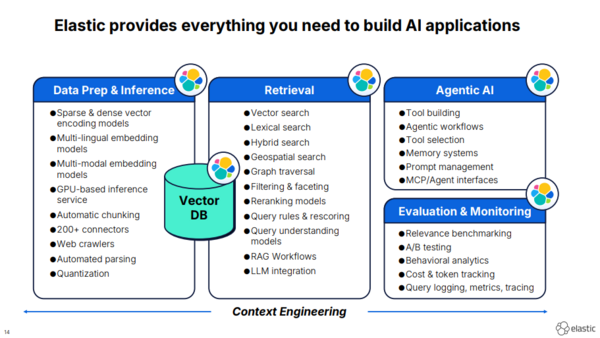
Key themes from the Elastic CEO:
- "Elasticsearch will serve as the context layer transforming the company's vast product catalog into real-time grounded AI context. When a customer queries a chip specification, compatibility requirement or part number agent builder returns an accurate answer with per user document level security, ensuring each customer sees only what's relevant to them. In a competitive RFP against pure-play vector databases and other platform players our hybrid semantic retrieval and natively integrated agent capabilities were the decisive differentiator."
- "AI is also changing the arena of observability as organizations build and deploy more agents, it requires more scalable monitoring of the entire application stack at a lower cost."
- "In a post-Mythos world, organizations are facing an increasingly challenging landscape, where vulnerabilities are being discovered at an alarming rate and weaponized at machine speed. This requires cyber defenders to detect, investigate and mitigate at speeds well beyond human capacity alone. To bridge this gap, AI-driven automation has become an absolute necessity for cyber defenders. Accordingly, we have invested in several areas to help our customers achieve their end goal of an AI-driven SOC."
Kulkarni said he was bullish on Elastic's security business, a recent partnership with Google Distributed Cloud.
- Elastic, Google Cloud partner for air-gapped environments
- ShortList Spotlight: Elastic’s Data-First Approach to Autonomous IT
- Elastic Security bets on native Workflows, data-centric approach
- Elastic sees early traction with Agent Builder, context play, hybrid architecture
- Elastic's Agent Builder is generally available, Elastic Workflows in tech preview
The numbers
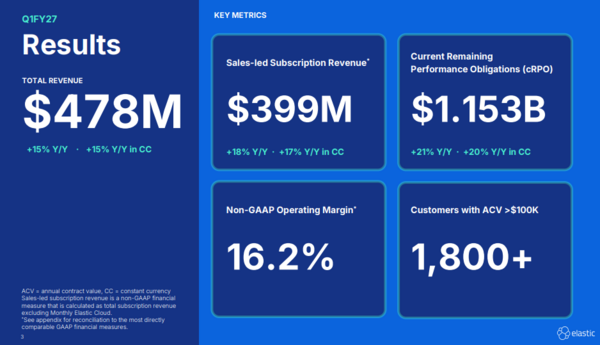
Elastic reported a better than expected fiscal first quarter. The company reported a net loss of 16 cents a share on revenue of $478 million, up 15% from a year ago. Non-GAAP earnings in the quarter were 70 cents a share, 12 cents better than Wall Street estimates.
As for the outlook, Elastic is projecting revenue growth of nearly 15% in the second quarter and 15.2% for the fiscal year.
Specifically, Elastic projected second quarter revenue between $486 million and $487 million with non-GAAP earnings of 80 cents a share to 82 cents a share. For fiscal 2027, Elastic projected revenue between $1.998 billion and $2.01 billion with non-GAAP earnings of $3.29 a share to $3.37 a share.
In addition, Elastic's pipeline looks strong exiting the quarter. Current remaining performance obligations were $1.153 billion, up 21% from a year ago and remaining performance obligations were $1.854 billion, up 27%. The latter metric indicates demand beyond 12 months is strengthening.
Larry Dignan is Editor in Chief of Constellation Insights at Constellation Research, where he leads editorial coverage focused on enterprise technology, digital transformation, and emerging trends shaping the future of business. He oversees research-driven news, analysis, interviews, and event coverage designed to help technology buyers and vendors navigate complex markets with clarity and context. ...
Read morePublished
Author
