Snowflake Summit 2026: Redrawing the Boundary Between Data, Context, and Action
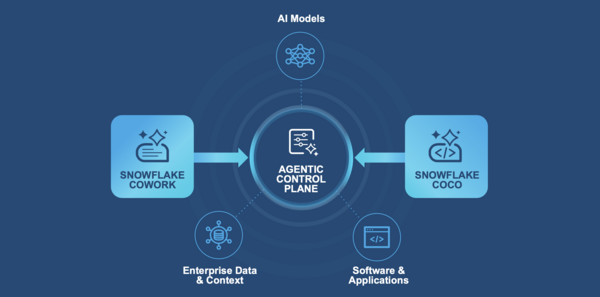
Enterprise architecture has spent the last twenty years separating systems of record, systems of insight, and systems of execution. Applications executed business processes. Data platforms store and govern information. Analytics platforms delivered insights. Humans interpreted those insights and took action.
AI is forcing those worlds back together.
That was my biggest takeaway from Snowflake Summit 2026.
As enterprises move from AI experimentation toward operational deployment, they face a new challenge: where should business context, governance, permissions, and decision rights reside when machines begin participating in work?
Snowflake's announcements showcased their answer to questions of their AI capabilities. It also showcased their belief that the next competitive battleground is not data management, analytics, or even AI models. It is the layer that sits between data and execution.
The race is increasingly about determining where enterprise context lives, how decisions are governed, and how humans and machines operate from a shared understanding of the business.
What Data and AI Leaders Need to Know from Snowflake Summit 2026
Snowflake’s announcements reflect their stated vision of being your AI Control Plane (link to announced capabilities).
1. Interoperability and Open Architecture
The headlines included expanded support for Iceberg V3, Polaris, Postgres integration, Snow Grid, and broader interoperability initiatives. The story is Snowflake's acknowledgment, along with the industry, that future enterprise architectures will be heterogeneous and multi-cloud.
The strategic control point is shifting away from owning storage formats toward serving as the trusted governance and context layer for coordinating AI operations.
2. Horizon Context and Cortex Sense Deliver on “Trusted and Governed”
Snowflake introduced Horizon Context and Cortex Sense to create a shared understanding of business meaning, metadata, governance, and operational knowledge across both humans and AI systems.
The interesting angle is Snowflake’s direction with Cortex Sense, which acts as a context assembly layer for AI. Sense targets automatically learning and then bringing together metadata, lineage, governance policies, and operational knowledge, extending the Horizon Context defined semantic context.

3. CoCo (Cortex Code) and CoWork (Cortext Intelligence)
Snowflake expanded its AI experiences for developers and business users through CoCo and CoWork, moving beyond chat interfaces toward workflow participation, automation, and agent-assisted work in familiar interfaces (e.g., developer CLI or IDE).
Snowflake is expanding from serving primarily data teams toward serving developers, analysts, and business users directly. This broadens adoption while increasing platform stickiness.
4. Natoma’s Acquisition As Part of Expanded AI Governance and Security
Snowflake announced its intent to acquire Natoma, adding capabilities around agent connectivity, tool orchestration, and governed interactions with enterprise systems. Natoma fills a strategic capability for Snowflake to govern beyond data toward tools, workflows, and AI-driven actions.
Additional governance capabilities include Agent Identity, AI Security Posture Management, Trust Center enhancements, and data exfiltration controls were introduced to support AI at enterprise scale. Similar to Natoma, Snowflake is expanding beyond controlling access to information toward controlling access to actions.
5. AI as the Modernization Onramp
Migration provided a common theme across conferences this quarter. AI-enabled migrations and modernization efforts has both made migration a faster and simpler option, but also enabled organizations to orchestrate new agentic solutions across legacy solutions without migrating at all. Snowflake provides both options expanding migration support, but also providing Teradata virtualization options from their @Datometry acquisition of to use data where it lies in a unified data estate.
That creates a much larger opportunity for data, integration, governance, and orchestration platforms.
The Implications
Looking across the announcements, three broader implications emerged.
1. The Real Signal: The Bottleneck Has Moved
One of the most interesting signals from Summit what we didn’t hear from Snowflake… data warehousing. Instead, Snowflake focused on governance, context, Interoperability, AI security, business, meaning, and workflow execution.
And this aligns with what we are hearing at Constellation Research: Most Enterprises are still wrestling with data quality, governance, integration, and modernization. But these issues increasingly are increasingly relegated to plumbing rather than strategy.
The bottleneck has moved. Enterprises can access data but far fewer Feel they can provide the business understanding, governance, controls, operational awareness, and decision boundaries required to scale their AI initiatives to make information actionable by both human and machines.
2. Why Context Matters More Than Another Model
The AI industry remains heavily focused on model innovation (larger, faster, cheaper).
While models matter, what the market is quickly realizing is that the billions invested in AI initiatives are not failing to deliver trustworthy “digital workers” due to poor models, but because models alone cannot understand your business or your priorities unless those are digitally accessible. That means a model cannot understand business priorities if those priorities are not represented. organizational policies if they are scattered across documents and tribal knowledge, how decisions should be made if the business itself has not defined the rules.
This is why nearly every major platform vendor is investing in some version of a context layer: Snowflake has Horizon Context and Cortex Sense, Microsoft is building IQ, Databricks is extending Unity Catalog and Genie, Salesforce has Data Cloud, ServiceNow has its knowledge graph, etc.
The industry has converged on the same realization, even if the broader understanding of context is still fuzzy. Enterprise AI requires more than access to information. It requires machine readable understanding of how the business operates. The question is where that context should now live.
Note: In answer to the siren’s call of the frothy “context” buzzword, expect the rise of vendor “context-washing” their marketing given every new agent, workflow, and application need a consistent understanding of the business, its priorities, and what an agent is allowed to do.
Also expect rising proof points of why context matters beyond abstract ideas of grounding and trust. The first metrics will be accuracy, time to first token, through to reduced token usage and time for a LLM to return an answer, decision, or take an action.
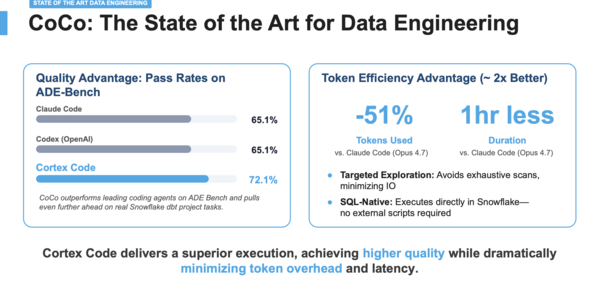
Source: Internal Snowflake limited benchmarks.
3. The Rise of the Machine Interface
While already covered by many pundits, it’s worth restating that the most important architectural shift is machines becoming a key consumer of enterprise information. For decades, information systems were designed around human interaction: reports, dashboards, applications who then take mostly appropriate action. Today, AI agents need to consume the data, but to take action, the data needs to be extended. While humans can resolve ambiguity, a machine requires explicit definitions. While a human can navigate organizational nuance, a machine requires permissions, policies, and guardrails to bound what actions they should and can take. That changes everything.
Just as companies spent the last decade optimizing for digital experiences and search engines, the next decade will require designing for machine consumers of information, context, and decisions.
My POV
Data and AI Convergence Is Now Assumed
One of the clearest signals from Summit was that data and AI are no longer being discussed as separate domains. My discussions with customers and partners throughout the week treated data, AI, governance, and security as a single integrated problem. Whether in Constellation Research, Inc. surveys or discussions with data and AI leaders, the "agentic enterprise" is increasingly being framed as the next evolution of analytics, applications, and workflows. Importantly, it’s not just a side project or add-on, but increasingly thought of as the next operating model.
Organizations should stop planning separate data strategies and AI strategies. Those plans are rapidly converging and analytics and AI buying center shifts to the operational teams reflects the change.
The Catalog Market Is Entering a New Phase … and It’s Not About Catalogs
Expect growing confusion … AND growing competition … around catalogs, semantic layers, metadata platforms, Master Data Management, and governance solutions.
Snowflake is clearly building a first-class context and governance layer through Horizon Context, Cortex Sense, semantic views, AI security, and native agents that deliver on their promise of simplicity. A promise that gets even more important as context management necessarily forces collaboration across the business, operations, and technical organizations.
At the same time, many customers continue to express interest in neutral layers that sit above individual platforms. Whether that is AtScale, DataHub, Omni, Open Semantic Interchange, or other approaches, there remains strong demand for portability and independence.
Lock-In Concerns Has Shifted to the Context Layer
Customer and partner conversations at Summit raised concerns around where business meaning, operational context/memory, and governance should ultimately reside.
Snowflake recognizes this challenge. Its investments in Iceberg, Polaris, Postgres mirroring, Snow Grid, external catalogs, and Natoma's MCP gateway are all designed to reduce the sense of lock-in with support a story of openness and interoperability. Snowflake is saying businesses should store data where they want, use the tools they want, and connect the applications they want …
… But allow Snowflake to remain the trusted foundation for governance, security, and AI operations.
Whether customers embrace that vision remains one of the most important strategic questions facing the ecosystem.
Snowflake Expanding TAM Through New Personas
Historically, Snowflake consumption was driven primarily by data engineers, analysts, and technical teams.
AI expands who both can use, as well as benefit from Snowflake.
- CoCo targets Snowflake’s base and importantly, the broader set of enterprise developers.
- CoWork targets business users.
- Cortex targets AI builders.
This expands Snowflake's addressable market beyond traditional data teams, and that has broader implications. Of course, not missed by the market, the more directly Snowflake becomes embedded in day-to-day workflows, the more durable consumption and platform stickiness become.
What This Means for Data and AI Leaders
For CDOs, CAIOs, and enterprise architects, the priority should move from evaluating features to understanding and planning for where context, governance, permissions, and decision rights will live within your future architecture.
Questions worth asking include:
- How will agents access business context?
- Where will semantic definitions be managed?
- How will governance policies extend to machine actors?
- How portable will your context layer be across platforms?
- What becomes your system of trust?
These decisions will likely have a greater long-term impact than choosing a specific model provider.
Looking Ahead
Snowflake CEO, Sridhar, has correctly identified that the center of gravity is shifting from storage to context.
The potential blind spot is that the market may move even faster: from context to decisioning.
Snowflake is building a strong foundation around trusted data, semantics, governance, and shared agent meaning.
The next challenge is helping enterprises determine where agents should focus, how they prioritize competing objectives, and what actions they are authorized to take. In other words, not just understanding the business, but governing decisions on behalf of the business and that's where the next architectural battle will emerge.
The industry is debating where context should live. Leading customers, we are working with are debating decision rights should live as they shift from looking at automated processes to looking at how they can move that machine speed constrained by where they need to insert a human.
The next phase of competition may not be about who owns the context layer.
It may be about who helps enterprises operationalize decisions safely, transparently, and at scale.
That is the boundary I will be watching next.
--
What did I miss? Share your thoughts in the comments 👇🏻
Michael Ni is Vice President and Principal Analyst at Constellation Research, covering the evolving Data-to-Decisions landscape—where CDOs, CIOs, and CPOs must modernize data infrastructure, integrate AI into decision-making, and scale automation to improve business outcomes. Ni’s research examines how enterprises operationalize AI, automate decision-making, and integrate data management and analytics into core business processes. He focuses on the challenges of scaling AI-driven decision systems, aligning data strategy with business goals, and the growing role of data and decisioning “products” in enterprise ecosystems. With 25+ years as a product and GTM executive across enterprise software, AI platforms, and analytics-driven technologies, Ni brings a practitioner’s perspective to…...
Read morePublished
Author