


Microsoft's releases MAI-Base-2 aimed at open models with a twist
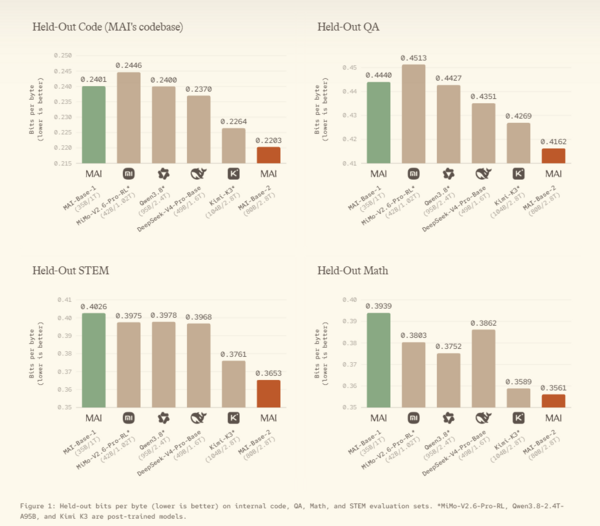
Microsoft released MAI-Base-2 and said it performs open weight models from China and is more efficient. The twist is that Microsoft makes an open weight model comparison, but it said it will license MAI-Base-2 weights in what could be another avenue for enterprises to train models with their own data.
The post about MAI-Base-2 has a lot of details, but the thing to note is the dance around being an open model. First the details: MAI-Base-2 is a mixture of experts foundation model with 80 billon active and 2.8 trillion total parameters. The real pitch is that MAI-Base-2 is more efficient and Microsoft didn't use distillation.
If you skim Microsoft's documentation, you'll think that MAI-Base-2 is an open model because the comparisons are to Alibaba's Qwen, DeepSeek and Kimi. You can see the arguments about open vs. closed models in the X posts by Microsoft AI CEO Mustafa Suleyman.
Some folks called comparing a closed model to open models a joke. Yet for enterprises, these binary developer arguments are much grayer. After all, there are P&Ls to worry about and enterprises are balancing cost, returns, risk and getting a task done.
Note this passage (emphasis mine):
"Owning our model pipeline end-to-end allows Microsoft to make a distinctive offering to our customers. Microsoft has strong data provenance over training tokens that go into our model. Our pre-training is built on organic data which does not involve distillation from other models. This will enable us to license our model weights to trusted partners through Foundry, which provides enterprises with a trusted source of world-class intelligence that serves their needs.
Owning the full stack allows us to tune our models and infrastructure together for the best performance at the lowest cost, first in our own products and then for Foundry customers."
The takeaway here is that Microsoft is going for an enterprise model play where it licenses a base model that companies can customize with their own data. The model will likely fit in with some broader enterprise licensing program. Given Microsoft's foothold in the enterprise and context it has there will be plenty of companies that decide building from an MAI base model makes sense. The biggest arguments for such a move would be safety, trust and ease of training.
Microsoft drops a lot of good lines in its model release including compute budget, scaling and codesign. For enterprises looking to train their own models and control their data destiny mostly with Nvidia Nemotron, Microsoft may be singing their tune.
- Meta launches Muse Spark Open, may appeal to enterprises
- Nvidia’s Nemotron hit enterprise AI inflection point
What's next? AWS and Google Cloud are likely to ramp their efforts for open-ish models that can be customized. These models will be compared to open models, but from a procurement perspective sit somewhere in between. For hyperscalers that monetize via cloud services, the model just drives consumption.
What's emerging is a new category of models that we could call open-ish and simply good enough. Models like MAI-Base-2 aren't frontier and aren't completely open. You’ll license the model weights and it’ll be lumped into an enterprise agreement license. Nevertheless, these models may get the job done for corporations with less risk.
Larry Dignan is Editor in Chief of Constellation Insights at Constellation Research, where he leads editorial coverage focused on enterprise technology, digital transformation, and emerging trends shaping the future of business. He oversees research-driven news, analysis, interviews, and event coverage designed to help technology buyers and vendors navigate complex markets with clarity and context. ...
Read morePublished
Author
