


How aviation maintenance looks at AI systems
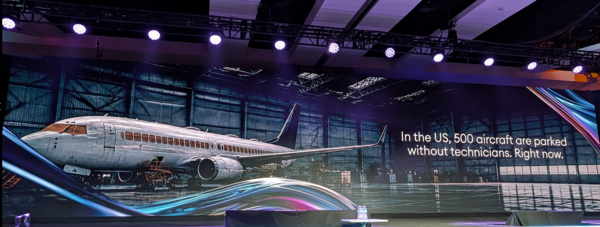
Aviation companies are looking toward AI to create the capacity needed for growth and manage through a generational change in talent and the institutional knowledge retiring.
A panel of IFS customers at IFS Unleashed 2026 focused on aviation maintenance illustrated why industrial AI is less sizzle reel and more practical use cases and returns.

DJ Rounsoville, managing director of strategy and digital solutions at Southwest Airlines, said capacity is falling behind demand and airlines are losing experience as technicians retire. Rounsoville said the challenge for the aviation industry is "more of an experience shortage."
"New mechanics may need up to two years to become fully efficient at troubleshooting," she said. Rounsoville said Southwest operates point-to-point and there's a lot of operational complexity. "We have to get our crew in the right place, we have to get our airplanes in the right place and we have of course have to get our customers to the right place," she said. "Service disruptions can compound and we use technology to resolve those issues throughout the day.
Lauren Purcell, aircraft engineering manager at UPS, agreed that the industry doesn't have the labor capacity to support the rate it's going. "In terms of workforce, we just can't keep up with the training to replace those that are leaving the industry and that are retiring," said Purcell. "We're seeing retirements from these people that have been in the industry for so long and have years and years of knowledge just walk out the door, and we're working to better the training processes and more automated training processes.
More from IFS Unleashed 2026:
- Palihapitiya on AI valuations, energy, auditors
- How IFS’ industrial customers are approaching AI use cases
- IFS launches IFS Intelligence, Industrial AI Harness, eyes industrial productivity
Purcell added that UPS is looking to leverage AI to train a younger workforce faster.
Sugimoto Kei, VP of IT and digital promotion at Japan Airlines, said his airline faces a similar issue. Kei said Japan Airlines is focused on helping employees "make decisions faster and more informed."
Takeaway: All three panelists are looking toward AI to speed up troubleshooting and preserve experience. The general idea is to use AI assistants to surface relevant maintenance documentation and provide expert knowledge. The metric to watch is limit work carryovers with better troubleshooting.
Data management is also critical. Kei said, "a big challenge for us is really our data and it's very disparate." "It's not always in enterprise datasets and we're spending a lot of time now on our data foundation with the goal of enabling AI functionality.
One big use case for data and AI is preventive maintenance. "We see supply chain issues as actually a disruption for our maintenance," said Kei.
Purcell said UPS is trying to use AI to help find alternative parts and speeding up the supply chain process. "Anything we can do to have other supply chain sources is advantageous," she said. "Alternative parts has been a big focus for the last year."
According to Rounsoville, AI can also play a role in retooling the system overall to better navigate supply chain issues in advance.
Takeaway: Data and AI is seen as a way to improve predictive and planned maintenance, but reliable data on maintenance history, components and operational data is needed to enable AI to identify emerging failure patterns.
Rounsoville said it's critical to think about AI holistically and not just by individual use cases. "We talk a lot about AI for the actual fleet piece planning and things like that, but there's also a piece of this for workforce as well. So you can't optimize one part of the system and not the other," she said.
The aviation industry revolves around navigating various constraints.
Process is also a key consideration and systems need to be evaluated holistically. AI, process and data all go together. "You can't have data integrity if you don't have processes to actually use that data," said Purcell.
"You can't do one without the other because you know the data, the data is the foundation, and then the processes are the framework and the technology is how you enable it," she said. "The culture is what determines if it's going to be successful or not."
Takeaway: Systems thinking is required for AI and the right outcomes will optimize people and operations together. The AI flywheel is enabled by usable data.
Larry Dignan is Editor in Chief of Constellation Insights at Constellation Research, where he leads editorial coverage focused on enterprise technology, digital transformation, and emerging trends shaping the future of business. He oversees research-driven news, analysis, interviews, and event coverage designed to help technology buyers and vendors navigate complex markets with clarity and context. ...
Read morePublished
Author
