Results

Saba Summit 2013: Getting Back To Their Strengths In Learning and Development

Saba Summit 2013: Getting Back To Their Strengths In Learning and Development

This past week in San Francisco Saba held their annual customer conference, Saba People Summit. After several hours of meetings with their executive team, my primary take away is that Saba is returning their focus (in both product development and in marketing) to their core strengths in Learning (formal and informal) and Development (ex: career planning, improving skills, etc.) This is a shift from the 2012 summit, where they launched Saba People Cloud (SPC), which they referred to as: "The first, people-centric Social Enterprise Platform that connects all the people in the value chain and enables strategic people processes". That (fluffy) message clearly did not resonate well, and Saba has responded appropriately by now talking less about "being social" and more about how their platform can help people learn, become better employees and advanced their careers.

This return to their strengths comes at a good time, as customers are looking for a more pragmatic approach to "social software", which I refer to as "Purposeful Collaboration". With purposeful collaboration, platforms and process are put in place with the goal of achieving specific business outcomes. For example, an engineering team could be focused on improving product quality, marketing could be trying to increase the lead pipeline, or customer support could be looking to reduce call times.

Image:Saba Summit 2013: Getting Back To Their Strengths In Learning and Development


For Saba, purposeful collaboration manifests itself around talent management use-cases. For example, instead of just showing us a demo of teams sharing status updates or collaborating on a project, Saba highlighted how SPC can display course catalogues, enabling students to discuss content and provide reviews, plus via seamless e-commerce functionality, courses can be purchased, and once they are completed certifications are displayed on people's profiles.


Saba's product portfolio contains three primary offerings: Saba Enterprise Cloud (SEC), Saba People Cloud and Saba Meetings.

  • SEC is their original talent management platform and is what the majority of their customers are currently using. The name is misleading as it is available both on-premises (which is how most of their customers are currently deployed) and in the cloud.
  • Saba People Cloud contains all the standard elements of a social platform that you'd expect such as activity streams and file-sharing, plus one of the most robust feature sets around profiles and directories that I've seen. It also offers excellent real time communication integration with Saba Meetings, formerly Centra. Even though Saba People Cloud was launched last year, I got the feeling from several execs (via the tone of their voice, defensive wording, etc.) that it was a bit early, but they now feel SPC is truly ready for customers to start using it. Saba has a Services offering called LEAP which will help customers make the transition from SEC to SPC. However, since SPC is cloud only, customers who wish to continue with their on-premises deployments will have to stay on SEC. This could be a concern for customers, as SPC appears to be where the majority of Saba's development work will be going forward.

    Image:Saba Summit 2013: Getting Back To Their Strengths In Learning and Development

Despite a difficult year which included several executive departures (including founder and CEO Bobby Yazdani) as well as investigations into the company's financial practices, Saba People Summit 2013 had quite a positive vibe. The customers I spoke with seemed happy and employees where very proud of the progress they have made on their products. In my opinion Saba People Cloud is quite a capable platform, especially when integrated with Saba Meetings. It should provide a good solution for customers that are looking to provide a modern (cloud-based, socially enabled) Learning and Development solution to their employees and partners.

 

Future of Work Chief People Officer

Demystifying Enterprise Gamification for Business - Keynote

Demystifying Enterprise Gamification for Business - Keynote

Demystifying Enterprise Gamification for Business. R "Ray" Wang. Lotusphere 2012.

Future of Work Marketing Transformation New C-Suite Next-Generation Customer Experience Chief Customer Officer Chief Executive Officer Chief People Officer Chief Marketing Officer On <iframe width="560" height="315" src="https://www.youtube.com/embed/xOpctxcQKzw" frameborder="0" allowfullscreen></iframe>
Media Name: screenshotibm.png

The Enterprise Cloud Buyer’s Bill of Rights - SaaS Applications

The Enterprise Cloud Buyer’s Bill of Rights - SaaS Applications

The Enterprise Cloud Buyer’s Bill of Rights - SaaS Applications Webinar. R "Ray" Wang. Originally aired December 5, 2012.

New C-Suite Tech Optimization Chief Information Officer On <iframe src="http://player.vimeo.com/video/55642826" width="500" height="281" frameborder="0" webkitAllowFullScreen mozallowfullscreen allowFullScreen></iframe>
Media Name: screenshotcr.png

Lessons Learned: Avoiding Failure in Mobile Deployment

Lessons Learned: Avoiding Failure in Mobile Deployment

Making Mobility Pay in Your Enterprise webinar 3 of 3. Charles Brett. Originally aired July 24, 2012.

New C-Suite Tech Optimization Chief Information Officer On <iframe src="http://player.vimeo.com/video/46326083" width="500" height="281" frameborder="0" webkitAllowFullScreen mozallowfullscreen allowFullScreen></iframe>
Media Name: coitthumb.png

How to Exploit, Not Fear, BYOD

How to Exploit, Not Fear, BYOD

Making Mobility Pay in Your Enterprise - webinar 2 of 3. Charles Brett. Originally aired July 17, 2012.

New C-Suite Tech Optimization Chief Information Officer On <iframe src="http://player.vimeo.com/video/46276798" width="500" height="281" frameborder="0" webkitAllowFullScreen mozallowfullscreen allowFullScreen></iframe>
Media Name: coitthumb.png

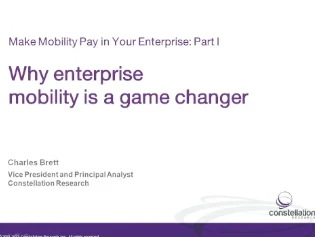
Why Enterprise Mobility is a Game Changer

Why Enterprise Mobility is a Game Changer

Making Mobility Pay in Your Enterprise webinar 1 of 3. Why Enterprise Mobility is a Game Changer, Charles Brett. Originally aired July 10, 2012.

New C-Suite Tech Optimization Chief Executive Officer Chief Information Officer On <iframe src="http://player.vimeo.com/video/46274369" width="500" height="281" frameborder="0" webkitAllowFullScreen mozallowfullscreen allowFullScreen></iframe>
Media Name: screenshotmobilitygame.png

Why Reputation Matters

Why Reputation Matters

Keynote, Badgeville City Tour, New York City. October 17, 2012.

Future of Work Chief Customer Officer Chief Executive Officer Chief People Officer Chief Marketing Officer On <iframe src="http://player.vimeo.com/video/52711698?byline=0&amp;portrait=0" width="500" height="281" frameborder="0" webkitAllowFullScreen mozallowfullscreen allowFullScreen></iframe> <p><a href="http://vimeo.com/52711698">Keynote: Why Reputation Matters</a> from <a href="http://vimeo.com/badgeville">Badgeville</a> on <a href="http://vimeo.com">Vimeo</a>.</p>
Media Name: screenshotbadgeville.png

TCO in YOUR Next Gen Comms World

TCO in YOUR Next Gen Comms World

CAPEX, OPEX, and the true cost of comms webinar with E. Brent Kelly. Originally aired July 11, 2012

New C-Suite Tech Optimization Chief Information Officer On
Media Name: screenshotebkellweb1.png

Trends in Manufacturing ERP and How to Ensure Success

Trends in Manufacturing ERP and How to Ensure Success

ERP Manufacturing Experience Keynote

Tech Optimization Chief Information Officer Chief Supply Chain Officer On <iframe src="http://player.vimeo.com/video/61423262" width="500" height="375" frameborder="0" webkitAllowFullScreen mozallowfullscreen allowFullScreen></iframe>
Media Name: scavo-thumb.jpg

DataGrok

DataGrok

For all the silliness surrounding Big Data and Data Science, all the hype and all the controversy, there are actually very innovative and disruptive technologies coming from this area, this new approach to data management and analytics [DMA]. How do we categorize the vendors or the technologies that have never existed before?

Predictives

One new area is Predictive Analytics, also called Predictive Intelligence. Since predictions are not analytics, as the term is used in BI, and certainly not the Intelligence used in BI, I don't like either, but prefer the simpler "Predictives". Four companies with which I've had briefings, fall into the Predictives category, but each of these companies have very different approaches and technologies for performing predictives. These companies are Opera Solutions, Alpine Data Labs, INRIX and Zementis. There are other companies that I'll include in a full report after receiving briefings, such as KXEN, Soft10 and Numenta. By the way, Numenta's product is named "Grok". Given their differences, do they really all belong in the same category?

Opera Solutions: Acting on petabytes of data, Opera Solutions provides a signal hub stack starting with data management, going through pattern matching in the signal layer, and, enhanced by their own Data Science teams, resulting in predictions and inferences for better decisions for enterprise advantage, understanding the "signal" is more important than the underlying technology, to actually create front line productivity through signals manifesting and adjusting "gut feel" where machines don't direct humans but do the heavy lifting.

Alpine Data Labs: Alpine Data Labs brings mathematical, statistical and machine learning predictive methods to the data in situ, no matter how small nor how big the data sets, within a variety of RDBMS technologies and Hadoop distributions. Alpine Data Labs helps data science teams address the data where it lays, across data types and functional areas, working with all the data to bring insight to bear on better decisions.

INRIX: INRIX data science teams and technology provides unique predictives using connected cars, connected devices and connected people.

Zementis: Zementis brings predictive modeling into decision management through their data science teams, Adapa product and strong commitment to the predictive markup modeling language [PMML]. Through partners and customers Zementis works with traditional and innovative data sources to provide decision management from predictives, data mining and machine learning for marketing solutions, financial services, predictive maintenance and energy/water sustainability.

DataGrok

One of the more interesting things to come out of data science is how do you really understand the data that is being gathered and presented. Two of the companies with which I've recently have had briefings, challenge the categories of Data Discovery or Data Exploration. However, each of these companies have different technologies, and different approaches to fully, deeply understanding your data, and to being able to draw conclusions from the data before doing other, more formal analytics. Over the past month, I've had the good fortune of having very in-depth, in-person briefings by both of these companies. Both of these companies are helping those who need it most to truly, fully, deeply, easily understand their data. These approaches, while very, very different, both constitute an entirely new category. Beyond data discovery, beyond data exploration, I call this new category Data Grokking.

"Grok" as I wrote in 2007, means to

"to fully and deeply understand"; [but to you need some background on the word's origins]. It's Martian and not from any Terran language at all. It comes from the fertile mind of Robert A. Heinlein, and was brought to Earth by Valentine Michael Smith in Heinlein's wonderful 1961 novel Stranger in a Strange Land.


One of these companies is still in stealth mode, and I won't mention their name here. The other is Ayasdi, and Ayasdi takes a very, very interesting approach to grokking your data.

These two very different technologies, based upon very different science and mathematics, do indeed allow us to fully and deeply understand our data. Much like the Martian ceremony, the DataGrok allows us to mentally ingest our data, to realize creative insights from our data sets, and to recognize the fundamental interweaving among the data, that, prior to these two innovative firms, could only come about through a long, arduous struggle with the data sets.

As I mentioned, the one company is still in stealth mode, so I'll write about Ayasdi here.

Ayasdi

Ayasdi comes out of the intersection of Topology and Computer Science, as brought together by two Stanford Professors, Gurjeet Singh and Gunnar Carlsson. The project started as a DARPA contract that has spanned more than four years, comptop. The CompTop project included Duke, Rutgers & Stanford nodes. Topological methods discover the structure of the data - this is somewhat analogous to, but not the same as the probabilistic or cummulative distribution or density functions [pdf, PDF, cdf or CDF].

Ayasdi is focused on four markets:

  1. Pharmaceuticals, Healthcare and Biotech
  2. Oil & gas
  3. Government
  4. Financial Services

From this, you can see that Ayasdi customers go after expensive data, i.e. expensive to collect, expensive to use. Iris is the front end to the Ayasdi Platform, and while available as a private cloud, their offering is primarily SaaS.

The analyst community is trying to figure out where to put Ayasdi, thus my category of DataGrok. Another area of confusion is "What is the right tool of each step of the process from DataGrok to inferences and predictions?" Some of this stems from mistrust of machines, but we need machines that do more than count and sort, we need machines that help us to find insight and improve performance.

Creative Commons License: Attribution, Non-Commercial, Share-AlikeExcept where otherwise noted, this content is
licensed under a Creative Commons License.
Data to Decisions Chief Customer Officer Chief Information Officer Chief Marketing Officer