


Workday outlines monetization plan, sees HR as jump off point to market expansion
Workday is expanding into the identity market, ITSM and planning to ride a consumption model as a big part of its monetization engine.
At an investor meeting with Wall Street analysts, Workday executives walked through how AI is changing its business and expanding its total addressable market.
- Workday makes Sana its interface, launches Agent Harness, decision and work intelligence
- Workday Q2 strong, says AI attracting more wallet share
- At DevCon, Workday courts developers with optionality
- Workday CEO Bhusri on two-sided coin of agentic AI
Here's what customers need to know about Workday's strategy.
Workday thinks HR is the more natural path to people and AI agent identity. At Workday Rising, Workday said it will acquire C1.ai, an agentic identity platform. C1.ai connects to enterprise systems to give the right access at the right time and can remove it. The gist: "Every new hire, job change, and exit is a Workday event."
Bhusri outlined the rationale at a Wall Street analyst meeting.
"I've been talking about identity for a long time. I was one of the founding investors in Okta. I love that space. And I think there's a nuance that's lost on the market. HR systems are the source of identity. We have massive share in the HR space. Not saying I would do this, but if we turned off access to Okta to our HR system, they'd be in a lot of trouble, which just tells you we are at the front end, we're upstream of all the identity systems. It's a very fragmented industry. So HR is the source of identity. Now we're providing all the governance around it for not just humans, but for agents.
We can work with other IDPs whether it's Microsoft or Okta, but we now have that agentic layer that manages human and agent governance around all the things that are going to happen in the world of AI."
Later in a Q&A with Wall Street analysts, Bhusri elaborated:
"HR is the system of identity. We built the agent a system of record to couple with our HR system. There's no question, no will debate you that HR is the source of identity for all enterprises. Where else do you get your source of identity. ServiceNow doesn't have it. Salesforce has it for salespeople and the people that are in their system. But the one thing about every company is that everybody in the company is an employee, and that's where you get the identity. And we were architected for that."
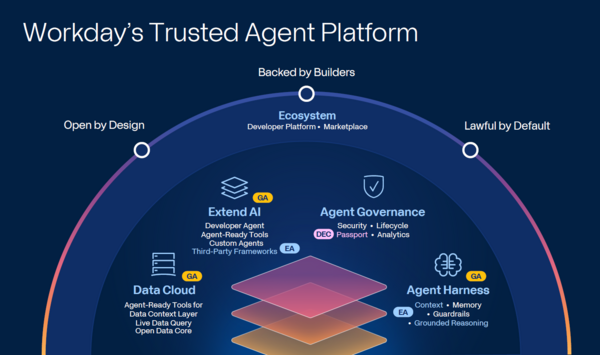
Workday sees ITSM as an avenue for growth. The theory behind entering identity and ITSM rhyme in that Workday thinks HR is the door to total market expansion. Joel Hellermark, founder of Sana and chief AI officer at Workday, said:
"In May, we introduced the Self-Service Agent as well as Sana for ITSM. And today, we're bringing all of those capabilities together around our new offering, Sana Concierge. This is a new way to deliver employee service across HR and IT. And I think it's really delightful to use. Employees can get help with onboarding, leave, payroll, access, IT support all of that in a single place.
With the history, supporting context and the next steps already serve there, a specialist can approve it. This is very, very difficult to replicate without Workday's context and processes. Customers get fewer tickets, faster resolution and lower support costs. And this is a radical change. We already heard 25% increase in resolution rates across Self-Service Agents."
A question: Is there anyone not getting into ITSM now?
Workday sees itself as the AI cop enforcing deterministic laws in the enterprise. Bhusri said:
"What we need to do as a company and part of our refounding is this differentiation is take these deterministic rails. Every business process has a start and an end. Some business processes have 20 steps along the way. A lot of that work between those steps are very mundane. They could be automated. There's a human involved. Well, AI can actually move the process from step to step. And in some cases, just redefine that business process. And that's where Workday comes in, to take the strength of those deterministic applications and now come up with the agents that can move work across these different business processes."
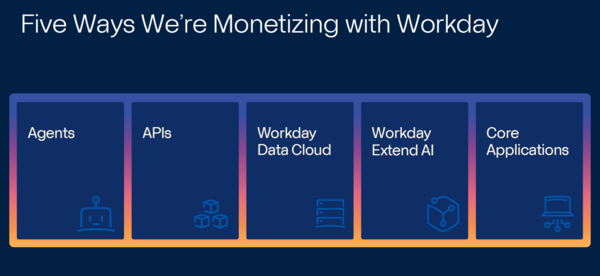
There are five ways to monetize Workday's platform. For Workday and Wall Street, these monetization models are just swell. For customers, there's a risk of confusion.
Bhusri said:
"Obviously, we're going to sell agents on a Flex Credit basis. APIs. If you don't want to use our agents on the front end or you want to use something like Cowork. Anthropic integrates into Sana. It doesn't even integrate directly to our base level APIs. It integrates through Sana. Workday Data Cloud is a way you want to do deep analytics off to the side and marry with a whole bunch of other data sets, we've got the Workday Data Cloud. Workday Extend AI, if you want to build your own custom applications, again, Flex Credit-based. And then, of course, we still have our core applications that we monetize."
The Workday CEO added that the company is neutral about which monetization model you choose (even though Workday benefits from AI agents and consumption).
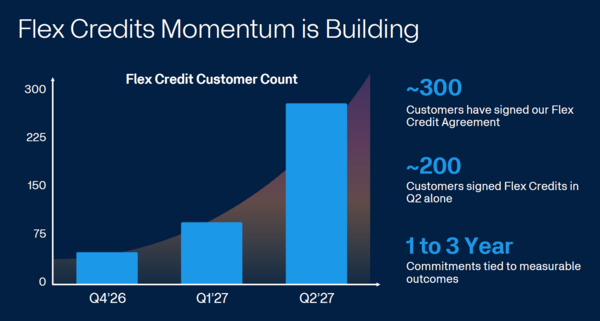
Zane Rowe, CFO of Workday, noted that Sana, Extend AI, HiredScore and Paradox are all above the $100 million revenue mark or approaching it. Rowe said that 300 customers are signed up for Flex Credits and there are more than 5,500 customers using organic AI agents.
Bhusri said Accenture has signed up for Flex Credits for Workday's self-service agent for 400,000 employees.
Credits are swell. Bhusri said:
"On the agentic front, the agents, the APIs, Workday Data Cloud, this new consumption model is a beautiful model. It's a flywheel. Once it gets going, it really gets going. And it's new to us. It's not new to us as executives or leaders. It's new to Workday, and it's new to you and how you look at Workday but it's a far better model than a people-based subscription-based model, which will continue for a long time. But I'm super excited. I see the bills we have to pay to Google Cloud and AWS and Azure. And I think why I'd like to be in that business, and now we have an opportunity to be in that business. And we have to do it in the right way for our customers."
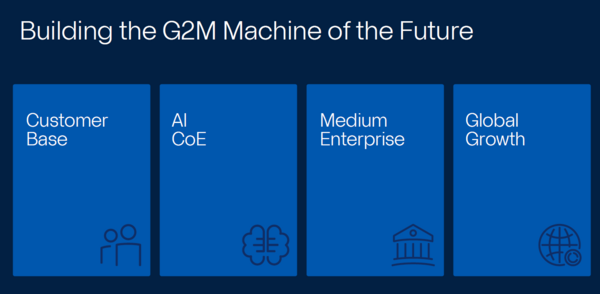
Workday is eyeing the midmarket. Robert Enslin, president and chief commercial officer for Workday, said the company is being more intentional about chasing the midmarket with Workday Go. Enslin said:
"We focused our midmarket upmarket land team on the category of 500 to 3,500 employee segment. This is our sweet spot. And we've been more intentional about this. As a result, we've seen improvement in win rates and an increase in net new deal sizes nearly 20% year-over-year.
We also simplified the packaging and implementation model and expanded Workday Go into more than 2 dozen markets. We're seeing good momentum as we continue our rollout and expansion, including strong win rates and faster deal cycles."
Larry Dignan is Editor in Chief of Constellation Insights at Constellation Research, where he leads editorial coverage focused on enterprise technology, digital transformation, and emerging trends shaping the future of business. He oversees research-driven news, analysis, interviews, and event coverage designed to help technology buyers and vendors navigate complex markets with clarity and context. ...
Read morePublished
Author
