


For Starbucks, AI returns are behind the scenes
Starbucks CEO Brian Niccol is betting the coffee company’s returns on AI investment will come from outcomes that aren’t noticed by customers that much. The company is focusing on supply chain, scheduling and optimizing behind the scenes processes.
The pivot is notable for anyone following Starbucks’ technology strategy, which used to be led by engagement and app technologies over the human baristas and in-store experiences.
Speaking at Cisco Live, Niccol spoke with Cisco CEO Chuck Robbins about technology, customer experience and the company’s transformation. Under Niccol, Starbucks has aimed to lean into its human differentiation. Niccol has been at the helm of Starbucks for nearly two years.
“You first have to understand how do you do a great job for your customer, and then in the case of Starbucks we also have to understand what do we do and make sure that our partners are also set up for success,” said Niccol, who said his approach is to make fast decisions and then pivot with new information.
“The human connection between our partners and our customers is really one of our biggest points of difference,” said Niccol. “Our job, frankly, is to set our partner up so that they can have that moment of connection with you.”
- Starbucks aims for 4 minute barista to customer handoff process to boost CX
- Starbucks lands new CEO from Chipotle: Here’s how digital strategy could change
Niccol’s approach makes sense, but stands out in the age where we’re supposed to replace humans with a large language model, robot or kiosk. But just because Niccol clearly wants humans as the lead at Starbucks don’t confuse him for a Luddite. Starbucks is conducting an AI-driven operational rebuild.
The approach
Niccol at Cisco Live noted that Starbucks is seeing returns on AI in behind-the-scenes operations and the plan is to use technology as the connective tissue between employees and operations. Technology is a key ingredient to Niccol’s broad “Back to Starbucks” plan.
“The connection now is probably greater than ever in pieces of our business that we probably hadn't originally thought about, whether it's supply chain, preparing schedules, forecasting, and the things behind the scenes that set up our partners to have a great experience,” said Niccol.
For instance, Starbucks is leveraging AI to be more precise about replenishment. “I just think the days of having to ship cases of things are starting to move to where we can start sending pieces and do this every day. We can get to a replenishment schedule where within 12 to 24 hours we don't have ship a case, but it could be something like we need one vanilla syrup and we need one bag of beans,” said Niccol.
Supply chain is another focus area.
“We're spending a lot of time right now on supply chain forecasting and scheduling in the stores, because the predictability has just gone way up with AI,” said Niccol. “The more information we have, our predictability of what you're going to order based on day of week, time of day, just goes way up, and then that better informs how we staff the store and set up the inventory.”
That focus on supply chain, replenishment and inventory also plays into Starbucks ability to customize drinks since “no two drinks are the same,” said Niccol.
When it comes to technology, Niccol likes to be ruthless about prioritization. “If the to-do list just keeps getting bigger and bigger and bigger, and we aren't actually ever getting anything off the list that's a signal to me that we're not actually making progress,” said Niccol. “For our business it really comes down to what's the customer experience, what's the partner experience. If we find ourselves working on things that don't actually make one of those two things better, we're probably off target.”
The projects
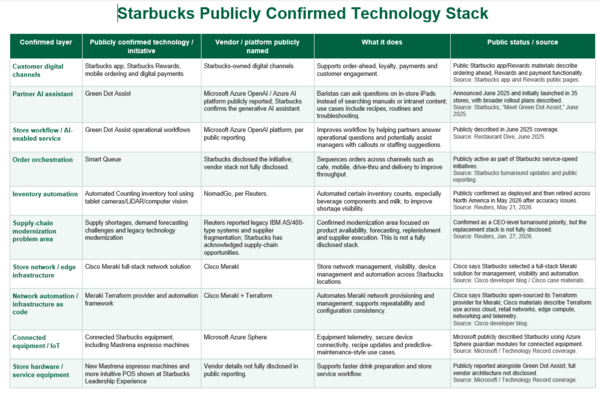
At Starbucks Investor Day in January, the company outlined technology projects that include AI and roll up to Niccol’s customer experience ambitions. Starbucks’ presentation in January was more about vibe, feel and experiences compared to Niccol’s predecessor, who focused more on technology.
Here’s a look:
- Green Dot Assist is a genAI app that helps partners solve problems on the floor and save time using AI.

- Smart Queue is a program that improves handoffs, speed and consistency by optimizing products. Mike Grams, Chief Operating Officer at Starbucks, said the system “intelligently sequences orders across cafe, mobile, drive-thru and delivery.”
- AI scheduling balances partner preferred hours, peak demand forecasts and the weather.
- Supply chain enhancements are designed to get more than 90% of coffeehouses on daily replenishment, said Grams. Niccol said 60% of stores get daily deliveries.
- A point-of-sale system upgrade.
- A revamped Starbucks Reward program with more personalization and tiers.
- Mobile scheduled ordering, trending beverages and customization.
“I want you to imagine a world where customers can order a beverage not by scrolling a menu, but by describing their mood and goals for the day. Well, we can imagine it, and we're making it a reality. We are actively developing a first-of-its-kind Starbucks ordering companion. Powered by AI, it will use quick customer prompts to discover that perfect drink,” said Tressie Lieberman, Global Chief Brand Officer at Starbucks.

The results so far
Niccol speaking at an investor conference on June 9 made it clear that the company still has work to do. He said:
“For the most part, we've got the fixing done on operations and marketing, menu, but there's still lots of opportunity to be better. The good news is now I'm on my front foot for operations, for menu, marketing, but still early innings of what I think we're capable of versus supply chain, I would say we're still in the process of fixing. Technology, we're still in the process of fixing. The store experience through uplifts, still in the process of fixing. The store pipeline, we're still in the process of fixing.”
In the second quarter, Starbucks reported a global same store sales increase of 6.2% driven by a 3.8% increase in transactions and a 2.3% increase in average ticket. Revenue in the second quarter was up 9% to $9.5 billion. Starbucks also raised its outlook for fiscal 2026 and now expects same store sales growth of at least 5%.
Larry Dignan is Editor in Chief of Constellation Insights at Constellation Research, where he leads editorial coverage focused on enterprise technology, digital transformation, and emerging trends shaping the future of business. He oversees research-driven news, analysis, interviews, and event coverage designed to help technology buyers and vendors navigate complex markets with clarity and context. ...
Read morePublished
Author
