


Dynatrace acquires Arize, accelerates AI observability efforts
Dynatrace acquired Arize, which specializes in AI observability and the AI development lifecycle, in a deal worth $915 million. The acquisition is just the latest data point indicating Dynatrace has momentum.
Arize has a strong open source community and works across all major AI frameworks.
Dynatrace, a leading observability platform, said Arize will give it the ability to continuously improve AI applications across the lifecycle and connect them to infrastructure health and business processes.
Rick McConnell, CEO of Dynatrace, said Arize "advances our AI observability leadership, accelerates our roadmap, enhances our long-term growth profile, expands our reach with the developer community."
The deal is expected to close in the third quarter. Arize’s two founders, Jason Lopatecki and Aparna Dhinakaran, will join Dynatrace and report to McConnell, who noted that Arize brings an AI-native team to Dynatrace.
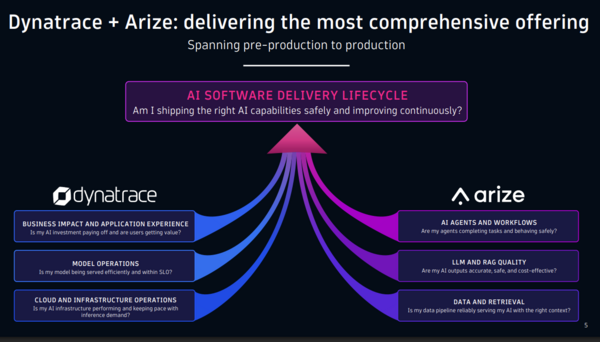
Dynatrace recently acquired Bindplane, an open telemetry data collection player, and DevCycle, which supports the open standard for feature flags. Dynatrace's strategy is to focus on open standards and interoperability.
- Constellation ShortList™ Digital Performance Management
- Constellation ShortList™ Autonomous IT Platforms
Constellation Research analyst Mike Ni said:
"Dynatrace buying Arize signals that observability vendors are angling to become a key control plane for autonomous operations. The value shifts from monitoring whether systems work to understanding whether AI decisions were right, what they changed, and whether the business improved. Like other observability vendors, Dynatrace understands that whoever owns that decision trace owns the learning loop, and increasingly, the trust layer required to scale enterprise automation."
Expanding footprint
Speaking at an investor conference, Dynatrace's McConnell said observability is going into a new era and evolving quickly.
McConnell's take is that observability is a category that only becomes more important amid AI applications. Enterprise software is being sorted into AI winners and losers and it's clear "AI workloads require more observability not less."
He said:
"What is evolving was a market that has existed for a couple of decades in observability oriented around what I would think of as business resilience. You need to make sure that your software is always running, that it's always optimized, that it's effectively delivering against its expected requirements.
In an AI observability world, it's evolving to answer a couple of incremental questions. If the first question around business resilience is, is it running or is it working, then in an AI observability land, is it right or is it accurate is the information that an AI workload is going to an LLM to extract actually, the right information that would be given to an end user of that particular customer. And so AI observability is extending the requirements of observability overall."
Dynatrace's heritage in application performance management was built on tracking traces and that foundation can now extend into AI observability. Arize accelerates the move into AI workloads and production code and the optimizations that follow.
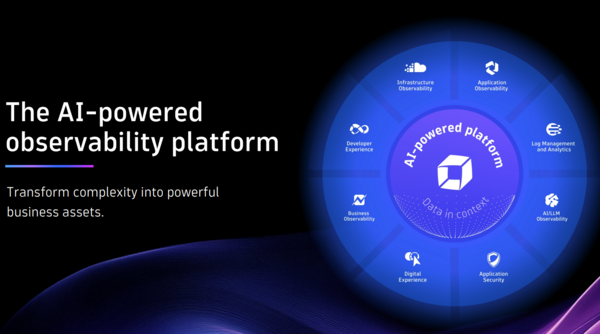
"You start with end-to-end observability, that's the foundation. You bring together all of these multi-vendor solutions into a common and integrated platform. That enables you to have the insights and answers you need to action those through a series of agents. And those agents can then ultimately lead to what we think of as autonomous operations," said McConnell.
Consolidating platforms
The fiscal first quarter earnings indicate that Dynatrace is starting to consolidate wallet share. McConnell said he has talked to one customer who had 16 observability tools and inflated log tracking costs.
McConnell added that Dynatrace is often in brownfield implementations where its platform consolidates legacy tools.
A few use cases for Dynatrace:
- A customer used Dynatrace as an operational system of record while building a custom CRM application through AI-assisted development to generate 7 figures of savings.
- A digital insurance provider used Dynatrace AI observability to reduce onboarding time and identify an outdated model that was eating up the token budget.
- Another customer used Dynatrace to validate model consumption, control cost and maintain data lineage from prompt to response.
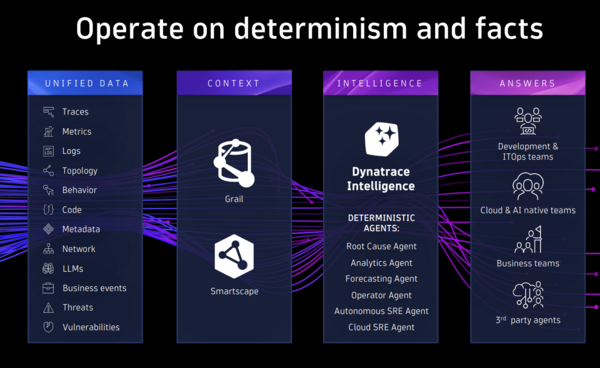
Dynatrace's platform features Grail and Smartscape, which provides a context layer and unified understanding of system relationships and behavior. Dynatrace Intelligence turns that understanding into action and combines deterministic processes and agentic AI.
The company reported fiscal first quarter earnings of $36.65 billion, or 12 cents a share, on revenue of $555 million, up 16% from a year ago. Non-GAAP earnings were 48 cents a share. Total annual recurring revenue at the end of the first quarter was $2.14 billion, up 17%. new logo ARR was up 41%.
Dynatrace projected second quarter revenue of $565 million to $570 million, up 14% to 15%, with non-GAAP earnings of 48 cents a share to 49 cents a share. Fiscal 2027 revenue will be between $2.3 billion to $2.32 billion with non-GAAP earnings of $1.97 a share to $1.99 a share.
"We are seeing AI contribute in three ways. Increasing consumption across our platform, creating demand for new AI observability capabilities and directly monetizing agent usage," said McConnell, speaking on Dynatrace's earnings call. "The observability market has entered a new era. Software that once took months to build now ships in days. AI agents are taking autonomous action across infrastructure and enterprise customers are now deploying AI rapidly, not because every risk has been resolved, but because standing still means falling behind."
Larry Dignan is Editor in Chief of Constellation Insights at Constellation Research, where he leads editorial coverage focused on enterprise technology, digital transformation, and emerging trends shaping the future of business. He oversees research-driven news, analysis, interviews, and event coverage designed to help technology buyers and vendors navigate complex markets with clarity and context. ...
Read morePublished
Author
