


Caterpillar's AI autonomy efforts accelerate, but domain knowledge drives returns
Caterpillar said its autonomous equipment efforts are accelerating, but the company is focused on using its domain knowledge as the differentiation as it trains its world models.
Speaking at CoreWeave's Fully Connected 2026 conference in San Francisco, Brandon Hootman, VP of physical AI platforms and construction autonomy at Caterpillar, said the company has been working on autonomy for more than a decade, but the efforts have been largely in structured environments.
Hootman said Caterpillar's autonomy efforts have focused on structured environments such as mine site where haul roads followed patterns. Construction sites have an unstructured dynamic because humans and machines operate in close quarters.
"It was only just three or four years ago where the dream of being able to bring autonomy operations to a construction site almost felt unrealistic," said Hootman. "But if you look at what has happened in the industry and the move to agency, real reasoning and models that can perceive the world around them that's exciting."
In recent days, Caterpillar has announced the following:
- An expansion of autonomous hauling with Luck Stone. Caterpillar hauled more than 3.5 million tons autonomously in an 18-month pilot. Caterpillar and Luck Stone are now expanding autonomous hauling at two other sites.
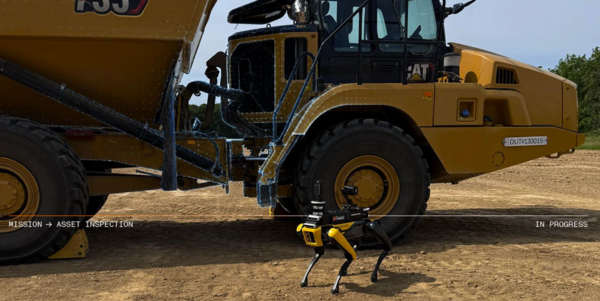
- The company announced a partnership with FieldAI to leverage robotics, digital wins and Nvidia technologies at job sites. Early applications include autonomous inspections, digital twins of facilities and job sites and simulation as well as AI-driven insights.
Hootman said Caterpillar will be adding to its autonomous equipment news flow in the near future. Caterpillar has been training its Nvidia-based models, outlined at CES 2026, on CoreWeave's platform.
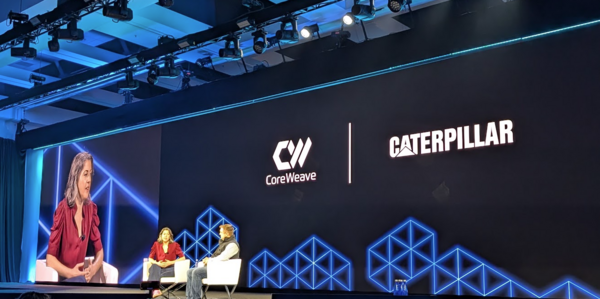
Does this mean Caterpillar will start looking like an AI lab? Hootman said no way. "We've got 100 years of serving our customers in our industries. We see that as a real advantage as industries transform," said Hootman. "We start with our customers and that's different than we've done technology development before."
Hootman said:
"We bring customers in early so we can understand how the technology and autonomy fits in with their workflows and we can drive value," said Hootman. "We work with AI leaders but what we bring to market is 100 years of experience, a vast amount of data from job sites and the ability to scale."
Caterpillar is seen as a good example of enterprises using CoreWeave to train their own models as the company expands its AI efforts. A big theme at CoreWeave Fully Connected 2026 is physical AI.
CoreWeave’s physical AI efforts
Leading up to CoreWeave’s user conference, CEO Michael Intrator said Caterpillar is “a great example of enterprise consumer coming to us and saying, hey, the way that we're going to participate with our company in artificial intelligence, the way that we're going to train our models, the way that we're going to serve our models is going to look different than it has historically. We're going to build our own clusters.”
On CoreWeave’s second quarter earnings call, Intrator said the company is using the company and its Nvidia Vera Rubin systems to “support Caterpillar’s physical AI training and inference at industrial scale.”
Intrator said CoreWeave is emerging as an AI cloud participant and a hyperscaler within the broader AI system. He added that enterprises are looking for more control over their data, model training and AI compute.
“Enterprises are going in with eyes wide open, which provides us with the opportunity to say, ‘we can assist you beyond what has been an oligopoly of three massive companies,” said Intrator. “We have a different way of providing the compute that will be most performant to you and that drives cost down.
What you can learn from Caterpillar
In a breakout session, Hootman walked through Caterpillar's key tenets for AI use cases in the context of massive autonomous machines.
Context. The building blocks of the models is about context and data. Hootman said data collection is huge. The model needs to understand the world and the machine.
"We're working very closely with Nvidia on adapting their models to our environment. But these models don't understand our machines. They don't understand job sites. Think about all those job sites that I described to you. Think about the different permutations of those," said Hootman.
Simulation matters. "Closing the simulation to real gap is an absolute must," said Hootman. "For every one hour of data that we collect, we'll probably do 1,000 hours of synthetic simulated data."
Construction will be a real test of the models. The complexity on a construction site is overwhelming. Residential, power plants, data centers and highways. "The complexity on a construction site is overwhelming when you think about it, and construction as an industry is extremely diverse. It can be home construction, residential, commercial, building infrastructure, power plants, data centers, can be on highway construction and metropolitan construction," said Hootman. "Those types of environments are extremely challenging."
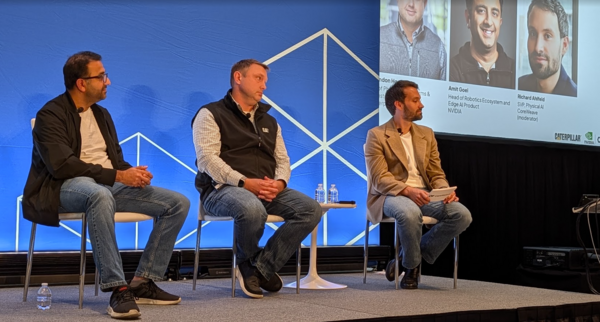
Stay grounded. There's a higher bar for physical AI deployments. "We've all got to ground ourselves in is the cognitive world of AI that we all live in: chatbots and agents doing things on your behalf, looking to travel, helping you with your shopping and things like that. When you get into the real world of what our customers do, you're talking about heavy equipment working around the clock, doing very critical work. And if the technology doesn't work in a way where it actually delivers value, it just becomes a cool demo that you see a video of on YouTube and adoption actually flatlines," said Hootman.
Continued reinforcement and digital twins. Hootman said he would "try to exit the conversation as quickly as possible" when digital twins were the topic. "The digital twin was useful up until the point where you actually put it into production, and you found out that the whole world around it had changed, and it was no longer useful. I think what Nvidia has built with continued reinforcement of real-world data has turned simulation into something immensely useful and absolutely critical, robotics as well," said Hootman.
Physical AI requires more work. "Once you get the GPU that's just the start of the game," said Hootman, who noted that edge compute and data has to be integrated with the cloud and AI infrastructure. The scale of physical AI is just different and the integration and tooling matters. "What we've learned is don't underestimate the harnesses and the tooling and the infrastructure that goes around the core," said Hootman.
AI speeds up product development cycles. Caterpillar used to launch a machine and benefit from an upgrade cycle that would last years. All of that has changed. Hootman said:
"We went from things being relatively stagnant and relatively contained, to being very iterative in capabilities. How do you develop this technology in a very modular, iterative way, where you can get it into the market quickly and start to learn with your customers? That's really where we're focused. So the whole clock cycle of the way we build inside of Caterpillar has completely changed with the dynamics of what's happening in the market."
Larry Dignan is Editor in Chief of Constellation Insights at Constellation Research, where he leads editorial coverage focused on enterprise technology, digital transformation, and emerging trends shaping the future of business. He oversees research-driven news, analysis, interviews, and event coverage designed to help technology buyers and vendors navigate complex markets with clarity and context. ...
Read morePublished
Author
