


Thomson Reuters brings agentic AI to legal workflows
Thomson Reuters launched CoCounsel Legal with Deep Research and guided workflows, an AI agent designed to answer legal questions, develop reports, draft reports and feature workflows for discovery and depositions.
The launch highlights how agentic AI can be utilized in industries such as legal and evolve from tools that require prompts to agents that can take on tasks.
Thomson Reuters has a bevy of legal products and services including CoCounsel, a generative AI assistant for legal and accounting professionals, Westlaw and Amlaw. Thomson Reuters has more than 20 billion legal documents that were used to train its models.
That Thomson Reuters data and reasoning models are complemented by domain experts. CoCounsel Legal will be a separate product addressing outcomes in litigation and be embedded into other services such as Westlaw Advantage.
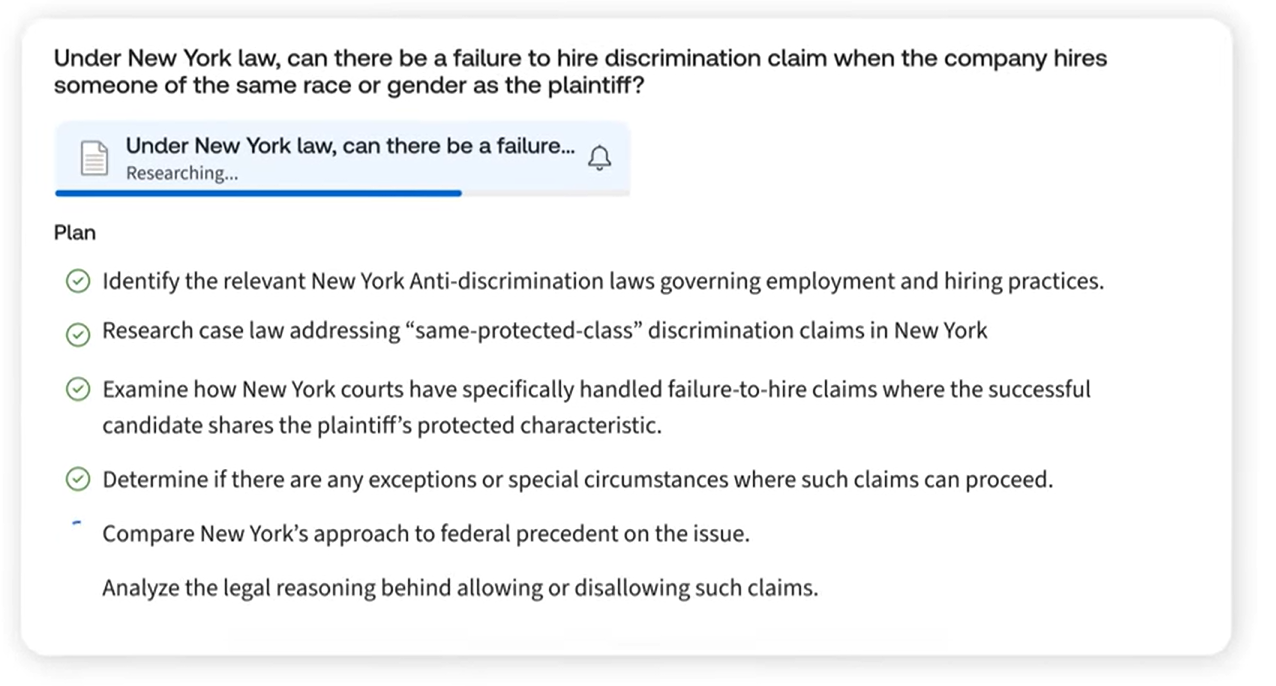
Key items:
- CoCounsel Legal includes Deep Research, which is grounded with Thomson Reuters content and tools such as Westlaw Advantage.
- CoCounsel Legal is built to reason, plan and deliver legal research.
- The AI agent is designed to understand process, sourcing of answers and argument foundations.
- CoCounsel Legal can generate multi-step research plans, trace logic, delivered Westlaw citation-backed reports and draft complaints, discovery requests and responses and operate with humans in the loop.
- Thomson Reuters said it tested CoCounsel with Deep Research with more than 1,200 customers and attorneys.
According to Thomson Reuters, more than 12,200 law firms, 4,900 corporate legal departments and the majority of top US Courts and Am Law 100 firms use CoCounsel.
- Agentic AI: Is it really just about UX disruption for now?
- Lessons from early AI agent efforts so far
- Every vendor wants to be your AI agent orchestrator: Here's how you pick
- Agentic AI: Everything that’s still missing to scale
- BT150 zeitgeist: Agentic AI has to be more than an 'API wearing an agent t-shirt'
I caught up with David Wong, Chief Product Officer at Thomson Reuters, and Omar Bari, VP of Applied Research at Thomson Reuters Labs, to talk about the approach to CoCounsel Legal with Deep Research and guided workflows. Here are the key points:
A model and cloud agnostic approach. CoCounsel Legal with Deep Research uses multiple models that are best suited for the task at hand. Thomson Reuters contracts with OpenAI, Google and Anthropic for foundational models and the big four cloud providers, said Wong.
Developing multi-agent systems. Bari said the multi-agent system behind CoCounsel Legal with Deep Research features agents for research, planning, discovery and orchestrating workflow. "We needed to multiple agents and the ability to launch in parallel," said Bari.
Bari said:
"We knew pretty quickly that we wanted to build a custom agent system for legal deep research that lets agents navigate Westlaw content like an expert researcher would. And that meant taking a lot of the rich content that we have in Westlaw and making it available via tools to agents and then using the best frontier models for the job."
The importance of process. Wong said Thomson Reuters built CoCounsel Legal with Deep Research based on the process that's used by trained legal researchers. "Legal research is taught in law school as a discipline. Legal research is often different because you're trying to often support or to critique an argument or some type of legal proceeding," said Wong. "We mimicked the process used by trained researchers and the agent is autonomous. Humans trained the models and created the process steps." When the system runs it is fully autonomous, but humans are focused on validation, quality and evaluation.
Build your orchestration layer. Bari and Wong said Thomson Reuters built its own orchestration framework for CoCounsel Legal with Deep Research. "We built the agent scaffolding ourselves," said Bari. The effort required continuous tweaking for high quality function calling, instructions, evaluation, memory management and orchestration, he added.
There are agent orchestration offerings, but most are first generation. "It's pretty easy to get to a prototype or demo, but production requires a lot of work on the details and each piece of orchestration," said Bari.
Larry Dignan is Editor in Chief of Constellation Insights at Constellation Research, where he leads editorial coverage focused on enterprise technology, digital transformation, and emerging trends shaping the future of business. He oversees research-driven news, analysis, interviews, and event coverage designed to help technology buyers and vendors navigate complex markets with clarity and context. ...
Read morePublished
Author
