


Google claims quantum advantage with Willow breakthrough
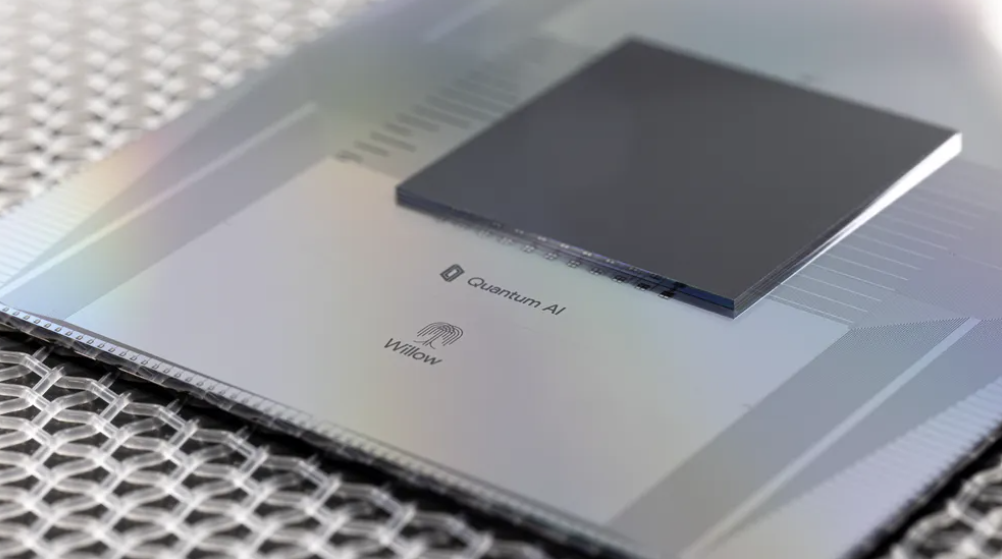
Google said its Willow quantum computing chip has achieved quantum advantage. Google's breakthrough hit pure play quantum computing companies.
In a post on X, Google CEO Sundar Pichai said Willow ran an algorithm called Quantum Echoes 13,000x faster than the world's faster supercomputer. The Quantum Echoes algorithm explained interactions between atoms in a molecule using nuclear magnetic resonance.
Google's breakthrough was published in Nature.
2025 is the year of quantum computing | Constellation ShortList™ Quantum Computing Platforms | Quantum Computing Software Platforms | Quantum Full Stack Players
The company explained:
"This implementation of the Quantum Echoes algorithm is enabled by the advances in quantum hardware of our Willow chip. Last year, Willow proved its power with our Random Circuit Sampling benchmark, a test designed to measure maximum quantum state complexity. The Quantum Echoes algorithm represents a new class of challenge because it models a physical experiment. This means this algorithm tests not only for complexity, but also for precision in the final calculation. This is why we call it “quantum verifiable,” meaning the result can be cross-benchmarked and verified by another quantum computer of similar quality. To deliver both precision and complexity, the hardware must have two key traits: extremely low error rates and high-speed operations."
Other key points.
- The current-generation Willow chip features fidelities of 99.97% for single-qubit gates, 99.88% for entangling gates, and 99.5% for readout across its 105-qubit array.
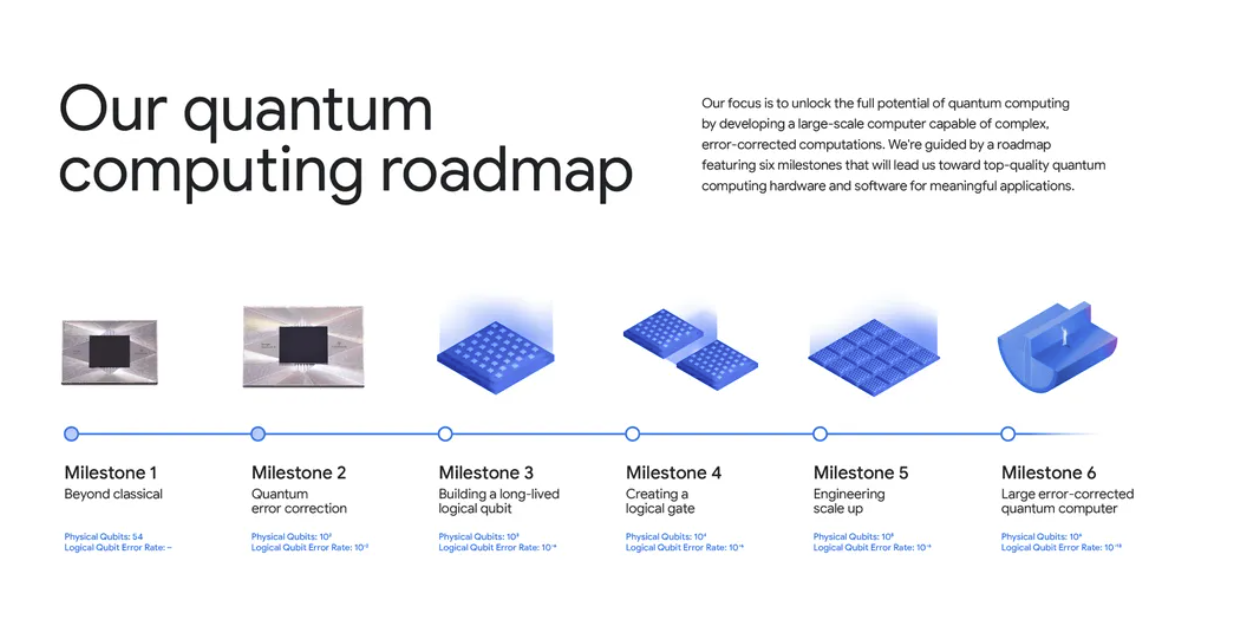
- Google said its next milestone will be a long-lived logical qubit.
- The company also showed its progress against its quantum roadmap.
The fallout
Quantum computing stocks, which have been on a tear of late, took a hit on the Google news.
Why?
Many of the pure play quantum computing companies are using different technology than Google, which is focused on superconductors for quantum. IBM, which is also focused on the same technology as Google, was up.
IonQ, Rigetti, D-Wave and others were down double-digit percentages.
The big question is whether quantum computing is nearing its VHS-Betamax moment when it's clear one type of technology will win out.
Here's a look at the types of quantum computing and the vendors in that category.
- Superconducting qubits are seen as general quantum computing options and vendors in this category include IBM, Google and Rigetti Computing.
- Trapped Ion quantum computing has high fidelity and long coherence times. IonQ is the big player in this category along with Quantinuum, which was created by the merger of Honeywell's quantum unit and Cambridge Quantum.
- Neutral atom quantum computing has the potential to scale better and QuEra is a player here.
- Quantum annealing is designed for optimization over general purpose computing and D-Wave has championed this approach.
- Topological quantum computing has the potential to be more fault tolerant and is an avenue being pursued by Microsoft. Topological quantum computing uses a concept similar to semiconductors using "anyons," which can arrange qubits into patterns.
Today, quantum computing chatter talks about the sector as if all the vendors are all using the same technique. Ultimately, CxOs will have to ponder use cases and how they align to the various flavors of quantum computing.
Larry Dignan is Editor in Chief of Constellation Insights at Constellation Research, where he leads editorial coverage focused on enterprise technology, digital transformation, and emerging trends shaping the future of business. He oversees research-driven news, analysis, interviews, and event coverage designed to help technology buyers and vendors navigate complex markets with clarity and context. ...
Read morePublished
Author
