Michael Ni

Vice President and Principal Analyst
Constellation Research
Michael Ni photograph

Results

For fear of adding to the "AI Governance" ramp of hysteria, some research caught my eye on visibility and control

A recent review of Lovable apps by Crissy Field found of over 34K+ Lovable projects using Supabase, 7.4K+ had readable tables containing email addresses; some exposed passport data, payment details and 200K+ private chat messages where basic access controls were missing and sensitive data could be exposed.

The bigger issue is not Lovable.

The Cloud Security Alliance found that 82% of organizations had discovered AI agents they did not know were running, even though 68% thought their visibility was strong.

AI is making software and automation much easier to create. Governance isn't keeping pace.

For CIOs, CDAOs and security leaders, the question is becoming pretty basic:

Do you know what is running, what data it can access, and what authority it has?

MyPOV: AI is lowering the cost of creating software faster than enterprises are lowering the cost of governing it.

Read the research:

What caught my eye: Microsoft researchers demonstrated a technique for inserting triggerable backdoors by modifying a small number of model neurons without retraining the entire model. A compromised agent could behave normally during evaluation but execute an unauthorized instruction when a trigger appears. Microsoft has not observed the technique being exploited in the wild.

Why it matters: An agent can pass ordinary behavioral testing while carrying hidden vulnerabilities. This becomes more consequential as agents receive credentials and execution authority. While a compromised model does not magically bypass your network controls, we've all seen too often too many capabilities given to any solution. Yes

Executive/investor takeaway: Model provenance and supply-chain assurance belong alongside runtime authorization. Enterprises using third-party or open-weight models should test model integrity and limit what any model can execute.

Read the article: link

Microsoft had plenty of news at Ignite, with much of it focused on operationalizing AI:

• Copilot and agents: How people and agents work together

• Agent 365 and security: Agent identities, permissions, security, and the watchword of the year, spending

• Microsoft IQ: Managing/connecting business knowledge and context across agents and applications

• Data and AI infrastructure: HorizonDB, Fabric, and other services bringing operational data, analytics, and AI closer together

What caught my attention was Microsoft IQ.

Multiple keynote speakers drove home the point that “context is your IP.” It's an asset enterprises need to actively manage and build on. More on that in a future post.

The IQ family was introduced previously. What's new is Microsoft's move to manage and reuse context across agents through business plugins and an open architecture that can incorporate knowledge from other systems, including process intelligence from Celonis.

That's important because context is already one of the harder problems in enterprise AI, and even how we define and manage it is still evolving.
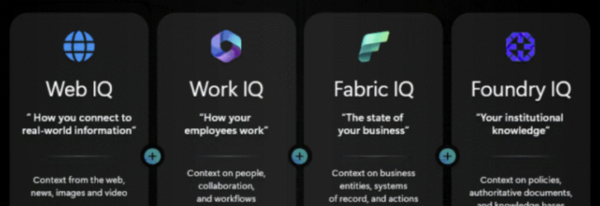
MSFT IQ

Five implications stand out:

1. Context conflicts need resolution. Different systems and domains may have conflicting definitions, rules, or views of the business. Enterprises need to establish which sources are authoritative for a given decision and how conflicts get resolved.

2. Shared context becomes operational infrastructure. When multiple agents depend on the same context, its accuracy, freshness, and availability become critical. One bad definition can affect multiple workflows.

3. Domain ownership still matters. Sales, finance, and supply chain have different definitions, processes, and rules. The teams that understand those domains need to own their context.

4. Federation matters. Enterprises need to bring context from different domains and systems together without rebuilding everything in one global model. Microsoft's open approach is a step in that direction.

5. Trusted execution requires more. Agents need current operational state, business policies, and authority to act. Understanding the business doesn't automatically mean an agent can safely execute a decision.

What should CIOs and CDAOs do next?

Start with a process where multiple agents need the same context. Determine what can be shared, who owns it, and which systems remain authoritative.

Then measure whether reuse actually reduces development effort and improves decision consistency, while testing the controls needed to execute reliably.

Microsoft is making progress. The test is whether shared context can support real business decisions and actions across the enterprise.

Read more

• Larry Dignan coverage: https://buff.ly/fRcNNHD

• Microsoft’s IQ introduction: https://buff.ly/ywkF34k

Workday's planned acquisition of Honeydew is an interesting move in the growing competition over who owns business context as AI agents operate across enterprise systems.

Workday already has deep knowledge of its HR and finance domains, along with the governance and MCP capabilities to expose that knowledge to external agents.

What Honeydew adds?

  • Consistent semantics: On its face, Honeydew provides a semantic compiler that can select among different business definitions based on the user, agent, and situation, then ensure those definitions results in consistent, governed queries. The standard "it's semantics" examples come to mind. Consider a simple question like "What's our headcount?" The answer might include or exclude contractors, open positions, or contingent workers depending on who's asking and why.
  • Own the context for "people" and "money" domain: As enterprises move toward federated AI architectures, that capability could strengthen Workday's position as the trusted interpreter of HR and finance information, even when the agent asking the question operates outside Workday (and doesn't have well-formed queries). Competitively, enterprise application vendors have an incentive to retain authority over their business domains, even as AI solutions and decisions increasingly span multiple platforms.

The test will be whether external agents increasingly rely on Workday's governed interpretation of business data rather than rebuilding that logic themselves.

That's where I see the strategic value of this acquisition.

Boomi has been assembling its Active Data Foundation via Rivery for data pipelines, Data Hub for MDM, and Meta Hub for metadata management. Elementary adds a missing piece: deeper data observability, quality monitoring, and lineage to establish trusted enterprise data.

Three things caught my attention:

1. You can't ignore bad data anymore... and detecting the problem after the fact isn't enough. Stale customer records used to be bad dashboards or frustrated analysts. Now, AI could drive incorrect pricing, approvals, or customer actions at scale.

2. Competition is shifting. Boomi is assembling more of what companies need to manage and trust their data. That moves it closer to Informatica for data management through to ServiceNow for connecting business context to drive workflows. It also raises the pressure on standalone observability vendors as larger platforms absorb their capabilities.

3. Integration is where Boomi needs to deliver. Elementary can identify unreliable data. Boomi already connects applications, controls execution (see lunar.dev acquisition), and orchestrates workflows. The opportunity is to be one of the independent vendors who can bring together those context and quality signals to stop an automated action, request better data, or route a decision for review.

MyPOV: For CIOs, consolidation could simplify the stack, but only if the acquired capabilities work together, stay open to other platforms, and show how better data quality leads to fewer bad decisions and faster execution.

For more information:

• Announcement: https://www.businesswire.com/news/home/20261019376249/en/Boomi-Acquires-Elementary-Data-to-Bring-Trusted-Governed-Data-to-the-AI-Era

• Larry Dignan's coverage: https://www.constellationr.com/insights/news/boomi-acquires-elementary-data-adds-data-observability-quality-governance-layer

#Boomi #DataObservability #EnterpriseAI #DataManagement

NOTE: I'm adding "Research Notes" to my notebook to capture interesting academic papers.


What happens when AI gives you the right answer to the wrong question?

Consider a sales executive asking, “Why did our highest-value customers churn more last quarter?”

An AI analytics tool might generate valid SQL and return a convincing explanation ... but what if churn among those customers actually declined?

A new paper, PremiseSQL: Evaluating Premise Critique and Abstention in Text-to-SQL Systems, looks at this problem.

The researchers tested frontier models against 1,800 questions containing flawed assumptions, along with 1,800 valid questions. Similar to assuming your prompt is always correct, the researchers found models generally accept the question as written and try to answer it. When prompted to challenge assumptions, they get better at identifying bad questions but also start rejecting legitimate ones.

Why is it interesting to me?

What's already covered by analytics vendors ... they validate queries, resolve ambiguous terms, and use semantic layers to enforce business definitions.

This research challenges how current solutions don't recognize when a question rests on an incorrect assumption, or ask for clarification without frustrating users by over-asking. It also has implications for semantic and context management, where knowing how the business defines churn isn't enough. The system may need to check actual churn trends before deciding whether the original question makes sense.

MyPOV: We've made considerable progress helping business users ask questions without knowing SQL. This research highlights another requirement: knowing when to challenge the question before answering it.

As AI moves from answering questions to making decisions, that distinction becomes more important. A bad assumption that once produced a misleading dashboard could now trigger an automated action.

Since @Workday Rising last week, one of the execs I met with forwarded me Anthropic's latest research on how AI is changing its workforce and asked how it relates to my work on data, AI, and decision-making. Below is a summary of my response.

MyPOV: AI has moved from productivity to changing how companies decide what work needs to be done, who does it, and what skills they'll need.

A few findings from Anthropic caught my attention:

• Entry-level technical hires fell from 27% to 9% of technical hiring, even as the company's overall workforce tripled

• Code commits per engineer increased ~5× over 6 months

• ~80% of interactive agent elapsed time was waiting for human input

This story connects to what I saw at Workday Rising.

Workday introduced Work Intelligence, which breaks jobs into tasks to help companies decide whether people, AI, or a combination should handle each activity. Research points to re-engineering work as the key to increased AI-initiative ROI …

… BUT there's another important piece to consider.

Tasks are what get done. Decisions determine what needs to get done, who does it, and under what conditions.

Four implications

1. Individual contributors need to become managers of execution. As AI takes on more execution, employees spend more time defining objectives, making judgment calls, handling exceptions, and checking outcomes, creating new skills for many and implications for how teams should be organized.

2. Decisions become the next productivity bottleneck. Agents waiting for human input is not new, but it's telling. Companies need to figure out where to insert a human in a decision process and still move at machine speed. Where do machines have the depth of data + context + controls to be trusted to act?

3. Decision velocity becomes the ROI constraint. As execution accelerates (and we delegate more to agents), organizations must speed up how they make, authorize, and evaluate decisions.

4. Career ladders are being redesigned … leaving a future hole. Organizations risk eliminating the execution work through which employees historically developed judgment.

Bottom Line

Leading enterprises have already started shifting AI initatives from productivity to AI-driven process re-engineering. What those same leaders miss is that the largest ROI gains come from connecting workforce planning with how decisions are made within those processes.

Which decisions should people own? Which can machines handle? What skills, context, and controls are needed to make that work?

Anthropic is an early look at what happens when AI becomes an accelerator of execution capacity … and it is not about doing more work with fewer people, but about making better decisions, acting on them faster, and learning from each decision to improve future decisions and results.

That's where decision velocity becomes a useful way to measure whether AI is actually changing business performance.

For links to articles and outside research
• Anthropic research: Employment at Anthropic
• National Bureau of Economic Research on GenAI at Work
• Stanford Digital Economy Lab: Recent Employment Effects of AI

#DecisionVelocity #FutureOfWork #EnterpriseAI #Workday

News: One of the more notable AI launches this month, TypeSafe AI, doesn’t generate anything.

TypeSafe AI came out of stealth with Jev, raised a $40M seed, saw fast developer uptake, and is reportedly already discussing another round that could top $1B.

The funding grabbed attention, but developer momentum reflects real uptake. Vercel says Jev became the fastest-adopted model in its AI Gateway history, with ~13% of paid teams had tried it in the first 24 hours, more than twice the adoption of any prior model launch.

What is it? Jev is used for smaller judgments by inserting a fast, low-cost judgment layer between context and decision/action. Judgment today is often delegated to an LLM to reason through for every small decision (e.g., which action or model, is this relevant, should this escalate, etc.)

It takes context/intent as input and returns a typed choice, score, or probability. Software then uses that output as one input into the business decision.

That points to an enterprise AI stack:

Context → Judgment (separated from decision) → Decision → Authority → Action → Learn

None of this is entirely new. Pega, Aera, and other decisioning platforms have long separated predictive models from decision logic and execution.

What could be new is the AI/developer focus and, more importantly, the economics.

Instead of building a rule or specialized ML model for every judgment, developers may be able to use a general-purpose model for many of them.

For CIOs and CDAOs, review how you architected your reasoning:

  • Your most capable model probably shouldn’t handle every judgment. Your context layer becomes more important because these decisions depend on current business state, not just a good model.

  • And the better unit of measurement may be the decision loop itself: how fast it runs, what it costs, how reliable it is, and how much can safely move to automation.

Jev is early. The bigger signal is that enterprise AI is starting to mature, and like traditional decision systems, is beginning to separate reasoning, judgment, decision logic, and action instead of asking one model to do everything.

Read more about Jev: https://typesafe.ai/blog/introducing-system-one-models-and-jev?utm_source=chatgpt.com

Larry Dignan's quick coverage of Christian Klein's comments at the Goldman Sachs investment conference... is worth a read because it points to where SAP thinks the next AI advantage lies (inside business processes) and reminds us why SaaSpocalypse was an overreaction.

SAP's bet is pretty practical. Agents need to know the data, semantics, permissions, process state, and business rules ... and the learning loops around a decision before they should be allowed to act. That is hard to recreate outside the systems where the work already runs.

What is increasingly apparent ... enterprise application vendors have what is increasingly recognized as deep domain and execution loops upon which leaders are increasingly looking to build atop to differentiate from the rest of the market:

  • Proprietary data and context
  • Deep understanding of customer workflows and backend processes
  • The ability to act within systems
  • Wired feedback loops that improve the product with use
  • Evaluation systems customers can trust ... and have trusted for decades
  • Embedded expert judgment
  • Ability to build atop for business-specific knowledge and strategies

For data and AI leaders, the implication is important: the next architecture battle may be less about which model you use and more about who supplies trusted business context at runtime.

SAP has a real advantage there, but it also has a hard execution problem. Most large enterprises still have mixed estates, custom processes, and plenty of non-SAP data.

The takeaway: when evaluating agent platforms, ask less about how many agents they ship and more about how they handle context, permissions, exceptions, and process state across the real environment.

Read Larry's coverage here: https://www.constellationr.com/insights/news/sap-ceo-klein-our-ai-agents-want-solve-complex-business-processes

24% of consumers said they canceled or stopped buying from a brand over concerns about how AI uses their data.

52% said they would pay more for a brand that is clear about it.

Not a new story, but one that will become more central as companies add AI data leverage to their solutions.

For data and AI leaders, privacy and consent are not just compliance issues. They now affect retention, pricing, data quality, and how far customers will let you go with personalization. This brings back conversations about zero-party data and how you want to manage your direct relationship with customers and the promise you make about how you'll use their data.

Increasing model capabilities may give you new features. The customer still has to say yes.

https://buff.ly/8qPH2hm

Snowflake’s latest quarter gave the Street what it wanted: accelerating product revenue growing 37% to $1.49B, RPO reaching $9B, and higher full-year guidance. Importantly, management also said AI products have accounted for roughly half of recent growth acceleration.

The story: Snowflake is aggressively pushing its AI vision, and buyers are approving.

Since its bevy of announcements at Snowflake Summit in June, Snowflake has added model routing, agent governance, MCP connectivity, context services and AI development tooling around its data platform. Snowflake has been clear: it wants to sit between enterprise data and AI execution.

Databricks is pushing toward the same control point.

For CDAOs and CIOs, the platform decision keeps shifting as consolidation continues, with each player approaching from its starting point.

MyPOV:

  • The question is no longer just where data is stored or analyzed … Snowflake is shaking off the perception that it's anchored in warehouse economics. The question is increasingly where AI gets its context, permissions, model choice, and rules for action.

  • What you should do: keep ownership of your data, context, policies, and decision logic clear. Preserve model optionality. Be deliberate about where the AI execution control point lives.

Snowflake’s growth is the headline today, but the story I am following is that the data platform is moving closer to the decision layer.

For more:

Qdrant has released Qdrant-Fineweb-10B, a public benchmark dataset built on 10 billion documents with exact ground truth for 120,000 queries. It covers dense, sparse and metadata-filtered retrieval, with known nearest-neighbor results to k=1,000. Qdrant is also releasing Supernova, the toolkit used to generate the embeddings and compute the benchmark.

MyPOV

  • Vector search is becoming table stakes (often embedded into DB or platform)
  • Specialists like Qdrant need to differentiate: better retrieval quality, latency, scale economics
    CDOs, CDAOs and COOs neeed to understand retrieval is part of the AI operating architecture given retrieval determines what evidence reaches the model before an agent decides.
  • Qdrant pushing to educate with making evaluation easier to force leaders to ask the question, “When does retrieval become important enough to operate, optimize and govern as its own infrastructure layer?”

--

News: https://www.techtarget.com/data-technologies/news/366649627/Qdrant-builds-dataset-to-benchmark-vector-retrieval-at-scale