EnterpriseDB Already Had ClickHouse. So Why Buy Altinity?
Building an Open AI Data System for the Hybrid Enterprise
EnterpriseDB (EDB) already offered ClickHouse software as part of EDB Postgres AI. So why acquire Altinity, one of the largest independent contributors to the ClickHouse ecosystem?
The acquisition comes as data and AI vendors expand into each other's markets. Databricks and Snowflake have moved into Postgres. Microsoft is extending its operational database capabilities alongside Fabric. ClickHouse recently announced Managed Postgres and its acquisition of Xata.
The boundaries between operational databases, analytics, and AI platforms are shifting.
The Bottom Line: EDB is betting that enterprises will need transactional databases, real-time analytics, and AI to work more closely together. Altinity brings engineering expertise and production operations that strengthen EDB's ability to deliver these capabilities as a coordinated AI data system, built on open-source technologies with customer control over deployment, without requiring customers to rebuild their existing data estates.
For enterprises, the near-term opportunity is to extend their existing Postgres investments with real-time analytics and AI without replacing whole portions of their data estate. Longer term, EDB aims to reduce the operational and governance burden of coordinating these workloads across hybrid environments. How much integration EDB can deliver, and at what cost, will determine how it competes with managed cloud alternatives.
Operational AI Is Reshaping Data Platform Choices
As AI moves from analyzing information to taking action, enterprise data systems increasingly need to bring transactions, real-time and historical analytics, and AI closer together.
Take, for example, an AI agent managing inventory during a product launch. The agent would need current sales data, real-time views of available inventory, and historical views of demand patterns to identify current and potential shortages. Then, before executing an inventory transfer, the agent would have to verify inventory commitments, check authorizations, and then complete the transaction.
This creates new demands on data systems. Enterprises must decide which capabilities need to work closely together, how to govern them, and who takes responsibility for operating the system. See Figure 1 for a summary of the considerations for evaluating converged data and AI systems.
|
Consideration |
Capabilities needed |
Key buyer tradeoff |
|
Breadth of workload support |
Transactions, real-time and historical analytics, AI retrieval |
Specialized engines versus tighter integration |
|
Shared intelligence and control |
Data integration, metadata, semantics, context, governance, policies |
Data freshness, consistency, and control across workloads |
|
Operations and infrastructure |
Availability, scaling, observability, cost management, deployment |
Managed convenience versus customer control and flexibility |
Figure 1. Key considerations for operational AI data systems. Buyers must evaluate workload support, integration and governance across systems, and the cost and responsibility of operating the complete environment.
Vendors are addressing these needs from different architectural starting points:
- Databricks and Snowflake are extending their cloud analytics platforms into operational databases, although Databricks is pursuing deeper transactional-analytical storage integration while Snowflake relies more on managed replication. Both aim to provide integrated cloud environments.
- Microsoft combines cloud-native operational databases, including HorizonDB, with analytics and AI services across Azure and Fabric, building on the breadth of its ecosystem at the cost of coordinating services across it.
- ClickHouse Inc . (the company) is expanding from real-time analytics into operational workloads with Managed Postgres (see acquisition of Xata). Its cloud approach combines specialized transactional and analytical engines through managed integration.
- Oracle offers a different approach, combining transactional and analytical capabilities within its established converged database engine.
EDB is taking another path. It starts with enterprise Postgres and is building an AI data system around specialized open-source engines, common operations, and governance that customers can deploy under their own control. The acquisition of Altinity brings ClickHouse engineering depth and production operations to accelerate their approach.
Each approach brings its own trade-offs in integration, performance, management, and flexibility. For CIOs and CDAOs, the question is which architecture best supports their operational AI workloads while fitting their existing systems.
Altinity Adds the Engineering Behind EDB's AI Data System
EDB has spent more than two decades making open-source Postgres dependable for mission-critical enterprise applications. Altinity has built a similar business around ClickHouse, with deep engineering expertise and tools for running real-time analytics in production.
EDB's strategy brings together three priority areas for operational AI: access to real-time operational data, customer control over data and infrastructure, and open-source technologies backed by enterprise engineering. These requirements are increasingly connected. AI agents acting on live business data need reliable access to operational systems and control over what they can execute. Enterprises also need the flexibility to run those workloads where their data, applications, and regulatory requirements dictate. EDB is betting that combining these capabilities in a supported system will make operational AI easier to deploy and manage.
The need to manage specialized data technologies is already widespread. OpenLogic's 2026 State of Open Source report showed 81% of respondents use multiple open-source data technologies. The opportunity for EDB is to bring more of the engineering, support, and operational responsibility for these environments under a coordinated system.
81% of respondents use multiple open-source data technologies.
The acquisition gives EDB more engineering and operations capabilities to make ClickHouse a more integral part of its AI data system strategy. Figure 2 outlines what EDB gains.
|
AI data system requirement |
What Altinity brings |
Why it matters to enterprise buyers |
|
Workload support |
Deep ClickHouse engineering expertise and real-time analytics expertise |
Extends EDB's transactional Postgres foundation with an engine built for high-volume analytics |
|
Shared intelligence and control |
Engineers who can develop deeper integration with Postgres, AI services, and governance |
Creates a path toward consistent data access and controls across engines; integration remains on the roadmap |
|
Operations and infrastructure |
Three-year stable builds, a proven Kubernetes operator, Altinity.Cloud, and bring-your-own-cloud / sovereign / hybrid deployment |
Strengthens long-term support, production operations, and customer control over infrastructure |
Figure 2. How Altinity Strengthens EDB's AI Data System. Altinity adds established engineering and operational capabilities while supporting EDB's plans for closer integration and governance across engines.
Red Hat provides a good analogy. Its enterprise Linux business was built around making open-source software reliable, manageable, and supported across different environments. EDB and Altinity share that engineering and operating philosophy DNA.
That shared DNA matters. Enterprise IT teams can already combine Postgres and ClickHouse software, but they would then have to manage integration, upgrades, security, and support across both systems. Altinity gives EDB the expertise and tooling to take on that responsibility.
Plus, solving the operational burden is a problem. OpenLogic’s 2026 open source report found 37% named shortage of skilled open-source data technologists and 32% cited upgrades to supported versions as key challenges. That helps explain the value of Altinity's engineering expertise, stable builds, and operational tooling, beyond access to ClickHouse itself.
The acquisition makes EDB's strategy more credible today. The next test is whether EDB can expand its current tools to deliver consistent operations and governance across its broader set of specialized engines, reducing the work customers must do to run them as a coordinated AI data system.
EDB Is Betting on an AI Data System
EDB calls its approach an “AI data system” because it wants to take responsibility for making specialized databases, real-time and historical analytics, and AI capabilities work together easily and at scale. The goal is common operations and governance across engines, with customers retaining control over where and how the system runs (See Figure 3).
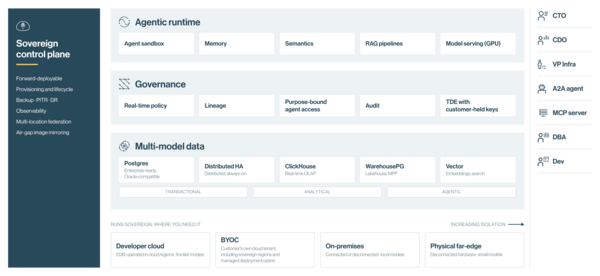
Figure 3. EDB's AI Data System Architecture. EDB's architecture brings specialized data engines, governance, and agentic runtime capabilities together under a sovereign control plane, with deployment options spanning cloud, customer-controlled environments, and on-premises infrastructure. The diagram shows EDB's system strategy with individual capabilities and integration depth to evolve. Source: EDB.
That approach builds on EDB's open-source roots. Postgres handles transactions/operational state, ClickHouse supports real-time analytics, and WarehousePG handles historical analysis. EDB provides the engineering and operational support to bring them together. The individual technologies are proven. Common management and governance across engines are still evolving.
Figure 4 compares EDB's approach with other architectures competing for enterprise data and AI workloads.
|
Architecture |
What it prioritizes |
Buyer advantage |
Buyer tradeoff |
|
Coordinated engines (EDB) |
Multi-model data layer that integrates open source, specialized engines, and customer- controlled infrastructure |
Workload flexibility, specialized engines, simplified management & deployment choice |
Cross-engine integration and governance still evolving |
|
Lakehouse- centered (Databricks) |
Analytics and AI with growing transactional capabilities |
Simpler, integrated data and AI environment |
Platform dependence; transactional integration & performance maturing |
|
Converged engine (Oracle) |
Multiple workloads within one database engine |
Consistency and integrated controls |
Greater dependence on one database ecosystem |
|
Cloud-service portfolio (MSFT) |
Broad managed services across Azure and Fabric |
Extensive capabilities and managed operations |
Integration and governance across service boundaries |
Figure 4. Architectural Choices for Enterprise Data and AI: Different architectures force different potential tradeoffs in integration, operations, and control. Workload requirements and the enterprise's existing systems would drive enterprise choice.
For CIOs and CDAOs, EDB offers a way to extend existing operational infrastructure without committing every workload to one cloud platform. That can be attractive for organizations with significant Postgres or operational database investments, requirements for platform optionality, complex/hybrid deployment environments, or requirements to control where data and applications run.
The decision comes down to what the enterprise wants to manage itself, what the vendor can take off its plate, and how easily the architecture can adapt as requirements change. EDB's opportunity is to reduce the work of operating specialized engines together while preserving that flexibility.
Operational AI Without Rebuilding the Data Estate
Most large enterprises already run a mix of operational databases, streaming systems, warehouses, lakehouses, and AI platforms. They also have years of business logic, integrations, and skills invested in those systems. Those investments aren't going away simply because vendors are converging.
At Constellation Research, we're seeing CIOs and CDAOs focus on modernizing business processes and putting AI into production without rebuilding their data estates. That creates opportunities to bring related workloads closer together while retaining rather than replacing shared enterprise platforms. For example, a retailer could extend its Postgres implementation and combine Postgres transactions, real-time inventory analytics, and AI-driven decisions and actions, while continuing to use its enterprise lakehouse for broader forecasting and reporting.
In the near term, EDB can build on its existing support for hybrid deployments and specialized data engines. Enterprises can already combine Postgres transactions with ClickHouse real-time analytics backed by enterprise support and flexible deployment options. Enterprises could assemble these technologies themselves or extend their existing cloud data platforms. The acquisition gives EDB more engineering and operational capabilities to support these workloads together, while keeping the flexibility of an open-source approach.
The next, longer-term phase of EDB's strategy is to make its coordinated AI data system easier to operate as a whole. Building on existing support for specialized engines and hybrid deployments, EDB plans deeper integration of management, governance, and analytical data access across Postgres and ClickHouse. Altinity's Project Antalya extends ClickHouse to work with Apache Iceberg-based data lakes, creating opportunities to share analytical data across engines, improve performance, and reduce storage and operating costs. While EDB's cross-engine integrations continue to evolve, the direction is clear: let enterprises use the right engine for each workload while reducing the effort of bringing operational data, analytics, and AI together without replacing what already works.
The potential advantages would be faster deployment of operational AI, less integration work, and greater control over where data and AI run. However, EDB will need to demonstrate those benefits across production workloads over time.
For CIOs and CDAOs, the larger question is how to modernize incrementally while building towards and maintaining common governance and operational accountability across the enterprise.
MyPOV
EDB's acquisition of Altinity reflects a broader shift in enterprise data and AI infrastructure. As vendors converge on more workloads, five implications stand out.
1. AI initiatives will increasingly drive data-platform investment
As AI initiatives move from chat and content generation to automating business processes, more data investments will follow initiatives requiring current operational data, real-time insight, and reliable execution. Centralized platforms will remain important, but the majority of new funding will be tied to measurable business outcomes that will require business process change and associated data, real-time insight, and automation rather than just platform modernization.
2. Workload breadth won't win the platform battle. Operating simplicity will
Supporting transactions, analytics, and AI creates more complexity for customers. Adding engines or consolidating vendors doesn't necessarily reduce it. EDB's acquisition of Altinity makes sense if its engineering and operations expertise can reduce the cost, risk, and effort of running those workloads together. Expect other vendors to try to solve the same operational problems starting from their architectural centers of gravity.
3. Architectural flexibility is becoming an economic consideration
Data infrastructure investments last for years, while AI requirements, cloud economics, and regulatory obligations can change quickly. It is no accident that over 85% of enterprises cite open-source support as important to their AI strategies to protect themselves from technology and standards change. EDB's open-source and customer-controlled approach gives enterprises more options, but like any open-source provider, EDB’s options have a cost. Buyers should compare the value of flexibility against the integration and operating advantages of managed cloud platforms.
4. Platform convergence will make enterprise interoperability more important
As vendors combine more capabilities, enterprises will still operate multiple operational databases, analytical platforms, and AI services. EDB's success will depend not only on simplifying the operation of its own solutions, but also on how well its system works with broader enterprise investments. Common interfaces, business context, and orchestration across platforms may become as important as integration within them.
5. AI execution will push governance beyond data access
As agents act on business data, database permissions and access control are not enough to decide whether an action is authorized. EDB's investment in database-level access controls, enterprise security extensions, and purpose-built AI-agent governance enforcement provides the core governance. The ability to determine whether an agent/individual has the authority to make a decision or take an action is increasingly spanning applications and business process domains. CIOs, CDAOs, and business owners will have to define policies and accountability that cross those boundaries.
What Should Enterprise Leaders Do Next?
Three questions should guide near-term investment decisions.
1. Where does bringing workloads together improve the business? Start with processes where delays/drops between operational data, analytics, and action affect cost, revenue, or customer experience. Prioritize which workloads need to work better together before investing in broad platform convergence.
2. How much work will the vendor actually take off your plate? Having more capabilities under one vendor doesn't necessarily make them easier to run. Compare what it takes to integrate, secure, upgrade, and recover the complete system, and determine what the vendor manages versus what remains your responsibility.
3. What happens when requirements change? Prioritize architectures that work with existing systems and allow workloads to move as needs evolve. Weigh that flexibility against the simplicity and cost advantages of cloud or other managed platforms.
EDB's acquisition of Altinity strengthens its engineering and operational capabilities to support AI-driven workloads without requiring customers to replace existing infrastructure. For enterprises already invested in integrated cloud platforms, extending those environments may still be the simpler and more economical choice. EDB offers an alternative for organizations that value specialized workloads, open-source flexibility, and greater options/ control over how and where it's deployed.
EDB doesn't need to replace the enterprise data platform to win. It needs to make operational AI easier to deploy and run where existing platforms fall short. Altinity gives EDB more of the engineering capability to make that possible. The proof will be in how much complexity EDB removes versus how many engines it brings together.
Michael Ni is Vice President and Principal Analyst at Constellation Research, covering the evolving Data-to-Decisions landscape—where CDOs, CIOs, and CPOs must modernize data infrastructure, integrate AI into decision-making, and scale automation to improve business outcomes. Ni’s research examines how enterprises operationalize AI, automate decision-making, and integrate data management and analytics into core business processes. He focuses on the challenges of scaling AI-driven decision systems, aligning data strategy with business goals, and the growing role of data and decisioning “products” in enterprise ecosystems. With 25+ years as a product and GTM executive across enterprise software, AI platforms, and analytics-driven technologies, Ni brings a practitioner’s perspective to…...
Read morePublished
Author