


Zillow bets on content, context, data flywheel as AI differentiator
Zillow is betting that AI is going to be a boon to its business both internally and for customer experiences due to a hefty dose of proprietary data, context and the ability to tailor its own large language models.
At an AI day for investors, Zillow executives outlined their AI plans and the company's data moat. Like enterprise software companies, Zillow shares have been caught in a downdraft over concerns about Anthropic. The general idea is that AI agents will find you a house and proceed through a transaction.
The problem with that theory is that real estate transactions are complicated, messy and have multiple moving parts. Even without agentic AI fears, Zillow faces tough competition from players like Rocket, which provides mortgages and services and recently acquired Redfin to complete its own data flywheel.
- Rocket Companies’ genAI strategy: Playing both the short and the long game
- Rocket buys Redfin, pays $437.5 million per petabyte of data
- AI? Whatever. It's all about the first party data
- Enterprises leading with AI plan next genAI, agentic AI phases
"When we have the data and user intent we have and you think about the models we're building and training, who's going to build the best personalization? The ones who will build the best models to drive experiences are the ones that have the expertise and data do that in context," said David Beitel, Zillow's chief technology officer.
Zillow is building a feature called Zillow AI mode that is designed to help both consumers and real estate agents remove friction from real estate transactions. Zillow executives see context and content as their differentiator. On a roughly three-hour investor presentations, Zillow executives said context 24 times, content 39 times and data 72 times.
The message from Zillow is simple: It has its data flywheel running and that means its tailored approach to AI models will trump horizontal players. Zillow also has 235 million unique visitors to its sites and apps and 80% of that traffic is direct to research buying homes and rental properties. Zillow also provides back-end systems to real estate agents so it touches multiple points of a transaction.

Jeremy Wacksman, CEO of Zillow, said:
"Once you operate across the entire transaction, you get something incredibly unique and valuable, data that compounds. We don't just see the search or the initial question you ask. We see the tours you take. We see the affordability data you're using. We see the conversations you're having with your agent, the offers you make, the homes you close on. All of that data, proprietary data and context about our buyer, sellers and our professionals is context. And that context is what allows Zillow to build a far more powerful AI experience than any horizontal LLM can deliver for real estate.
That context is a feedback loop. The more people that use it give us more context about themselves and their professionals that feed the system. That is not something that is theoretical. That works in our system today."
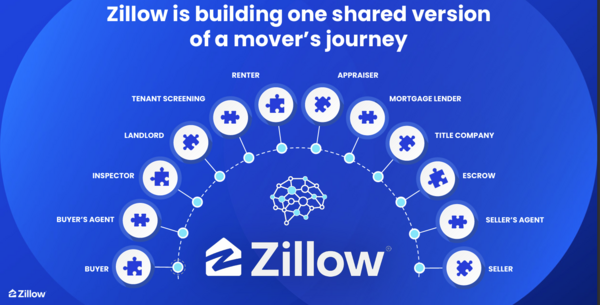
Content and context
Wacksman said Zillow's secret sauce is its ability to see signals in a real estate transaction. A buyer or seller using Zillow has been scrolling for months and saving homes. They've been comparing neighborhoods, checking mortgage rates and Zillow's Zestimate. Renters have taken a similar route.
According to the company, 70% of everyone who buys and sells a home in the US uses Zillow during the transaction process. Buyers spend two to three hours a week over 5 months.
Ultimately, these top-of-funnel real estate players look for actions to take and Zillow can act on the intent signals. "Only Zillow can see things like all the homes you've saved and viewed and the ones you're coming back to every day signaling intent," said Wacksman, who said Zillow also sees available tour times on listings, what's available and reviews.
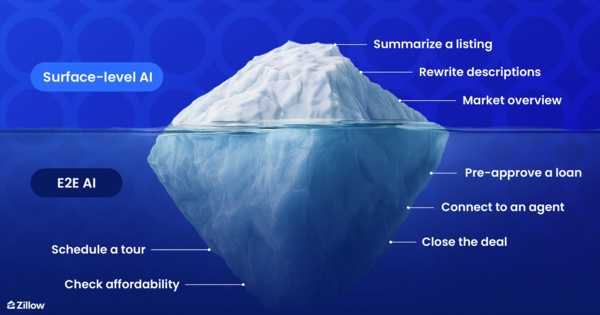
"We can guide and help consumers take action from understanding what a home might appraise for to gauging real-time demand to understanding why this Zestimate is what it is, to helping someone decide if they're financially ready to transact. And we don't stop at guidance, we help them take action, booking an instant book tour, getting preapproved, hiring an agent. That guidance -- that strategy only works if you have the full advantage of the category. You need live housing data, the content. You need all of that consumer behavior, the context, and you need to be an end-to-end platform, the transaction infrastructure," said Wacksman.
Wacksman said Zillow's bet on immersive media and content provides a better consumer shopping experience but also drives insights. That content and the data from it will help Zillow build its AI experience since the company can use data on layout, room flow and lighting to couple with accurate square footage to train models.

On the backend, Zillow has a CRM system for its Zillow Premier Agents that has 100,000 agents using it. Wacksman said the company has been layering AI-powered workflows into its CRM systems. Real-time tour customers convert 3x the rate of normal customers and preapproved buyers on Zillow Home Loans convert at a 5x clip.
"When you integrate the shopping behavior, the touring data, the CRM data, the financing data, the transaction data, you create context that differentiates Zillow and value that only we can deliver. Sustained intent combined with proprietary rich media, provides an AI platform that is directly integrated into the rails of the industry," said Waxman.
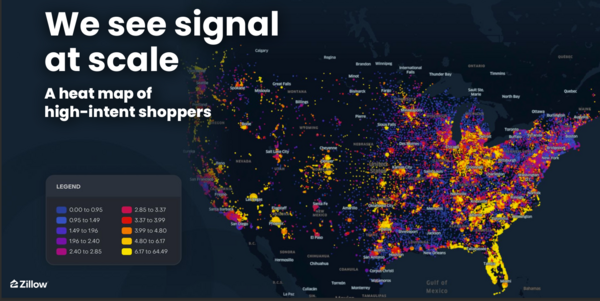
Does Zillow have a moat?
Wacksman said the data flywheel and complexity of a real estate transaction serve as natural moat. That moat isn't foolproof but does give Zillow an edge. "We are doing this in arguably the most regulated and complex category in the country. Structural complexity in housing shapes how AI can even operate. In fact, we must have licensed brokerage relationships in all 50 states just to get listings, let alone answer questions that require a license to properly answer," said Wacksman. "The volume of complexity in this category is staggering. Every state is unique in regulation. There are hundreds of thousands of brokers working across over 500 MLSs, powering 1.5 million agents to do transactions."
Cynthia Taylor, Senior Vice President of Product, said generic LLMs won't be able to answer questions that look like agency or fiduciary guidance or brokerage activity due to licensing. In addition, the real estate market is fragmented and few platforms have it the whole picture of buyer intent.
The AI strategy
Zillow executives laid out multiple AI efforts to improve efficiency for the customer journey as well as internal operations. "AI is accelerating our strategy to become the housing operating system of choice," said Wacksman. "Consumers and industry professionals choose Zillow. And agentic AIs will need to choose Zillow because we sit at the center of it all."
Taylor said Zillow's AI strategy is to leverage its "unified intent layer" to create product experiences that remove friction and anticipate a buyer's next steps. Like most AI strategies, Zillow's journey all starts with data.
"Zillow is building one shared version of the deal across the entire Zillow professional ecosystem. These are the products that hundreds of thousands of real estate agents use daily. One identity layer, one deal object, one contact model, one document system. And what this allows Zillow to do is it allows Zillow to paint a picture into the deal and have one version of the truth," said Taylor. "When this content, context and integration are in the same system, the experience deepens in a meaningful way for our consumer and our professional customers."
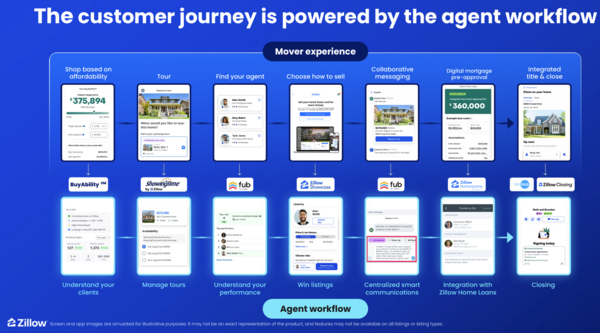
This approach to data and AI is beginning to show up in Zillow's products. Along with its AI day for investors, Zillow has recently announced the following:
- A new personalized AI mode allows movers to research homes, understand affordability and explore neighborhoods within Zillow. When consumers are ready to take next steps, Zillow connects them to a real estate agent. The model behind Zillow's AI guide is customized for real estate and routes intent across the company's ecosystem.
- SkyTour, Zillow feature that uses drone footage and AI to provide an external view of properties and the surrounding neighborhood.
- AI enhancements to virtual tours. Zillow added new AI image processing and navigation updates to Zillow 3D Home tours and interactive floor plans.
Nicholas Stevens, Vice President of Product at Zillow, said the company has 300 people building AI-driven experiences. Stevens said Zillow is building AI experiences that go beyond surface-level questions. "It's an incredibly hard challenge because if you make up any of the answers, if you get anything wrong, if you give the wrong guidance, that's an incredibly trust-busting moment. You need the AI to join the customer where they are in the trenches and really make sure it's appropriately guiding and directing, just like any good confidant would," said Stevens.
Stevens said generic LLMs can find homes, but once consumers need to go deeper, they usually hand off to Zillow. "AI with content, with context about the users and professionals and with integration, end-to-end integration, that's what closes the loop," said Stevens.
In a demo, Stevens showed AI mode in Zillow and a customer was having a conversation with Zestimate and asking questions. "With AI mode, we can actually have that conversation based on all the data that Zestimate uses behind the scenes," said Stevens.
For real estate pros, Zillow is working across its product portfolio such as Zillow Pro, Showcase and Follow Up Boss to layer in AI tools to automate workflows. AI is used to draft content, message clients, update customer profiles, surface signals to sellers and analyze documents.
The tech stack bets on AWS
In its annual report, Zillow said it primarily relies on Amazon Web Services, the company's preferred cloud provider, for its compute and storage.
Zillow has adopted a strategy that uses AWS at its core to scale storage, compute and delivery as the company focuses on its data moat. In many respects, Zillow is a data products company that relies on an AWS-native machine learning stack.
Here's a look at Zillow's AWS stack as detailed in blogs and multiple re:Invent appearances.
- Storage and data lake leveraging Amazon S3 and Amazon Kinesis Firehose for streaming and ingestion.
- Serverless compute with AWS Lambda.
- Various Amazon databases including DynamoDB and Keyspaces.
- Observability via Amazon CloudWatch.
- Amazon SageMaker for model training and inference.
Zillow has detailed its data streaming architecture and noted in a blog post that Amazon S3 is its persistent storage and the company has created a hub for all data streams called Zillow Data Lake. "Our Data Lake stores all historical data so it can be consumed by our data processing engine, Apache Spark, to run our complex machine learning algorithms. It can also be used by other teams at Zillow Group, including Premier Agent, StreetEasy, Trulia and dotloop," said Zillow.
Internally, Zillow is leveraging multiple AI code tools. "There's a lot of people that are using Replit, which is basically a non-developer vibe coding tool to express their ideas. All the developers use Cursor and Claude Code or ChatGPT or Gemini. Those gains are real, and we're moving as fast as we can to become what we call an AI native company," said Lloyd Frink, Co-Founder, Co-Executive Chairman & President.
And there's a healthy dose of co-opetition but that doesn't preclude Zillow from partnerships. Horizontal players like Google have always been a threat to Zillow and a partner. OpenAI and Anthropic fall into the same category. "These large LLM, horizontal LLMs are quite excited to partner with us, and we are going to go meet our customers wherever they are. So, they're there and we're going to be there," said Frink.
Larry Dignan is Editor in Chief of Constellation Insights at Constellation Research, where he leads editorial coverage focused on enterprise technology, digital transformation, and emerging trends shaping the future of business. He oversees research-driven news, analysis, interviews, and event coverage designed to help technology buyers and vendors navigate complex markets with clarity and context. ...
Read morePublished
Author
