


SpaceX’s Q2 takeaways: Rocket building knowhow translates to AI data center efficiency
SpaceX’s second quarter featured better-than-expected results and CEO Elon Musk’s big theme was that rocket science applies to multiple markets including AI.
“Terrestrial data centers are a trivial problem compared to making gigantic reusable rockets and which are launched frequently, and the Starlink satellites also are like alien-level technology,” said Musk, who said SpaceX is taking a small amount of engineering knowhow and applying it to new markets.
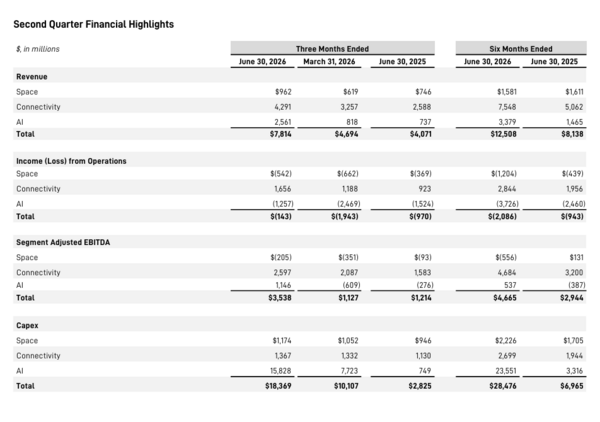
SpaceX reported its second quarter results, its first since launching its IPO. The company reported a net loss of $541 million on revenue of $7.8 billion, up 92% from a year ago. The company said it is looking to close its Cursor acquisition in the third quarter.
- SpaceXAI, Meta puts pricing squeeze on Anthropic, OpenAI
- SpaceXAI launches Grok 4.5
- SpaceX buys Cursor
- SpaceX's worth $2 trillion: Do you believe in space data centers, xAI's potential?
- Google to rent 110,000 Nvidia GPUs from SpaceX
The company said that it ended the quarter with 12 million Starlink subscribers. SpaceX said its AI revenue was $2.6 billion, largely due to revenue from cloud computing deals. In addition, SpaceX said it is working to design the Starmind AI1 satellite with Nvidia. Each Starmind satellite will include Nvidia Rubin GPUs and Vera CPUs.
Musk said SpaceX is gunning for $1 trillion in revenue by 2030, up from the 2031 previous projection by the company, and there's a non-zero chance that revenue target is hit in 2029.
Time will tell if Musk will be on target, but there were multiple takeaways from the earnings call to ponder.
SpaceX is going to fund its AI capital expenses in part via cloud services. CFO Bret Johnsen said:
"We continue to see robust demand in all three of our business segments, but in particular in our cloud services arrangements. We see increasingly favorable economics with each agreement we sign, and we expect the supply-demand imbalance in the compute market to continue. The current economics have translated into a less than one-year payback on our new capital deployments for compute. For example, in the first few weeks of the third quarter, we've already contracted an additional $6.7 billion of cloud services revenue over a six-month period that begins ramping starting in October of this year. We believe this puts us on a trajectory, including contribution from Cursor, to reach $100 billion of ARR or annualized revenue run rate by the end of this year, based on our expected revenue in the month of December of this year."
Musk said the “$100 billion in ARR in December is not a question mark. That’s what we would achieve if we basically did nothing.”
SpaceX sees itself as an enterprise player, especially for Starlink. Government, maritime, airlines and other industries are looking toward Starlink. Gwynne Shotwell, President of SpaceX, said:
"Enterprise revenue is quite sticky. We have never lost an enterprise customer. They're quite happy with the Starlink capability that we have right now. I'm quite bullish on enterprise, very bullish on government, and quite happy with the stickiness that we've seen in those markets."
Musk added:
"In order to secure a large amount of enterprise revenue, you have to demonstrate very high reliability, very high uptime, and in the early days, Starlink did not have high uptime. Most enterprise customers had a Starlink experience where it was a little patchy. We're building up a large enterprise sales team just to go out there, meet with enterprise, corporate and government customers and show them the incredible uptime and low latency of the Starlink system today. I would expect enterprise revenue to substantially exceed consumer revenue."
Starlink's new satellites will deliver more bandwidth. "Starlink V3 satellite is about an order of magnitude more capable than the Starlink V2 satellite, which was already a very capable satellite," said Musk. "We expect to launch about an order of magnitude more Starlink V3 satellites. So that that would mean a roughly quarter of magnitude increase in the delivered bandwidth. Even if our monetization per bit dropped by a factor of 10, that would still mean a 10x increase in the revenue of Starlink. I think people are really underestimating Starlink here."
Musk added that it expects Starlink to deliver the bulk of bandwidth for humans, AI and robots.
Starship is critical. Musk said the company has completed two successful flights of Starship in the past 90 days. Starship will be able to move more tonnage into space. Musk said:
"Right now, we deliver roughly 2,500 tons a year to orbit via Falcon, and this is a big number by normal standards. We deliver 80% to 90% of total Earth mass to orbit per year with Falcon. Now, with Starship, our aspirations are to deliver well over a million tons to orbit per year, and probably ultimately 10 million tons per year."
Grok 5 will include all of the SpaceX data. "Grok 5, which should be out before the end of this year, will be incorporating the entire corpus of SpaceX data, basically all the data that SpaceX has ever produced. We think this will make Grok by far the best engineer," said Musk.
SpaceX is standardizing on Nvidia. The data center business will have about 2 GW of compute by the end of the year and going forward it will be based on Nvidia. "We've decided to build exclusively on Nvidia. This new capacity coming online will obviously both benefit the development of Grok as well our Cursor acquisition, which should close quite soon," said Musk. "Our understanding with Nvidia is that we will receive a very significant percent of their GPUs next year."
Server designs will be built for Earth and space. Musk said racks will be designed to house an optimized Nvidia Vera Rubin system. SpaceX is creating its own design to simplify standard racks. "We expect to actually deploy this on the ground as well as in orbit because we think it's going to be a radical simplification of the normal Nvidia rack, it will cost less. It'll be more effective, and so if we're going to put it in space, why not put it on the ground?" said Musk.
SpaceX is focusing on power and cooling equipment over GPUs for its AI buildout. "Our tentative target is to actually have 20 gigawatts of the power and cooling level online by the end of next year. I don't think we're going to achieve 20 gigawatts, but we want to have a series of projects that cumulatively come to 20 gigawatts by the end of next year. Some of them won't pan out exactly on time, but I would expect that we still probably have at the at the power plant level something close to 15 gigawatts," said Musk. "Our goal is to have far more power, cooling, and electrical equipment than we have GPUs. That's the logical thing to do given the relative expense of GPUs versus balance of system. SpaceX, as a company, is incredibly good at hardware. We're taking a small amount of the expertise that we use for rockets and satellites and applying that to scaling terrestrial data centers, and we're finding that even a small amount of what we've learned building rockets applied to data centers yields tremendous benefits."
Larry Dignan is Editor in Chief of Constellation Insights at Constellation Research, where he leads editorial coverage focused on enterprise technology, digital transformation, and emerging trends shaping the future of business. He oversees research-driven news, analysis, interviews, and event coverage designed to help technology buyers and vendors navigate complex markets with clarity and context. ...
Read morePublished
Author
