


General Mills bets on AI, supply chain redesign to drive $3 billion in savings
General Mills is planning to save $3 billion over the next four years via technology modernization and redesign its supply chain to offset inflation, fund growth investments and grow earnings and cash flow over time.
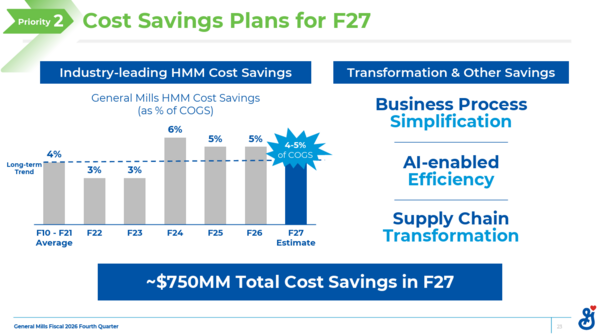
Of $3 billion in savings, General Mills is looking to deliver $750 million in fiscal 2027. The consumer goods products company is facing multiple challenges amid changing tastes, blowback from price increases and longer-term trends such as GLP-1 drug use that's altering food consumption. General Mills' brands include Cheerios, Nature Valley, Häagen-Dazs, Annie's and Old El Paso for humans and Blue Buffalo and Tike Cat for pets.
General Mills delivered fiscal 2026 revenue of $18.42 billion, down 5% from a year ago, with a net loss of $88 million. During General Mills' fourth quarter earnings call July 1, CEO Jeffrey Harmening said the transformation efforts are a part of a two-step process for the company.
"The first thing we had to do was to get our base pricing back in line, not necessarily equal competition or anything like that, but really making sure we are under key price cliffs and price thresholds," said Harmening, who added that the job now is to improve brand communications, packaging and innovation.
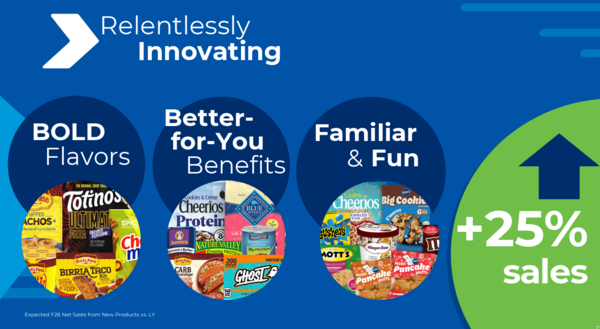
Next up for General Mills is to use data to capitalize on major trends and leverage technology such as AI to improve margins and profits. The big trends are a growing consumer base over 55 years of age, pet humanization and value and convenience. "E-commerce is kind of the new convenience. We know consumers care a lot about value, which is why the base pricing worked so well last year. They care about health, and now it's really all about protein. And the question is how long will all of these things last? And the answer is really kind of unknowable in a volatile environment," said Harmening.
General Mills has launched Cheerios Protein, bold flavors for Chex Mix and new versions of pet food to court consumers. Dana McNabb, COO and group president of North America Retail and North America Pet, said the company has to start with the primary goal of restoring profitable organic sales growth via a productivity program called Holistic Margin Management (HMM) and a broader transformation effort.
Of the $3 billion in savings, $2 billion will come from HMM and another $1 billion will come from a global transformation effort. McNabb said the transformation initiative is "really about improving our end-to-end business processes and identifying new ways of working when you think about new tools, technology, operating models to be more agile."

McNabb said General Mills is focusing on its supply chain. "Our supply chain is the best in food, very good at what they do. But our supply chain was also built for a different time, a little bit lower in volume. We've seen that we need faster innovation, more packaging flexibility. And so, it's really about thinking how do we reimagine the supply chain for the future so we can get that profitable growth," said McNabb.
She said the supply chain overhaul is in its early phases and General Mills will share more details in the future.
The foundation
During an October 2025 investor day, General Mills executives laid out the case that the company can accelerate its savings. For the last five years, General Mills has been setting up its data and technology foundation including a move to cloud computing.
Jaime Montemayor, Chief Digital & Technology Officer, walked through the pillars that have set up its next phase.
Since 2021, every technology deployed by General Mills has run in the cloud. "This cloud foundation that we have built has given us the opportunity to change the physics in how we deliver technology solutions across General Mills," said Montemayor.
Google Cloud is the lead provider of cloud infrastructure and data lake migrations at General Mills. General Mills is using Google's AI models.
General Mills also created a Connected Data Foundation that started in the supply chain and expanded.
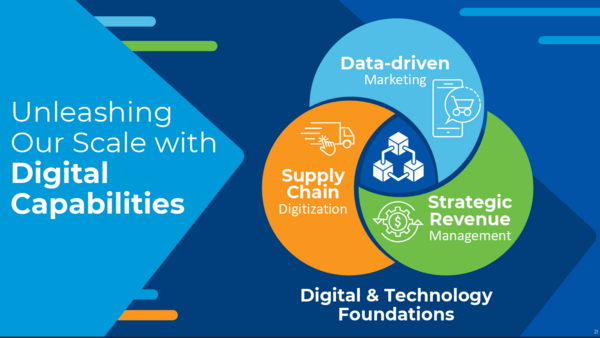
The company also completed an upgrade of its core SAP systems to SAP S4/HANA. Montemayor said: "We've completed the upgrade of SAP into S4, and thankfully, you didn't have to hear that from me or anybody in the company because the program went as planned with no disruption to our business or any of our customers."
Agile processes. Montemayor said the company has adopted agile processes to speed up delivery. He added that General Mills also focused on data governance. "Our data is perhaps as clean as it needs to be for us to accelerate AI investments," said Montemayor.
Supply chain efforts
Paul Gallagher, Chief Supply Chain Officer at General Mills, said during the October meeting that the company has retooled its approach to data governance and that base gives it the opportunity to redesign over time.
"It's not just the master data that goes into our SAP system. It's also our operational and our transactional data. And to bring that to life for you across our supply chain, we sit at about 96% to 97% data accuracy," said Gallagher. "We have one version of the truth."
General Mills has leaned into "letting the data make the decision," said Gallagher, who noted that dashboards only go so far. A few examples:
- Smart contract management with suppliers.
- Forecast improvements driven by data signals.
- Retooling process streams in manufacturing to improve efficiency. "We've got proprietary algorithms that run on top of the data dynamic set through sensing that's allowing us to realize dynamic opportunity across our manufacturing. And we've really only started in that space. And where we've actually driven it across a number of our facilities, it's generated over $40 million so far. So, we think there's a healthy pool of opportunity in that space going forward," said Gallagher.
- Tying supply chain advances to the customer.
Gallagher said:
"With one of our biggest retailers, we're talking system to system in our customer order taking and optimizing our truck utilization, which was a healthy pool of opportunity for us. We affectionately call that Project ELF, which is end-to-end logistics flow, where we're using not just machine learning and AI and GenAI, but facilitating Agentic AI on top of the opportunity to drive not just millions of dollars out of that supply chain, but also it's taken over to date 15,000 tons of carbon because we have less trucks on the road. It's enabling us to deliver a better service offering. And what used to take us 18 hours to go through those orders and optimize those orders to get truckloads is now taking us less than 30 minutes."
Tying experiences and growth to AI
Lanette Werner, Chief Innovation, Technology and Quality Officer, said her group's goal is to combine science including data, digital and AI and experiences.
"We also aspire to be a digital-first organization and its simplest embodiment, what we mean is how do we digitize, how we experiment first and then validate physically when needed," said Werner.
General Mills has a unit called Growth Labs that revolves around a process to generate growth ideas and then create experiences with digital tools. Growth Labs uses visualization tools to create and iterate hundreds of visual prototypes before making a physical. Werner said the process has "substantially increased our learning velocity."
"We are also using digital personas to gain feedback on all those great ideas that we're generating. And this year, we partnered with our sales organization to create buyer customer personas to really supplement our learning and get these teams learning in real time on what we might expect from our customers," said Werner. "We are also leveraging AI-moderated research platforms to literally conduct hundreds of consumer interviews overnight. And we're doing this with always-on chatbot interviewing, really helping us to drive new insights at the pace of learning and integrate those into our learning plan so that we can be testing the next iterations as we learn."

Other projects from General Mills Growth Labs include:
- General Mills oat breeding program uses advanced machine learning to predict traits before seeds are planted.
- The company is using satellite imagery for regenerative agriculture and understand and model greenhouse gas emissions and outcomes from various programs.
- AI deep research tools to harvest the volumes of technical data available at the company.
- Data is also being leveraged in packaging and real-time sustainability tracking.
The secret sauce for General Mills will be partnering across functions to drive results. Werner said Growth Labs worked with Gallagher's supply chain organization on predictive models and real-time data to optimize cereal line speeds. "We are combining a physics-based twin model with our control systems and some in-line sensors really to create a foundation that we know we can redeploy across other platforms such as pet," said Werner.
In addition, General Mills is modernizing its product lifecycle management system to streamline product formulation changes and improve data accuracy and traceability. "It's really helping to get more of our data connected end-to-end. And it's resulted in about a 25% reduction in touches when we go in and have to make a change and also time savings in our conversion of specs and specifications that come from my world and how we translate those into bill of materials at our plants," said Werner.
Larry Dignan is Editor in Chief of Constellation Insights at Constellation Research, where he leads editorial coverage focused on enterprise technology, digital transformation, and emerging trends shaping the future of business. He oversees research-driven news, analysis, interviews, and event coverage designed to help technology buyers and vendors navigate complex markets with clarity and context. ...
Read morePublished
Author
