



Executive Summary
Autonomous IT Platforms represent the next stage in the evolution of observability and AIOps. As IT environments have become more distributed, dynamic, and software-driven, visibility alone is no longer sufficient. Organizations need platforms that can observe what is happening, determine what matters, explain why it matters, and support timely and safe operational action.
These platforms combine core observability capabilities, such as collecting and correlating logs, metrics, traces, and events, with AIOps capabilities that apply analytics and machine learning to reduce noise, detect anomalies, and identify probable root causes. Increasingly, they also support AI-assisted SRE and operations workflows, where natural-language interfaces, guided analysis, and automated runbooks help teams investigate incidents, assess impact, and decide on next steps more efficiently.
Autonomous IT Platforms reflect a shift from reactive monitoring to more adaptive, resilient operations. Early use cases focus on assisted incident response, operational intelligence, and reduced manual toil for SRE and IT operations teams. Over time, these platforms are expected to support more closed-loop scenarios, where detection, diagnosis, and selected remediation actions occur with minimal human intervention, guided by policies, approvals, and operational guardrails. As organizations adopt SRE, platform engineering, and AI-assisted operations, Autonomous IT Platforms are becoming central to scaling reliability and operational consistency.
Threshold Criteria
Constellation considers the following criteria for these solutions:
Core Capabilities
- Unified observability across logs, metrics, traces, and events
Platforms must ingest and correlate multiple telemetry types to provide a consistent, service-centric view of system health and behavior. - Native AIOps capabilities for signal analysis
Support for anomaly detection, alert correlation, noise reduction, and probable root cause analysis across distributed systems is required. - Dependency and service mapping
Platforms should model relationships across applications, infrastructure, and services to support impact analysis and faster diagnosis. - Real-time monitoring, dashboards, and alerting
Operational teams need live visibility, configurable thresholds, and timely notifications to respond to issues as they emerge. - AI-assisted SRE and operations workflows
Support for guided investigation, natural-language interaction, and contextual insights that help SRE and IT operations teams understand incidents and coordinate response. - Scalable data ingestion and analysis
The platform must support high data volumes and high-cardinality environments without degrading performance or query responsiveness.
Differentiated Capabilities
- AI-assisted incident investigation and summarization
Advanced platforms use AI to synthesize telemetry, change signals, and historical patterns into clear incident summaries and operational insights for SRE and IT operations teams. - Context-aware operational intelligence
The ability to incorporate change data, service ownership, historical incidents, and operational policies to improve the relevance and accuracy of analysis and recommendations. - Predictive insights and proactive operations
Use of historical and real-time data to anticipate potential issues, surface risks, and support preventive action before user impact occurs. -
Automation and guided remediation
Support for runbooks, workflow integration, and policy- controlled automation that enables faster resolution while maintaining governance and human oversight.
The Constellation ShortList
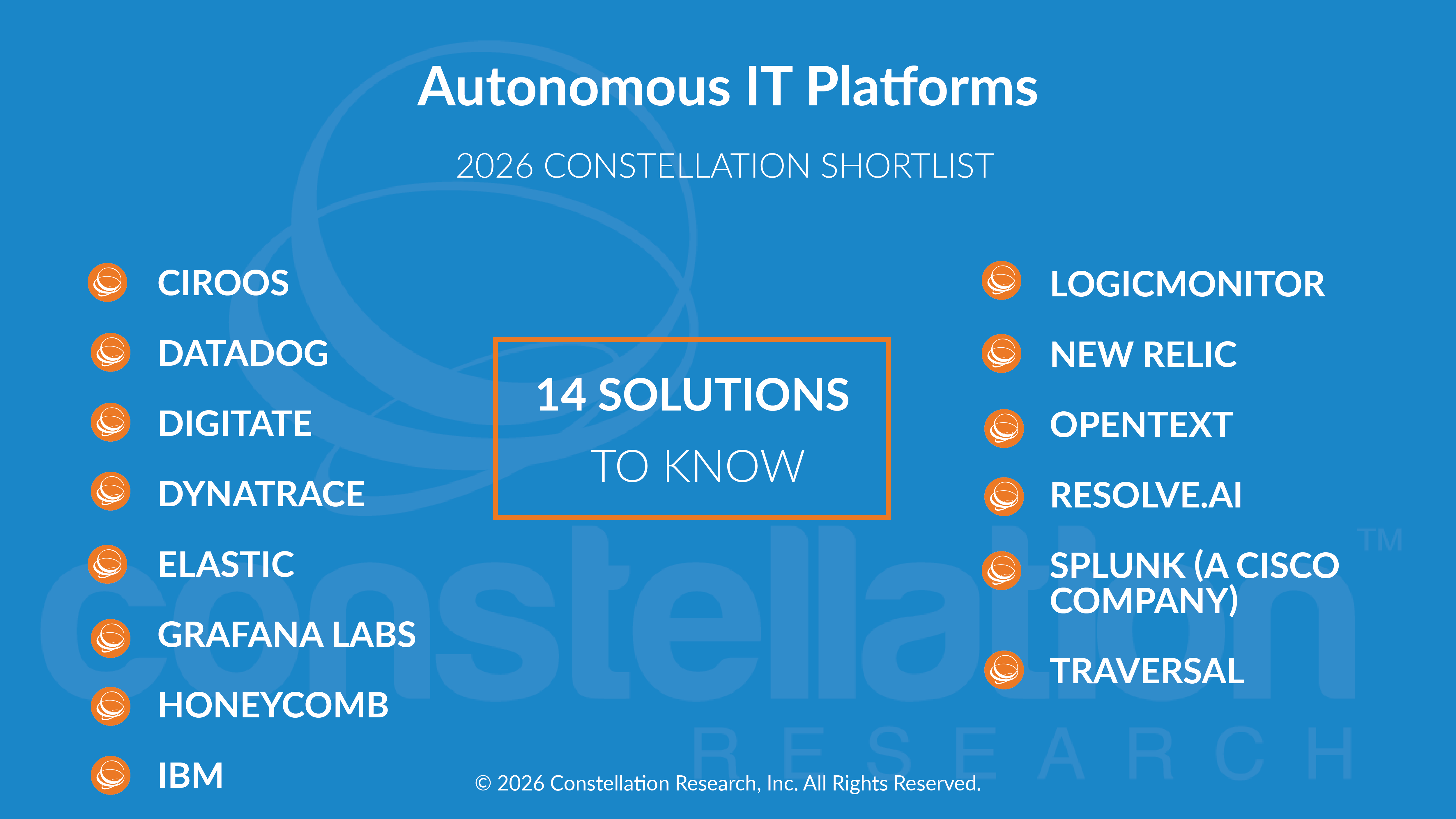
Constellation evaluates more than 35 solutions categorized in this market. This Constellation ShortList is determined by client inquiries, partner conversations, customer references, vendor selection projects, market share, and internal research.
- CIROOS
- DATADOG
- DIGITATE (A TCS COMPANY)
- DYNATRACE
- ELASTIC
- GRAFANA LABS
- HONEYCOMB
- IBM
- LOGICMONITOR
- NEW RELIC
- OPENTEXT
- RESOLVE.AI
- SPLUNK (A CISCO COMPANY)
- TRAVERSAL
Frequency of Evaluation
Each Constellation ShortList is updated at least once per year. Updates may occur after six months if deemed necessary.
Evaluation Services
Constellation clients can work with the analyst and research team to conduct a more thorough discussion of this Constellation ShortList. Constellation can also provide guidance in vendor selection and contract negotiation.