


Will enterprises learn to love Meta AI models again?
Meta released Muse Spark 1.3 and said it improves coding and agentic tasks, promised that Watermelon, an improved model is on deck, and said Muse Spark open weight releases are coming. You can get into performance, prices and nuances of the Muse models, but Meta’s big AI bet will boil down to whether enterprises and developers will trust and adopt the LLMs.
Meta released Muse Spark 1.3 and said it improves coding and agentic tasks. Meta is also keeping its price the same as Spark 1.3. Meta CEO Mark Zuckerberg said the model has "frontier performance almost too cheap to meter." The company also said more powerful models are on deck. What'll be interesting is whether enterprises begin to see Spark as an option.
Zuckerberg knows that the biggest benchmark for LLMs right now is price for performance. If Meta can play the open weight model game and offer its closed models at a competitive price (even if heavily subsidized) enterprises are likely to play ball. One thing is clear: Meta is serious about putting the squeeze on OpenAI and Anthropic.
The hurdle here is whether enterprises will welcome Meta back to the LLM game after Llama. Meta was among the leaders with Llama early in the generative AI race. Hyperscalers added Llama to their selection of models. Then Meta pulled back and revamped with bigger ambitions.
My guess is that Meta will be welcomed back and Spark and its follow-up models will gain enterprise acceptance. Here’s why:
- Enterprises are optimizing AI costs and models.
- LLMs are commoditizing.
- Once Meta drops its open weight versions of Spark, enterprises will be able to fine tune them.
- In the US, Nvidia Nemotron is the open weight family of models being used the most by software companies and enterprises. There needs to be more selection and Meta can fill a gap.
- Given most of the open weight options are Chinese models pushing frontier labs, regulated industries may be more into Meta.
- Meta is motivated since it has nuked its cash flow, went off balance sheet for AI infrastructure funding and needs a monetization path for its efforts. Investors have panned the idea that Meta can monetize AI simply based on its core business. Meta needs a cloud offering or to scale its model monetization via API access and other services.
Snowflake CEO Sridhar Ramaswamy indicated customers are moving more toward arbitrage and optimization with open weight models. He said:
“We are absolutely seeing a lot of interest in being able to switch between different models and also to optimize cost. And this is also where open source models come in. There's obviously been several generations of these open source models, and we support many of them within Snowflake. And yes, we have pretty different economics when it comes to open source models since we run the inference ourselves. So that offers a lot of potential for future optimization.”
In other words, why not Meta? New releases from Google Gemini, OpenAI, Anthropic and open weight models are coming almost daily, but enterprises have little to no loyalty following token budget shocks. Meta has a pretty good shot especially if it can be included in hyperscalers model options, Snowflake and Databricks.
- Open-Weight Models Are Gaining Ground in Enterprise AI
- Get ready for US open LLMs and just in time
- Rightsizing open models may cut your AI inference spend
The Spark 1.3 release
While Meta’s model ambitions need to play out before enterprises buy into them, the progress Meta is making is notable.
Muse Spark 1.3 is performing on par with the leading models from OpenAI and Anthropic on benchmarks. This reality matters since Meta is undercutting OpenAI and Anthropic on price.
Meta added that Muse Spark 1.3 is designed to “to better sustain longer-horizon work by collaborating with users and juggling multiple workflows in a single, long thread.”
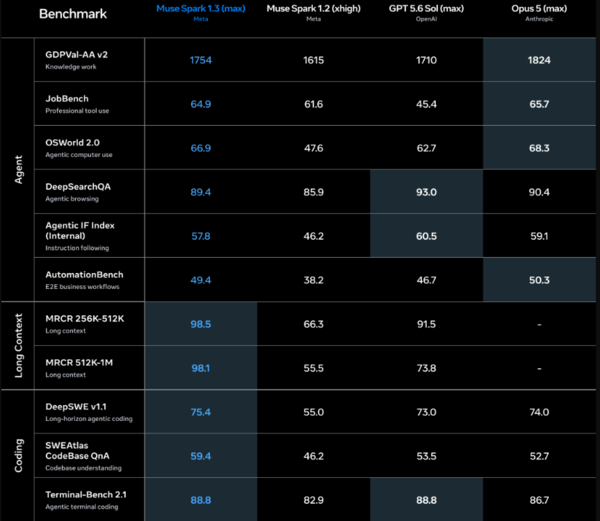
The company also noted that Spark 1.3 uses multiple tools to generate context across disparate sources of data and works in multiple harnesses. That ability fits exactly what enterprises are trying to do daily with AI.
In addition, Meta noted that Muse Spark 1.3 is more efficient relative to Muse Spark 1.2 with 20% fewer tool calls and about 25% fewer tokens.
More Meta:
- Meta Settles Lawsuit to the Tune of $17 Billion: What it Could Mean for Advertisers
- Meta feels the AI squeeze in Q2
- SpaceXAI, Meta puts pricing squeeze on Anthropic, OpenAI
- Meta eyes cloud computing: Here’s the fallout
Larry Dignan is Editor in Chief of Constellation Insights at Constellation Research, where he leads editorial coverage focused on enterprise technology, digital transformation, and emerging trends shaping the future of business. He oversees research-driven news, analysis, interviews, and event coverage designed to help technology buyers and vendors navigate complex markets with clarity and context. ...
Read morePublished
Author
