


Verizon vs. Starlink: It's about AI's edge, last mile
Verizon CEO Dan Schulman weighed in on the potential competition from SpaceX's Starlink and said the assumption is satellite mobile service will become a reality, but it'll take about $300 billion to $500 billion and 7 to 8 years to build a terrestrial network.
Today, the story revolves around Starlink entering the mobile market at some point. Tomorrow, the story will revolve around the last mile of AI workloads.
Schulman addressed potential competition from Starlink on the company's third quarter earnings call. If you back up a few days, SpaceX CEO Elon Musk said Starlink will be a mobile service provider.
Musk disagreed with Schulman and said the effort will take about two to three years.
Aside from the obvious trolling and the SpaceX Starlink question all mobile providers will have to answer the big theme is that sectors are blending together. Large tech players are encroaching into new markets and more competition.
Key Schulman quotes about Starlink include:
- "I operate under the assumption that everything SpaceX says they will do, they will do, and that they will execute flawlessly. We always knew that they needed a terrestrial network to have any chance at providing a competitive service."
- "I don't really need to rereview the satellite beam physics. But just suffice to say that without a terrestrial network, their addressable market for broadband services is relatively small. It's in very rural areas, and their service just can't compete with a terrestrial network. In suburban and urban areas, where like 98% of our revenues are, we're somewhere between 100 to 1,000x more efficient than they are. And when you think about wireless, it's even more difficult with them to compete on a satellite basis."
- "There is no magic wand. There's no secret sauce. There's no shortcut. There's no radically lower structural cost advantage. If they build one, they're going to look at 65,000 to 80,000 macro sites. They're going to need backhaul, some combination of fiber and maybe some satellite. They're going to need RAN. They're going to need a tremendous amount of spectrum. And assuming that's the case and assuming they try to go do that, it's going to take a minimum of 4 to 6 years to fully build that out. It's going to cost hundreds and hundreds of billions of dollars. I assume somewhere between $300 billion and $0.5 trillion over the next like 7 or 8 years. And then they need to build retail customer service, back-office systems, et cetera. And all of that gets them basically the same network and same capabilities and same cost structure as what we have today."
- "It's very hard to throw a punch against something that doesn't exist. But once they come into the market, we will be ferociously competitive."
- "There are no backdoors to any of our MVNO agreements. And I see absolutely no benefit whatsoever to extending an MVNO deal to any satellite provider. I don't buy into the idea of this prisoner's dilemma. That's ridiculous. There is no benefit to Verizon extending an MVNO deal, and we look forward to being able to 4 to 6 years to finally punch back, and we'll punch back hard when that happens."
What's this Starlink fascination with mobile all about?
Now that the jousting is over here's the question that matters: What's this all about? It can't be wireless service because that market simply isn't worth the hundreds of billions of dollars needed.
This wireless scrum, which to date is largely fictional, is about the last mile of AI delivery. That AI inference is likely to be completed at the edge and Verizon has the assets. Think about SpaceX's AI stack and how it has connectivity from its satellites to its data centers to its models. What it lacks is the last mile. There's a puncher's chance that all of this AI factory buildout is replicating a mainframe model. The disruption will be at the edge.
What was lost on the Verizon earnings call was comments about the AI Connect business. Verizon is partnering with the cloud providers including AWS and Google Cloud to deliver AI workloads at the edge. Verizon already has edge centers that are powered up and can be mini AI factories if retooled.
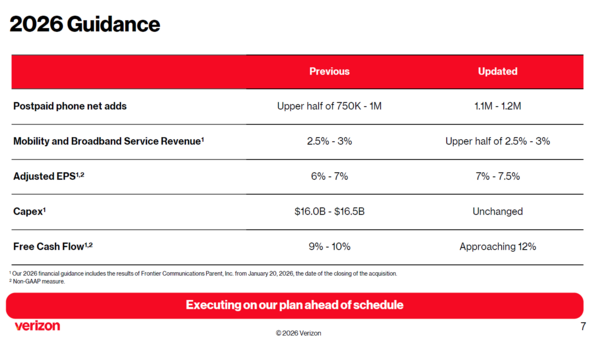
Verizon has $4 billion in signed contracts for its AI Connect offering. "AI Connect is a real business for us and a tremendous opportunity, and we're seeing that momentum. Customer demand across dark fiber, lit fiber, our edge compute locations is exceptionally strong," said Schulman. "The need for distributed inference computing, a move from GPUs to CPUs, like the assets we have for that edge computing are exactly in the right place, and we're seeing a ton of demand for what are scarce assets."
Here's where this will go: SpaceX will simply acquire a mobile provider. If Schulman's estimate of Starlink capex is correct, SpaceX's best move will be to acquire Verizon. Verizon's market cap is a bit north of $185 billion. SpaceX is worth $2 trillion. SpaceX could double Verizon's market cap and still come out ahead on capital spending. Schulman’s comments weren’t trolling as much as they were the start of a negotiation.
Larry Dignan is Editor in Chief of Constellation Insights at Constellation Research, where he leads editorial coverage focused on enterprise technology, digital transformation, and emerging trends shaping the future of business. He oversees research-driven news, analysis, interviews, and event coverage designed to help technology buyers and vendors navigate complex markets with clarity and context. ...
Read morePublished
Author
