


SpaceX's Q3: Musk says it could rent out its AI compute several times over
SpaceX reported better-than-expected third quarter earnings on strength of Starlink and the ramp of its AI business. CEO Elon Musk also riffed on renting out AI compute, Starlink's potential and why merging with Tesla is a good idea.
The company reported third quarter net income of $4.4 billion, or, 35 cents a share, on revenue of $14.57 billion, up 161% from a year ago. SpaceX's other income line benefited from tariff refunds for Starlink, which saw its gross profits double in the quarter.
Wall Street was expecting adjusted earnings of 13 cents a share on revenue of $13 billion.
By unit, SpaceX reported the following for the third quarter:
- The space business had a loss from operations of $7 million on revenue of $1.77 billion.
- Connectivity including Starlink had operating income of $2.37 billion on revenue of $5.25 billion.
- The AI unit, or SpaceX Superintelligence, had operating income of $431 million on revenue of $7.56 billion.
- Capex was dominated by SpaceX's AI business with $16.44 billion in the quarter.
- SpaceX had 113 launches in the third quarter with 13.6 million Starlink customers and 1.7 GW of compute.
- The Superintelligence unit made most of its revenue from Cursor as well as infrastructure as a service.
- Cursor revenue in the quarter was $608 million.
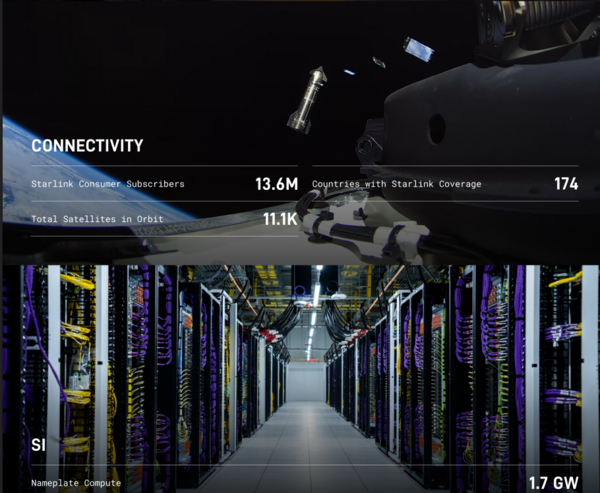
Key parts of the conference call.
- President and Chief Operating Officer Gwynne Shotwell said Starlink will scale "far beyond just human communication." "Connecting cars, robots, and the adoption of superintelligence will increase communication demands not in percentages but in many orders of magnitudes. In the years ahead, we expect Starlink will represent a significant Starlink alone to represent a significant portion of global internet traffic," said Shotwell.
- "Our engineering teams are scaling Starship and next-generation satellites across broadband, mobile, and StarShield, while our commercial teams expand Starlink across aviation, enterprise, government, and global markets," said Shotwell.
- CFO Bret Johnsen said: "At current pricing, new compute deployments are generating a payback of less than a year. We'll continue to be demand-led and prudent, and the pace of deployment matching our disciplined and proactive capital planning for procurement of semiconductor supply to the near-term customer demand. Our current customer contracts for SI Compute have the benefit of allowing us to flexibly manage our capacity for our own model training purposes, as well as be able to monetize for our SI cloud service agreements revenue at favorable pricing as the market availability continues to tighten."
- Johnsen said SpaceX will reach 2.2 GW of compute capacity by the end of October and could hit 3 GW by the end of the fourth quarter.
- Musk said the company plans to develop supply chain capabilities that are hard to compete with whether it's Terafab or turbines for data centers. Musk said the SpaceX will use its casting technology for blades and vanes for turbines and that move will benefit both the space and AI businesses. "Casting is this really difficult bottleneck, and if anything, it seems to be getting worse. That means that we can bring power online 12 to 18 months faster than anyone else. That's the kind of advantage that's difficult to replicate unless someone else is doing advanced casting, is building an advanced casting shop. They will be unable to compete with SpaceX," said Musk.
- Musk said he'd support a SpaceX and Tesla merger, but both companies have formed special committees and he can't be involved since he's a conflicted party. "I think some people out there assume that a SpaceX and Tesla merger is ia certainty, and I think that would be overstating it. Do I think it would be a good idea? Yes, but at the end of the day, the shareholders have to be supportive of this," said Musk.
- SpaceX will do short-term contracts for renting out compute. “Our belief is is that the value of compute per watt will increase over time, not decrease,” said Musk. “We are frankly hounded relentlessly by every hyperscaler and by dozens of smaller companies to rent more of our compute. So we could rent out our compute several times over if we said yes to everyone, that's the situation here.”
Larry Dignan is Editor in Chief of Constellation Insights at Constellation Research, where he leads editorial coverage focused on enterprise technology, digital transformation, and emerging trends shaping the future of business. He oversees research-driven news, analysis, interviews, and event coverage designed to help technology buyers and vendors navigate complex markets with clarity and context. ...
Read morePublished
Author
