


Retailers double down on AI, see productivity and growth ahead
Retailers are facing uneven consumer demand, customers stretching budgets and inflation that's hitting margins. The one common theme is that retailers are betting technology and AI can generate productivity gains as well as growth.
With a bevy of retailers reporting earnings, we waded through eight earnings calls to find a few common themes:
- Retailers are leveraging AI to personalize customer experiences and streamline operations. AI has moved to the operating layer.
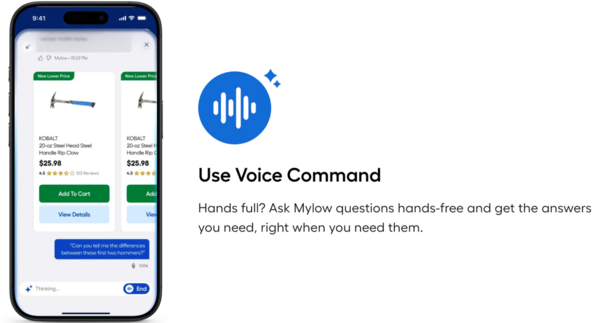
- The goal is to remove friction with AI assistants such as Walmart's Sparky and Lowe's Mylow.
- Customer experiences need to be seamless across physical and digital channels. Supply chain, inventory management as associate productivity are all key areas for AI-driven automation and speed, delivery and fulfillment differentiate CX.
- The store is being recast as part of the technology infrastructure.
- Retailers are using technology to anticipate and respond to customer needs with a focus on value, convenience and experience.
These efforts are ongoing as retailers look to build resilience and engender loyalty.
Here's a deeper dive.
AI is embedded now
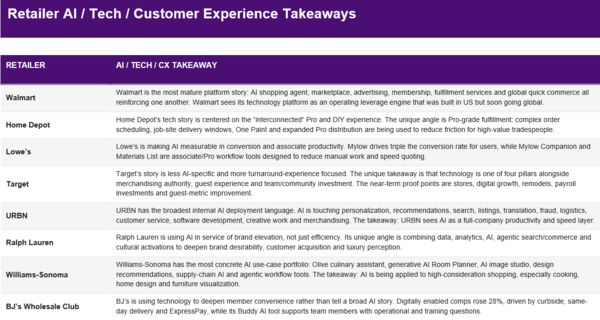
Among the retailers reporting earnings, Walmart, Lowe's, URBN, which includes Urban Outfitters as its flagship brand, Williams-Sonoma and Ralph Lauren were the farthest along in embedding AI into shopping, search, service, productivity, merchandising and fulfilment instead of being a standalone project.
Not surprisingly, Walmart was the most explicit about AI returns. CEO John Furner said its Sparky AI shopping agent is delivering returns. "Sparky weekly active users are up over 100% just in the last quarter, and our investments in AI have increased Sparky intelligence and response quality by 40% this year," said Furner, who said average order sizes among customers using Sparky are 35% higher than non-Sparky customers.
Furner also noted that AI is improving "how we position inventory, make fulfillment decisions and serve customers and members in real time."
- Walmart's Sparky AI agent increases order value
- Walmart's agentic commerce vision: Practical, personalized, immersive and less scrolling
For Lowe's, AI is about both conversion and associate productivity. Its Mylow AI assistant supports more than 1 million customer inquiries a month. The level of conversions is triple for Mylow customers compared to non-users. Joseph McFarland, EVP of Stores at Lowe's, said Lowe's is using AI for pro workflows with features that turn photos, notes, PDFs and spreadsheets into quotes.
URBN's David Hayne, CTO and President of Nuuly, "the tech teams that I oversee are using AI constantly throughout the day, helping to improve their code, helping to improve every function that they do basically, helping them do it faster and more efficiently." He said URBN has embedded Google's Gemini models and rolling out Anthropic's Claude to help "our teams be more efficient. That's a big initiative now."
Richard Hayne, CEO of URBN, said the company is "committed to increasing the usage of AI in just about everything that we do."
Sameer Hassan, Chief Technology & Digital Officer at Williams-Sonoma, added:
"We're seeing massive efficiencies come through the AI, the supply chain, identifying opportunities in our order lifecycle and the supply chain lifecycle, taking cost out of transportation, taking cost out of the order delivery process. And productivity within our corporate associates, coding automation is accelerating quickly. We rolled out agentic training and workflow tools to every corporate function with champions embedded into every part of our company with people moving from being users of AI to really being company builders. It's just really exciting to see that we're just-- not just deploying AI tools, we're becoming an AI-fueled company."
CX is about friction removal
Every mention of AI typically was combined with removing friction in customer experiences. These CX references usually revolved around using AI for faster search, better recommendations, faster fulfillment, easier checkout, better service, more relevant assortments and stronger in-stock execution.
Home Depot CEO Edward Decker said the company remains focused on “delivering a frictionless interconnected experience,” while Executive Vice President of Merchandising William Bastek said better search, more relevant recommendations and easier/faster fulfillment are part of improving the site. He tied friction removal directly to “incremental customer engagement leading to greater sales across all points of interaction.”
- Agentic AI experiences will determine enterprise winners
- How Home Depot blends art and science of customer experience
- NRF 2026: Agentic AI commerce, frontline workers, customer experiences
- Lowe's betting on AI to drive customer experience, optimize multiple processes
For Home Depot, the focus on AI and efficiency revolves around its Pro business, which is the growth engine.
Lowe's used nearly identical language in paint, Pro and appliances. William Boltz, EVP of Merchandising, said Lowe’s is removing friction by “simplifying the in-store journey,” improving online product information and creating “a more intuitive checkout experience.”
Target framed the same idea more broadly around guest experience. Target CEO Michael Fiddelke said Target’s refreshed strategy focuses on “leading with merchandising authority, elevating the guest experience, accelerating technology and strengthening our team and communities.” Later, he said Target has “significant opportunities ahead” to become “the most delightful shopping experience in retail.”
Speed, delivery and fulfillment are differentiators
Given that retailers have been jousting with Amazon and its sped up delivery efforts, it's not surprising that speed, delivery and fulfillment were a big focus. AI and technology are being layered throughout the retail distribution and logistics network. Walmart's Furner noted that 60% of the company's goods now run through an automated distribution facility.
Furner said:
"Speed becomes an engine of operating leverage, not just a better experience for customers and members. And at the same time, we're making our operations more productive and efficient. Automation across our supply chain in the U.S. continues to scale. Approximately half of our eCommerce fulfillment center volume in Walmart U.S. is automated, and more than 60% of our stores are receiving some level of freight from automated distribution centers. And more than half of our regional distribution centers are in various stages of being retrofitted."
Walmart is hardly alone. Home Depot, Lowe’s, Target, BJ’s and Williams-Sonoma all tied technology to fulfillment speed and service quality.
Home Depot said complex Pro order scheduling enables contractors to specify job sites and business hours. Lowe's is betting on same-day and next-day appliance delivery due to fulfillment improvements.
Williams-Sonoma is the most service-centric: CFO Jeff Howie said its goal is a “perfect order on time, damage-free every time,” adding that "we don’t just compete on price. We also compete on service."
The store as infrastructure
Retailers aren't seeing stores as legacy assets as much as fulfillment nodes, service centers and selling environments delivering CX.
Walmart executives called stores physical infrastructure that improves the economics. Target is investing in 30 new stores and 100 remodels as it integrates more technology to enable its employees to interact with customers with a better checkout experience.
Home Depot is centralizing merchandising so associates can better interact with customers. And Lowe's said the Mylow assistant is also freeing up associates to deliver more personal service.
For retailers like Home Depot and Lowe's stores are also delivery hubs.
Ann-Marie Campbell, Senior Executive Vice President, at Home Depot, said:
"We have been on a journey to remove friction from a shopping experience, and we are continuously evolving the way we operate to deliver a more seamless experience. When customers place an order online to complete their projects, they expect the right products delivered on time and complete. Over the last several quarters, we've leaned into faster delivery for our customers using our proprietary model, which leverages all of our assets to drive speed, what we call ship from best location. This has resulted in tremendous growth in deliveries out of our stores."
Personalization converts
A big use case for retailers has been using AI to personalize. These efforts showed up in home and fashion retailers the most.
- Target cuts deal with OpenAI as it plans customer experience overhaul
- Target gets new CEO, continuity in tech, AI strategy
Williams-Sonoma said it scaled personalization across brands, strengthened product discovery and is using design recommendations to help customers complete a look personalized to their style and preferences.
Laura Alber, Williams-Sonoma CEO, said:
"We extended AI further into the customer journey. We scaled personalization across our portfolio of brands. And we continued to optimize the shopping and checkout experience. We also made progress using automation to improve customer care and strengthen product discovery while continuing to advance our design tools."

URBN's David Hayne noted:
"We are hard at work deploying AI and machine learning across the company. Much of our online experience right now has been and is even more so now driven by AI. AI is driving our personalization and recommendation algorithms, a lot of our search and discovery across our websites. We have recently launched an AI customer service agent that's helping us to respond to customer service inquiries faster and more efficiently. That's been a nice win."
Larry Dignan is Editor in Chief of Constellation Insights at Constellation Research, where he leads editorial coverage focused on enterprise technology, digital transformation, and emerging trends shaping the future of business. He oversees research-driven news, analysis, interviews, and event coverage designed to help technology buyers and vendors navigate complex markets with clarity and context. ...
Read morePublished
Author
