


Celonis acquires Ikigai Labs, launches Context Model, eyes simulation-based AI models
Celonis said it has acquired Ikigai Labs and launched the Celonis Context Model (CCM) in a move that aims to meld process intelligence, decision intelligence and foundational models designed for operations.
Ikigai Labs has a patented Large Graphical Model (LGM) that powers its decision intelligence platform that is focused on enterprise tabular and time-series data including spreadsheets, databases and cloud data stores. Terms of the deal weren’t disclosed, but Ikigai Labs gives Celonis a proprietary model and more of an AI narrative.
"The future is large graphical models as we move from language to multimodal approaches, customers ultimately want to perform simulations at scale and move beyond a digital twin," said Constellation Research analyst Mike Ni. "The ultimate goal should be situational awareness as part of the decision intelligence and automation journey."
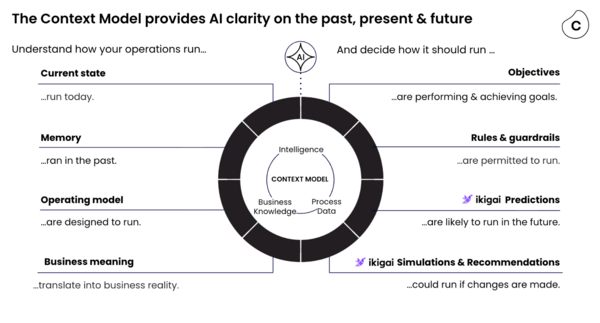
For Celonis, Ikigai Labs and the CCM could put it in good stead as an enterprise AI enabler by providing context, process knowhow and decision intelligence. According to Celonis, its Context Model provides the following:
- A dynamic real-time digital twin of operations that will translate the business into a language AI understand.
- Process data and business context from every system, application, device and interaction across the business.
- Operational context to make AI agents more reliable and accurate at scale.
- Forecasting, simulation and planning capabilities to model future scenarios via Ikigai Labs.
- Integration with the Celonis Platform, which can identify areas to deploy AI and orchestrate processes.
The CCM brings together a context graph and the inference and foresight provided by a world model and serves as the heart It is the new heart of the Celonis Platform, which is an evolution of the company’s Process Intelligence Graph. Ikigai Labs adds advanced simulation and prediction capabilities to CCM.
With the combination of process and decision intelligence, Celonis is looking to be a leader in the context layer, which is being targeted by multiple enterprise vendors. Celonis is arguing that CCM will be differentiated because it will be able to provide AI agents with the full picture of an enterprise including dependencies, exceptions and real-world constraints. Celonis' models, including those acquired via Ikigai Labs, will learn from simulating operations in addition to reinforcement learning and recognizing patterns.
- Celonis makes case for process, context in agentic AI, forges Databricks partnership
- AI agents, automation, process mining starting to converge
- Agentic AI without process optimization, orchestration will flop
- Hi-Fi process management needs to be foundation for AI
Celonis President Carsten Thoma said the rationale for CCM is to enable customers to give their enterprise AI "a holistic, living model of how a business truly operates" and the intelligence to simulate how it "should—and could—run tomorrow." In a statement, Celonis made it clear that its context layer is used by large enterprises with CxOs from Cardinal Health and Mondelez International quoted.
CCM will be able to leverage Celonis Platform partnerships and zero-copy integrations with Microsoft Fabric, Databricks, AWS and Snowflake and connectors to Oracle and other ERP and CRM platforms. Celonis also is integrated with agentic AI systems such as Microsoft Copilot and Agent365, Oracle OCI Enterprise AI, Amazon Bedrock, IBM watsonx Orchestrate and Anthropic's Claude Cowork.
What Ikigai Labs brings to Celonis
Ikigai Labs' portfolio includes a series of tools and AI agents for AI-powered what-if analysis, fraud detection, demand forecasting and planning and financial reconciliation across multiple industries.
At a high level, Ikigai Labs gives Celonis a stronger AI story. At a technical level, Ikigai Labs brings unique AI models to the market in an emerging space beyond large language models.
Ni added:
"Ikigai helps Celonis operationalize digital twins for customers. LLMs helped enterprises explain work. LGMs help enterprises understand how work actually happens. That’s a fundamental shift because enterprises can move from today’s LLMs summarizing activity to modeling operational causality across interconnected business signals, processes, and outcomes. Celonis customers can move from modeled relationships and digital twins to now simulate, predict, and eventually automate decisions across the business. That’s how Celonis can help customers move from workflow visibility to a foundation that enables AI to scale trusted, autonomous operations."
Ikigai Labs has said its platform is based on three proprietary pillars including aiMatch for data reconciliation, aiCast for prediction and aiPlan for scenario planning and optimization with expert in the loop reinforcement training.
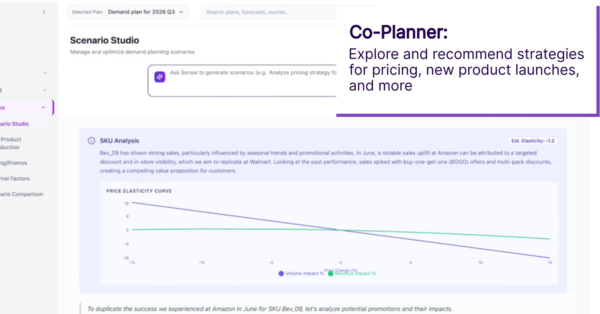
On the product front, Ikigai Labs has AI Co-Planner live. AI Co-Planner unifies demand, supply chain, finance, sales and revenue into future-based plans that are updated and adjusted in real-time. Ikigai Labs' website also notes that AI Co-Trader, which aims to automate supply chain execution, and AI Co-Marketer, which identifies growth opportunities, as coming soon.
Ikigai Labs also has a research arm focused on LGMs, resoruce-efficient time sensitive foundation models and eXpert-in-the-Loop (XitL) systems.
In 2023, Ikigai raised a $25 million series A round of venture funding.
Going forward, Ikigai Labs' team and experts in AI, machine learning, tabular and time-series modeling, causal inference and simulation will join Celonis. Devavrat Shah, CEO of Ikigai Labs, will become Chief Scientist of Enterprise AI at Celonis. "Together, we now provide the fullest operational representation of business reality. With the Context Model, AI agents have the hindsight, insight, and foresight to intelligently and continuously adapt," said Shah.
The challenge for Celonis and its latest efforts is that the context bandwagon is filling up. Here’s a sampling where the context layer for AI is headed.
Larry Dignan is Editor in Chief of Constellation Insights at Constellation Research, where he leads editorial coverage focused on enterprise technology, digital transformation, and emerging trends shaping the future of business. He oversees research-driven news, analysis, interviews, and event coverage designed to help technology buyers and vendors navigate complex markets with clarity and context. ...
Read morePublished
Author
