


Arm steps up physical AI efforts, bridges edge, cloud AI
Arm announced a series of moves that aim to connect AI deployments across cloud and edge as well as physical AI and robotics.
The big theme from Arm is that the company can offer a compute platform that spans cloud, edge and physical AI to enable agentic AI across multiple environments. Arm's bet is that AI agents are becoming personal at the edge and devices and expand more into physical AI.
The announcements include:
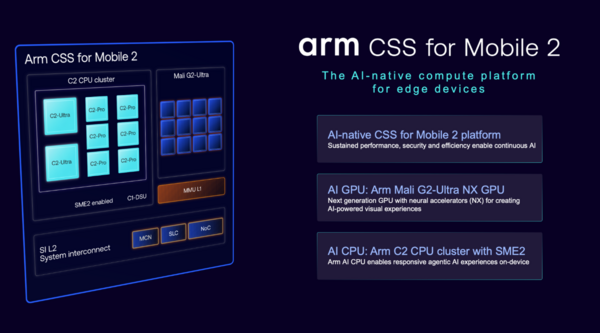
- Arm CCS for Mobile 2, an AI-native compute platform built for agentic AI and mobile graphics. The big theme here is that AI workloads will be handled on the edge.
- Arm Total Design for Physical AI, which represents an effort to build an ecosystem around robotics and physical AI.
- Arm Neoverse CSS N4, which is designed to enable multiple AI compute options and custom silicon.
Arm's news drop lands as the company is scaling its inference CPU chips aimed to deliver more memory bandwidth and performance per watt. Arm's argument is that AI will require different workloads with distinct compute demands.
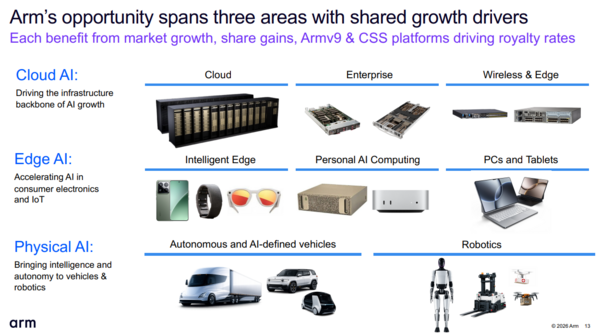
For Arm, the move to connect AI across edge devices, physical AI and data centers lays out a foundation for future growth. Arm reported a strong first quarter and touted its AI CPU efforts. CEO Rene Haas said: "Demand now exceeds $2 billion as we continue to add new customers, including multiple customers in the U.S. and China, while the overall value of our pipeline has continued to strengthen. We're also working closely with our manufacturing and supply chain partners to expand capacity. Our confidence in achieving upside to our $1 billion opportunity for the Arm AGI CPU business has increased in the past 90 days."
- Arm and the CPU renaissance
- IBM, Arm eye dual technology layer for AI, mission critical workloads
- Arm lands OpenAI, Meta as CPU customers
Here's a look at Arm's plays for edge AI, physical AI and AI data centers.
Edge AI
Chris Bergey, Executive Vice President for Edge AI at Arm, said AI agents will begin to anticipate what a person will do and offer continuous assistance and personal experiences.
Arm CCS for Mobile 2 is aimed at delivering "the performance you need at the edge for AI-first applications" with security, privacy and efficiency.
The ingredients of CSS for Mobile 2 include the Arm Mali G2-Ultra NX GPU and Arm C2 CPU cluster with SME2. Bergey said the setup is designed to provide agentic experiences on device.
Bergey said the reasons for more on-device AI is latency, personalized experiences and costs. "There's an interest in having AI compute as local as possible," he said.
Physical AI
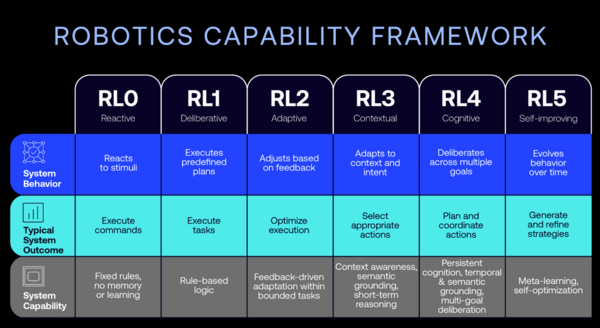
At an analyst briefing, it was clear that Arm wanted to formalize its push into physical AI via robots and autonomous systems. The company is also publishing an industry-wide robotics capability framework and manifesto.
Drew Henry, Executive Vice President of Arm's Physical AI Business Unit, said physical AI is defined by the company where "AI is being embodied into machines and those machines sense what's going on around them, make a decision and then go off and act safely in the world."
Arm will focus on latency in physical AI as well as details such as weight. "Compute for physical AI will be different from the mobile and cloud space," explained Henry. "You have to have a computing system that's as lightweight as possible and there's an impact on how you cool the system and design the subsystem."
Henry added that Arm has been participating in physical AI for years and last year shipped more than 2 billion units into the market. What's changed is that Arm is formalizing its efforts around physical AI.
Arm Total Design for Physical AI is a program that resembles what the company did in infrastructure. The goal is to layer Arm throughout the physical AI market much like it did for infrastructure. Arm has 80 partners in physical AI to develop the market faster.
Henry said Arm will also publish a manifesto that offers a framework for physical AI.
Cloud and data center
Mohamed Awad, Executive Vice President of Arm's Cloud AI Business Unit, said Arm is rapidly scaling Neoverse adoption in the cloud and Neoverse CSS N4 and the company's AGI CPU are looking to expand.
"Agentic AI is evolving the role of CPUs more broadly. CPUs are taking all those tokens being generated by accelerators and translating them into things like user intent. It's doing context retrieval. It's doing reasoning, tool execution, evaluation," said Awad.
Arm offers two Neoverse classes of CPUs including the N series focused on efficiency and the V series for performance. Awad said Neoverse CSS N4 is the most configurable compute subsystem so far and can further drive Arm's market share among hyperscale cloud vendors.
Larry Dignan is Editor in Chief of Constellation Insights at Constellation Research, where he leads editorial coverage focused on enterprise technology, digital transformation, and emerging trends shaping the future of business. He oversees research-driven news, analysis, interviews, and event coverage designed to help technology buyers and vendors navigate complex markets with clarity and context. ...
Read morePublished
Author
