


UiPath aims to bridge gap between process, agentic AI, orchestration
UiPath is leaning into its process mining roots and making the argument that agentic AI needs a manual based on process knowledge and context.
CEO Daniel Dines said:
"AI will need the manual. It's like every process, every business you have will have a full detailed manual of how your business operates. No company in the world has this manual and AI needs this manual. This is really the biggest difference today, and this is the reason that AI can fail. We call it the process context. I know that many people are talking about enterprise context, but I think we want to be precise. And in our world, we are bringing here to the picture a way to capture the process context, which is the way that the work happens in operations, in business processes."
To drive the point home, UiPath's investor day meetup included 206 mentions of process.
At UiPath's Fusion conference, the company outlined the following.
- UiPath Cartographer, a system for building a Map of Work and governed view of how a company actually runs. Cartographer is UiPath's latest spin on its core process mining technology and is designed to replace the interviews, documents and other unstructured data that hold institutional knowledge. UiPath said Cartographer includes prebuilt maps for more than 100 industry processes, a curated library of complex process maps and tools to build proprietary blueprints.
- UiPath Test Cloud to enable teams to execute tests autonomously and automate the testing lifecycle.
- UiPath platform enhancements with the general availability of UiPath Coding Agents and UiPath Delegate, a productivity agent. The company also launched an integration service that includes a database hub, connects cloud automations and connects third party agents and credentials. UiPath Data Fabric and governance tools for models, runtimes, identity and compliance were also added.
In a slide, UiPath's AI agent orchestration, process and automation mashup aims to couple deterministic and probabilistic workflows.
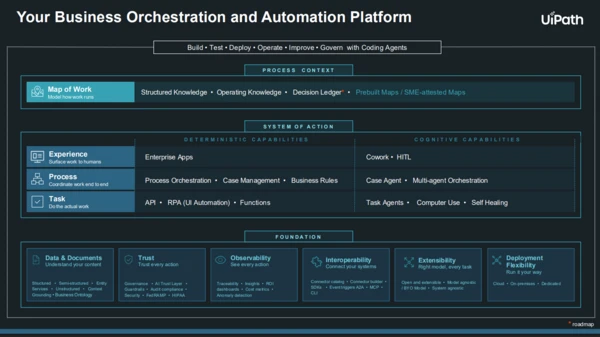
UiPath's argument that agentic AI will fail without process context isn't a difficult one to make. He's preaching to the choir in a few camps. Executing on process knowledge and melding it with large language models and orchestrating AI agents is another matter entirely.
"Deploying AI agents is not less complicated or faster than a year ago," said Dines, who said deterministic automation saves money and provides the accuracy needed to mix and match AI models as well as process knowhow. "The real problem of AI in enterprise and the main difference between an AI model and a human is that AI doesn't learn on the job. Now you tell me AI has memory. Yes, memory is not the same as learning."
It remains to be seen whether UiPath wins with its process-agentic AI-automation approach, but you can expect other enterprise software players to pick up the storyline. To date, process has been the key ingredient for vendors like UiPath, Celonis and ServiceNow to a lesser degree. The context talk that dominates today is likely to morph into a process spiel.
"I'm not saying our approach is unique and the only one. But I can make this prediction that most of the successful AI implementations in the context of enterprise process will have to have a foundation that offers them the orchestration and automation and also the map of work," said Dines.
Dines' bet is that neutrality will matter for UiPath customers. He referenced the tradeoff with using Salesforce or Epic as an orchestration engine, but it requires you to put data on their platform too. "Many people will feel comfortable having an agnostic orchestration and automation engine," said Dines.
UiPath Chief Product and Technology Officer Raghu Malpani said the company's Maestro business orchestration and automation platform is the base to gain more market share and expand into industries.
Indeed, UiPath featured customers USAA, Voya Financial and Equifax at its investor meeting.
Malpani said the Map of Work will ultimately lead to what UiPath calls the "decision ledger," which documents the judgment behind every decision and includes who decided on what evidence and captures data for continuous improvement.
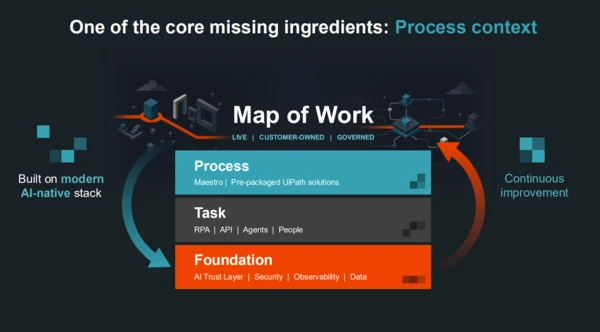
"The decision ledger is where the decisions and judgment that human makes and the rationale and the reason for it are captured. This becomes the gold mine, which our specialized agents can use to drive that continuous improvement for processes," said Malpani. "You have that shared enterprise context or process context, but you can use that process context as a living, breathing artifact that improves as your process knowledge improves."
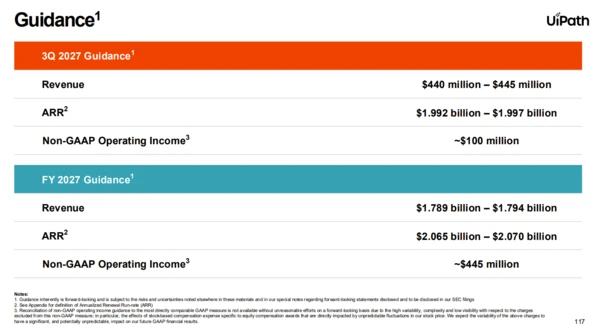
For UiPath, the ultimate report card for its strategy will be its earnings, which have been strong in recent quarters. The company continues to land and expand with customers and UiPath is planning to double down on its industry focus.
More process:
- Dow bets on process optimization, automation, AI to offset economic volatility
- SAP CEO Klein: Our AI agents want to solve the complex business processes
- Decision Intelligence Platforms: How Celonis Enables the Autonomous Enterprise
- Celonis acquires Ikigai Labs, launches Context Model, eyes simulation-based AI models
Larry Dignan is Editor in Chief of Constellation Insights at Constellation Research, where he leads editorial coverage focused on enterprise technology, digital transformation, and emerging trends shaping the future of business. He oversees research-driven news, analysis, interviews, and event coverage designed to help technology buyers and vendors navigate complex markets with clarity and context. ...
Read morePublished
Author
