


SAP's second quarter: The AI takeaways
SAP reported better-than-expected second quarter results with earnings per share of €1.89, which was well ahead of estimates. Revenue of €9.88 billion was up 9% from a year ago and in line with expectations.
The big news was second quarter cloud revenue was up 22%. As for the outlook, SAP noted that its non-IRFS operating profit outlook would take a hit due to the Dremio and Prior Labs acquisitions. Cloud revenue for 2026 will be €25.8 billion to €26.2 billion, up 23% to 25% in constant currency.
- SAP eases ERP maintenance and support rules for on-prem customers
- SAP Sapphire 2026: SAP makes its case that it should your autonomous enterprise platform
- SAP's Big Bet: Autonomous Enterprise or Overpromise? | 2026 Q2 SAP Coffee Corner
- SAP acquires Dremio, Prior Labs as it builds out its data platform plan
Here's a look at the takeaways:
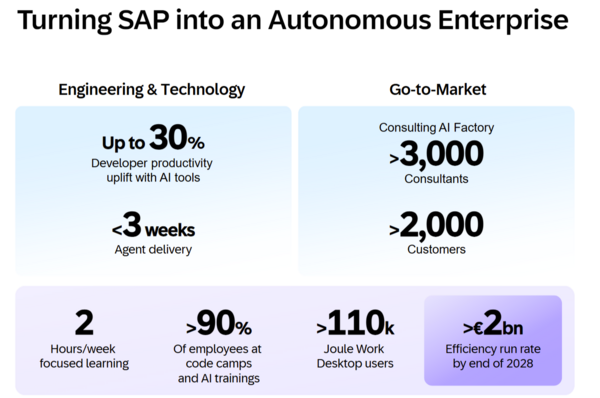
- SAP is trying to become more efficient with an assist from AI. CEO Christian Klein said: "Our AI transformation is progressing well, both among our customers and our employees reflected in growing AI consumption and tangible outcomes. We are moving with full speed to turn SAP into an autonomous enterprise. In engineering and technology, we are transforming our operating model from software development to building AI at scale."
- Business Data Cloud is being included in big deals. Klein said Business Data Cloud was in 90% of the 50 largest deals.
- SAP is stepping up its AI assistant releases. The company said the Joule Suite and Joule Work suites are oversubscribed in the beta program. The company will release about 50 assistants by the end of the third quarter with more than 400 Autonomous Suite agents by the end of 2026.
- The company's strong pipeline is helping SAP manage through Middle East war volatility, but decision-making has slowed. CFO Dominik Asam said: "The situation in the Middle East remains fluid and the longer it persists, the more it weighs on customer decision-making, particularly in directly affected industries and supply chains." SAP's outlook assumes that the Middle East volatility resolves itself in the second half.
- Enterprise customers are focusing on AI costs. Asam said: "The recent debate about exploding token costs at most enterprises supports our strategy of leveraging a unique combination of both deterministic, highly scalable and low-cost mission-critical enterprise applications on the one hand and probabilistic agentic AI-powered solutions on the other. We're highly assured deterministic solutions are not yet attainable and heavy human intervention is the baseline; AI can very effectively compete with labor."
- SAP is also managing its own AI costs. Asam said: "We are frankly optimizing massively now on how we spend tokens by virtue of a very tight controlling. We can now, on a very granular basis, see who's using what tool and what is output driven here, and we will funnel the tokens in a way that gives us a better bang for the buck. And there are also measures on cost containment to really make sure that we focus our resources where it really matters."
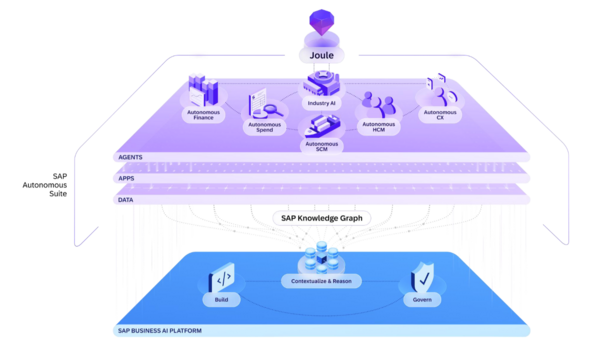
- Governance and choice matters. Asam added: "We are more convinced than ever that our strategy not to be locked into any generic large language frontier model, but to flexibly benefit from the vibrant competition amongst them in terms of both performance but also cost is the right one. And in times of high geopolitical uncertainties, customers do value the resilience of this model delivered by a provider headquartered in Germany. Sovereign requirements are taking center stage for more and more customers."
Larry Dignan is Editor in Chief of Constellation Insights at Constellation Research, where he leads editorial coverage focused on enterprise technology, digital transformation, and emerging trends shaping the future of business. He oversees research-driven news, analysis, interviews, and event coverage designed to help technology buyers and vendors navigate complex markets with clarity and context. ...
Read morePublished
Author
