


How Prudential CTO Liz Brand is approaching agentic AI, transformation
Prudential Financial CTO Liz Brand said governance is an AI advantage, the pendulum is swinging to build over buy and tech debt can be an odd advantage when technology is evolving so quickly.
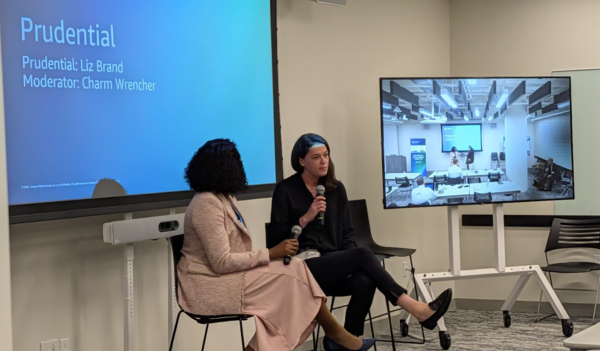
Speaking at the AWS Financial Services Symposium, Brand outlined how a 150-year old insurer is approaching AI, transformation and why governance is the scaffold for innovation.
Here's a look at the takeaways.
The approach to modernization. Once upon a time, Prudential used to chase multi-year big-band modernization projects. Today, Prudential is all about the incremental and value-driven efforts enabled by AI and better tooling.
"You've seen modernization be 1- to 3-year projects, but you're putting a lot of capital in one place. The biggest shift that we're all seeing now is this incremental ability to prove value. I can actually just reduce run rate and take off a couple chunks of this thing," she said.
Brand added that AI will accelerate IT rationalization and drive returns on investment. “We’re trying to get more methodical about AI rationalization across our environment,” said Brand. “If we check back in a year I would say it’s a pretty good bet that the savings will be bigger than people think it will be.”
The burden and benefits of being a 150-year-old company. Brand said Prudential certainly has its share of legacy systems and complexity. However, there are also scale benefits. "When we do something once, and we scale that across our entire environment we're scaling that across the world," said Brand.
- More from AWS Financial Services Symposium: How Stripe sees agentic commerce developing
Production grade or go home. Prudential, which works on multiple co-innovation projects with AWS, won't do pilots anymore. AWS won't take non-production work and neither will Brand's team. "AWS would only take production grade projects that we were committed to," explained Brand. "That's how we feel about our projects too. The ones we're committed to bring shorter time to value in production within months rather than years."
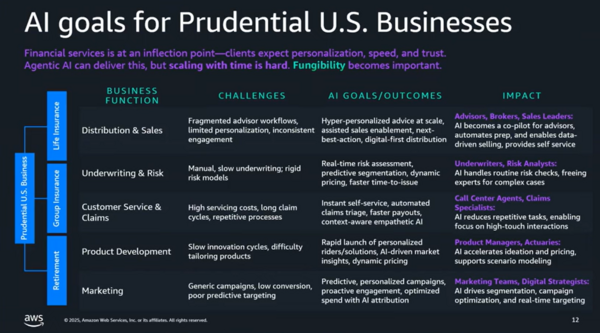
Build vs. buy pendulum is swinging back to build. Brand said Prudential is more interested in building applications due to cheaper costs and AI tooling. "Years ago, it was the rise of SaaS. Everybody pushed everything out to a provider. The pendulum is now swinging inward and the buy vs. build matrix is a lot more interesting," said Brand. "Once you achieve enterprise-grade governance, it's going to become a lot more favorable to build. There's a lot of risk coming to the SaaS industry."
Yet, enterprises shouldn't build everything. "I still probably wouldn't build commodity things where something is commodity and it's priced as a commodity in the market. Why not buy it? It's faster," said Brand.
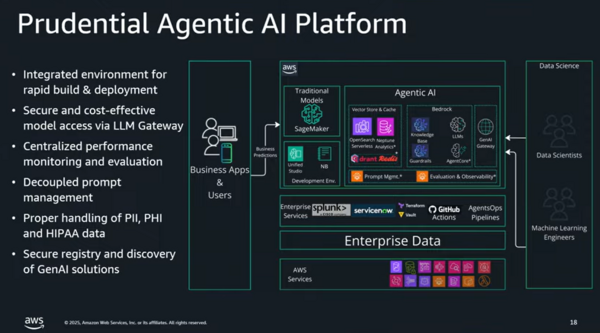
Governance means AI speed. "That LLM gateway, or the AI gateway, as we call it, is really critical to getting the AI telemetry data that's both proactive and reactive," said Brand. "On the proactive side, you're injecting governance and rules. And then on the reactive side, you're looking at how people are using it to better educate yourself on a feedback loop in your environment."
Without governance, Brand said you'll end up with AI agent sprawl that'll knock you off pace.
In a regulated industry, Brand said companies like Prudential need to treat regulation as a design input instead of an afterthought. "Embed regulation into the design so you can think about it from the start and deal with a lot less friction later," said Brand.
A strategic focus on headless CRM and AI agents. Brand said CRM and sales workflows are prime targets for AI and headless architectures. "You look across the relationships with customers and CRM spaces right now, they could be embedded and considered to be headless CRMs," said Brand. "We're making large investments in things that can construct away what isn't a key part of the business outcome."
AI agents as the next operating model. Brand said she expects AI agents to take over many digital operations tasks in two to three years. "There is a major transformation where we feel that agents start to take the place of many digital activities that are happening today," said Brand.
The joys of lagging when AI is changing rapidly. Brand said Prudential's technical debt is an opportunity to skip maturity layers. "You can either let your debt hold you back, or you can look at it to try to use it to leapfrog over your competitors," said Brand. "There are cases where we didn't take the project for three years and we said people are ahead of us. Now it's more work for them to get to the next maturity layer. Since we never did that maturity layer, we can suddenly jump to layer four a whole hell a lot faster," said Brand.
Business meets tech delivery. Brand said one of the biggest benefits from AI is that the business is more involved in tech delivery. AI coding is expecting. "Businesspeople got a lot closer [to] technology and the interest level peaked and people carry that into work," said Brand. "The ideas are a really healthy thing."
Token costs. Brand said token costs are being closely monitored as Prudential focuses more on returns. She said that token costs “are nearing the point where they are becoming a hard budget line item.”
“I know exactly how much we spend to date on tokens. I know what the sources and the cost centers and where they come from. I know the outcomes that are attached to that. So, we pay a lot of attention to this on the ROI side, and also getting an idea of our forecasting on it,” said Brand.
Larry Dignan is Editor in Chief of Constellation Insights at Constellation Research, where he leads editorial coverage focused on enterprise technology, digital transformation, and emerging trends shaping the future of business. He oversees research-driven news, analysis, interviews, and event coverage designed to help technology buyers and vendors navigate complex markets with clarity and context. ...
Read morePublished
Author
