Salesforce Bets on the Rise of the Agentic Enterprise
At Dreamforce 2025, Salesforce centered its entire narrative around a single concept: the agentic enterprise. Every announcement, demo, and customer story pointed toward a vision where AI agents drive business operations, decision-making, and collaboration. The company is aligning its products, platform, and partnerships through Agentforce 360, the core of the Salesforce 360 ecosystem that connects people, data, and systems in an intelligent, trusted framework.
Observations
The Convergence of Products and Platform
When Salesforce introduced Agentforce a year ago, it created the foundation for building AI agents. The initial rollout included only a few built-in agents, but the intent was clear: to move toward a more intelligent, agent-driven architecture.
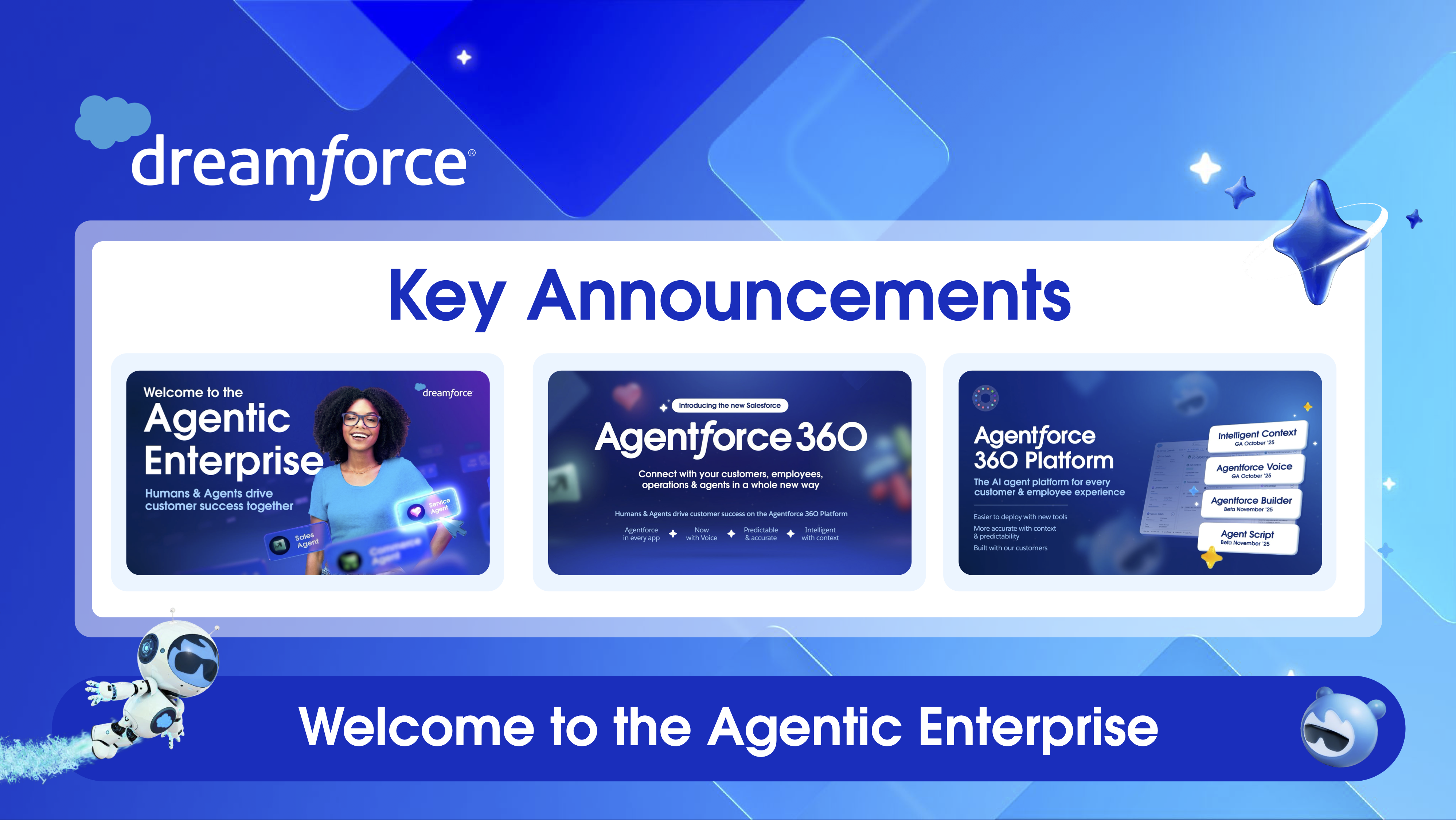
This year, Salesforce took a major step forward by introducing Agentforce 360 and renaming its product families. The familiar “clouds” are now Agentforce Sales, Agentforce Service, Agentforce Marketing, and so on. The goal goes beyond rebranding. It reflects a shift toward embedding agentic intelligence directly into the core products. Customers now gain agentic capabilities without needing to build separate custom agents, while developers and partners can still extend and integrate through the broader Agentforce platform.
Salesforce is advancing its portfolio in two directions: making its first-party products to be AI-first and expanding a platform that enables customers and partners to create agents that connect and extend those products. The company now positions itself at the intersection of product and platform within the broader Salesforce 360 vision of the agentic enterprise.
Deterministic and Agentic: Finding Balance in Workflow Design
Salesforce introduced AgentScript, a JSON-like declarative scripting language that lets customers define the specific actions an agent must follow. This addition provides structure and predictability to agent workflows by combining deterministic steps with agentic reasoning. Customers can specify where precision is required while still allowing agents to adapt intelligently in less controlled areas. This balance between control and autonomy reinforces the kind of reliability enterprises expect from agent-driven systems.
A similar trend is emerging in the broader AI agent market: Claude Skills, recently announced by Anthropic, operates as reusable modules, which are folders of custom instructions, scripts and resources that an agent loads only when needed. The appeal is clear: when the workflow is predictable and proven enterprises prefer to hold on to that predictability rather than discard it. In this context, the deterministic part and the agentic part end up in an and relationship rather than an or relationship. Using predefined workflows saves tokens and therefore cost for the platform because the model does not have to reason from scratch when it is given instructions to follow. In other words, embedding structure into the agentic layer improves efficiency and lowers consumption.
Incorporating this kind of workflow pattern into Agentforce makes sense; customers gain confidence because there is a “known path” for common tasks and the flexibility to deviate when needed. That dual mode of deterministic structure plus agentic flexibility aligns with what enterprises have begun to prefer in their agentic enterprise journey.
Slack Becomes the Interface of the Agentic Enterprise
Slack’s role has evolved from a collaboration hub to a conversational agentic interface. Historically, it operated alongside Salesforce applications with a few integrations. That separation is now diminishing as Slack becomes deeply integrated into Agentforce 360.
Salesforce now treats Slack as an agentic operating system, a space where people, apps, and agents work together through natural conversations. Slack runs on the Agentforce foundation and connects workflows across multiple Salesforce and third-party products. With more than a million customers, Slack gives Salesforce a powerful opportunity to extend the agentic enterprise vision beyond its traditional CRM base.
Although the current integrations remain centered on Salesforce products, Slack now serves as an important gateway for expanding Agentforce’s influence across the Salesforce 360 ecosystem and beyond.
My View: Progress, Gaps, and the Road Ahead
Adoption and Trust: Salesforce’s Next Test
Salesforce continues to invest heavily in helping customers adopt Agentforce 360. Forward deployed engineers and success teams are gathering insights from real implementations, and customer stories prominently featured at Dreamforce highlighted measurable progress.
Still, adoption remains low. Fewer than ten percent of Salesforce customers are using Agentforce capabilities at scale. This number reflects both the challenge and the opportunity ahead. Expanding adoption within the framework of the agentic enterprise will determine Salesforce’s success over the next two years.
Recently, news surfaced that millions of Salesforce customer records were leaked following a failed ransom bid; attackers used social engineering and malicious OAuth connections to access data. Salesforce frames security under a shared responsibility model: it secures infrastructure, while customers manage configurations, access controls, and integrations. Even under a shared responsibility model, customers will not adopt advanced agentic tools unless they believe them to be safe. Perception and reality both matter, and doubt in security can stall adoption. At Dreamforce, Salesforce acknowledged security topics via dedicated trust and security sessions, but it did not allocate meaningful spotlight to the breach and its implications. If Salesforce is serious about driving Agentforce 360 adoption, it must invest heavily not just in preventing future incidents, but also in proactive, transparent education around Agentforce security. For AI systems, security is often the highest adoption barrier.
Pricing Clarity as a Growth Lever
Customers and partners continue to point to pricing predictability as a barrier. Salesforce has introduced more flexible models such as usage-based credits and unlimited enterprise licenses, yet uncertainty about long-term costs persists.
When enterprises cannot accurately forecast their spending, they hesitate to expand use. Partners face similar concerns when recommending Salesforce solutions. Greater transparency in pricing and consistent commercial frameworks would strengthen customer trust and make it easier for partners to promote the platform. This evolution would also open space for global systems integrators and service partners to take a larger role in delivering agentic enterprise solutions. Historically, Salesforce has focused its marketplace on ISVs. The next phase requires deeper engagement with implementation partners who can drive scale across industries.
Reaching Beyond the Salesforce Core
Agentforce 360 adoption remains concentrated within Salesforce’s existing customer base. Yet the agentic enterprise extends beyond CRM. Growth will increasingly depend on expanding into non-Salesforce environments.
Slack, Heroku, and potentially Informatica (once the acquisition is closed) can help bring Agentforce 360 into more open enterprise landscapes. These platforms provide pathways for organizations that want to deploy agentic systems without migrating entirely to Salesforce.
Leadership Continuity and Focused Execution
The Dreamforce 2025 stage featured several new leaders compared with the previous year, reflecting ongoing organizational change. Marc Benioff remains deeply involved in shaping Salesforce’s agentic enterprise strategy, but consistent leadership and execution will be essential to sustain progress.
Transforming a company of Salesforce’s size requires coordinated teams, continuity, and a clear operating rhythm. Retaining and attracting talent with deep expertise in AI, integration, and enterprise systems will be vital to advancing the Salesforce 360 vision.
Final Thoughts
Dreamforce 2025 marked a defining moment for Salesforce. The company is no longer defining itself through separate clouds or individual applications but through the agentic enterprise, powered by Agentforce 360. Together with Slack as the agentic operating system and AgentScript as a control layer, Salesforce is building a connected ecosystem where agents enhance reasoning, collaboration, and decision-making across the enterprise.
The foundation is strong, but execution alone will not determine success. Trust and security must stand at the center of Salesforce’s next phase. Customers will not expand adoption of Agentforce 360 until they are confident that their data, models, and workflows remain secure. Predictable pricing, leadership stability, and a broader partner ecosystem will remain important, but lasting growth will depend on whether Salesforce can make trust its most visible and consistent differentiator.
Salesforce’s future now rests on its ability to operationalize the agentic enterprise it unveiled at Dreamforce 2025 and to prove that innovation and trust can advance together.
Chirag Mehta is Vice President and Principal Analyst focusing on cybersecurity, next-gen application development, and product-led growth. With over 25 years of experience, he has built, shipped, marketed, and sold successful enterprise SaaS products and solutions across startups, mid-size, and large companies. As a product leader overseeing engineering, product management, and design, he has consistently driven revenue growth and product innovation. He also held key leadership roles in product marketing, corporate strategy, ecosystem partnerships, and business development, leveraging his expertise to make a significant impact on various aspects of product success. His holistic research approach on cybersecurity is grounded in the reality that as sophisticated AI-led attacks become…...
Read morePublished
Author