


Quantinuum launches Helios quantum computer, touts fidelity, enterprise customers
Quantinuum launched its new Helios quantum computer, a high-performance general purpose commercial system with 98 fully connected qubits and fidelity north of 99.9%.
The launch is aimed squarely at enterprises looking to deploy quantum computing for certain use cases. Indeed, Amgen, BlueQubit, BMW Group, JPMorgan Chase and SoftBank are initial customers pursuing biologics, fuel cell catalysts, financial analytics and organic materials.
Quantinuum said it has also signed a strategic partnership with Singapore’s National Quantum Office (NQO) and National Quantum Computing Hub (NQCH). The deal provides access to Helios as well as a R&D center in Singapore.
Helios includes a first-of-its-kind real-time control engine with a software stack that gives developers the ability to program similar to the way they program classical computers. Helios also includes Guppy, which is a Python-based programming language for hybrid quantum and classical compute.
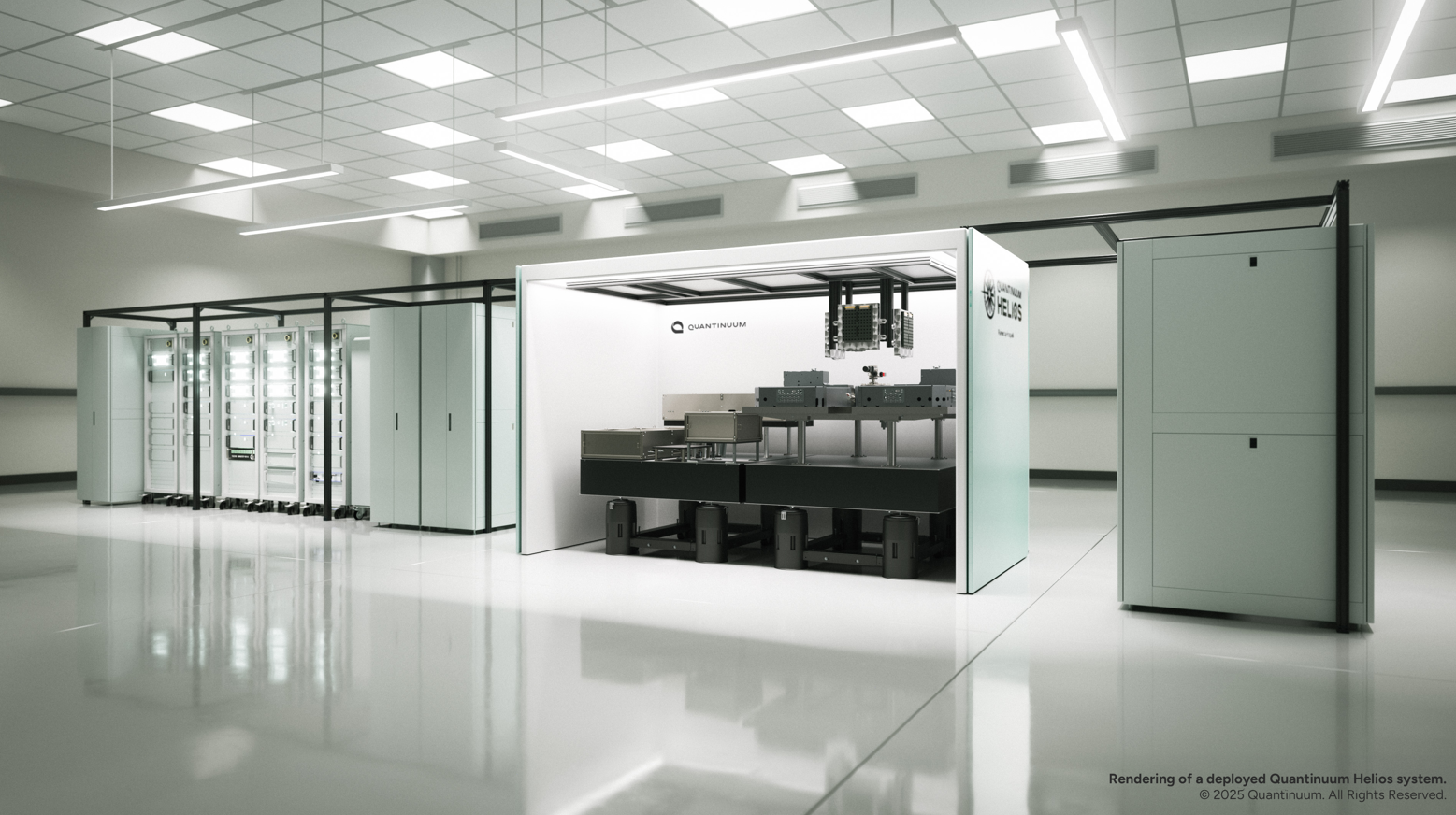
Quantinuum said Helios is available through Quantinuum's cloud service as well as on-premise. Dr. Rajeeb Hazra, President and CEO of Quantinuum, said "for the first time enterprises can access a highly accurate general purpose quantum computer to drive real world impact, transforming how industries innovate – from drug discovery to finance to advanced materials."
- Quantinuum valued at $10 billion after $600 million venture round
- Quantinuum fleshes out quantum software stack with open source Guppy, Selene
- Quantinuum, partners create true verifiable randomness, eye quantum computing for cybersecurity
- Quantinuum launches generative AI quantum framework, sees quantum computing as synthetic data generator
- 2025 is the year of quantum computing
-
Research: Constellation ShortList™ Quantum Computing Platforms | Quantum Computing Software Platforms | Quantum Full Stack Player
According to the company, Helios has the ability to enhance generative AI with quantum generated data. Those use cases could include data analysis, material design and quantum chemistry. Quantinuum said it expanded its partnership with Nvidia to integrate Nvidia GB200 AI accelerators with Helios via NVQLink. In addition, Quantinuum will switch to Nvidia accelerated computing for Helios and future systems, using Quantinuum Guppy alongside the Nvidia's CUDA-Q platform to perform real-time error correction critical to its roadmap.
Quantinuum also said it is launching two new programs to develop an ecosystem for quantum computing. Q-Net is a user group that will spur collaboration with customers and a startup partner program to develop third-party applications on Helios.
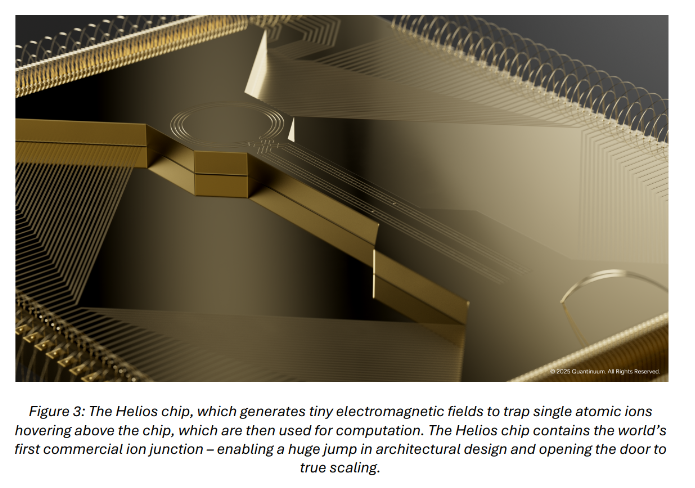
Constellation Research received a briefing on Helios from Dr. David Hayes, Director of Computational Design and Theory at Quantinuum. Here are the key points:
- Unprecedented Quantum Performance: "We really do believe Helios has the highest fidelity machine in the world at this scale. It’s almost 100 cubits. We got close. It's 98 and that first number there is the two qubit gate fidelity, 99.92%,” said Hayes.
- Breakthrough in Quantum Error Correction: Hayes said Helios reached an efficient error correction ratio. "We get to 48 [logical qubits], but even that, I think, will be surprising to people out there. We didn't quite get to 94 in this case, but we didn't quite get to a two to one encoding ratio for error correction,” he said.
- Practical Scientific Applications: Hayes said Helios successfully modeled a high-temperature superconductor to demonstrate that quantum computers are moving beyond theoretical demonstrations to real scientific research.
- Quantum Programming Environment. Helios includes Guppy. "Guppy was designed from the go-to make fault-tolerant programming really, really user friendly,” said Hayes. "It's Python based to make it easy to use, but it's a lot more performant than Python."
- Future Development and AI Integration. Hayes said Quantinuum is exploring the intersections between quantum computing and AI. "We're using AI in the lab to create new quantum circuits, more efficient quantum circuits, and we can have AI kind of fill in the gaps," said Hayes.
Larry Dignan is Editor in Chief of Constellation Insights at Constellation Research, where he leads editorial coverage focused on enterprise technology, digital transformation, and emerging trends shaping the future of business. He oversees research-driven news, analysis, interviews, and event coverage designed to help technology buyers and vendors navigate complex markets with clarity and context. ...
Read morePublished
Author
