


Constellation ShortList™ Next Generation Employee Engagement Intranets

Executive Summary
About this Constellation ShortList™
Next generation employee engagement intranet platforms can be considered the evolution from legacy corporate intranet offerings, in that they are built on a core model of content centralization and collaboration. But with the advent of generative and agentic AI capabilities, these tools are now critical in enabling more consistent and accurate employee communications that enable a more cohesive go-to-market message for all employees. This involves providing seamless access to essential company resources, fostering a sense of community through social features, streamlining workflows, and ensuring employees remain connected and engaged, regardless of their location or role. The sector is currently experiencing significant growth, driven by the increasing prevalence of remote and hybrid work models, the ongoing push for digital transformation within enterprises, and a growing recognition of the critical role intranets play in employee satisfaction and productivity.
Recent innovations in the sector include an emphasis on personalization, with AI-powered features tailoring content and experiences to individual employees. Mobile accessibility, often through dedicated apps, is no longer a luxury but a fundamental requirement, especially for remote and frontline workers. Furthermore, seamless integration with other widely used business applications like Microsoft 365, Google Workspace, and various HR and project management tools is crucial for creating a unified digital workplace. Many of the providers in this sector are embracing more composable, lo-code application platforms to foster more configurable user experiences as well as a more flexible injection of AI tools into the solutions.
Threshold Criteria
Constellation considers the following criteria for these solutions:
- User-Friendly Interface and Experience: The platform must be intuitive, easy to navigate, and visually appealing. A modern, consumer-grade design encourages adoption and reduces the learning curve for all employees, regardless of technical proficiency.
- Robust Search Functionality: Employees need to quickly find information, documents, and colleagues. A powerful search engine with advanced filters, keyword recognition, and potentially AI-powered capabilities is crucial for efficiency.
- Core Content Management System (CMS): A strong CMS is essential for creating, organizing, publishing, and managing various types of content, including news, announcements, policies, blogs, and multimedia. It should support version control and easy content creation.
- Embedded Generative and Agentic AI: Tools to drive user productivity such as writing assistants, content analysis to determine changes needed, and agent tools to automate the upkeep of core messaging and internal communication.
- Collaboration Tools: The intranet should foster teamwork through features like shared workspaces, document co-editing, project management tools (task assignment, tracking), discussion forums, and integrated messaging/chat.
- Mobile Accessibility (with a Dedicated App): Given the rise of remote and hybrid work, the intranet must be accessible on all devices (smartphones, tablets) with a responsive design or, ideally, a dedicated mobile app for on-the-go access.
- Integrations with Existing Systems: Seamless integration with other critical business applications (e.g., Microsoft 365, Google Workspace, HRIS, CRM, project management tools, Slack) is vital to streamline workflows and provide a unified digital workplace.
- Personalization and Customization: The intranet should allow for personalized experiences, delivering relevant content and news based on an employee’s role, department, location, and preferences. Customization options for layouts and dashboards are also important.
- Security and Access Control: Protecting sensitive company information is paramount. The platform must offer robust security protocols (encryption, multi-factor authentication), granular access controls, and compliance with relevant data protection regulations.
- Analytics and Reporting: To measure the intranet’s effectiveness and identify areas for improvement, the platform should provide analytics on user engagement, content popularity, search queries, and system performance.
- Internal Communications Hub: A central place for company-wide news, announcements, events, and crisis communications. It should support various communication formats, including text, images, and video.
- Knowledge Management and Knowledge Base: The intranet should serve as a central repository for institutional knowledge, including FAQs, wikis, training modules, and best practices, making it easy for employees to find answers and learn.
The Constellation ShortList™
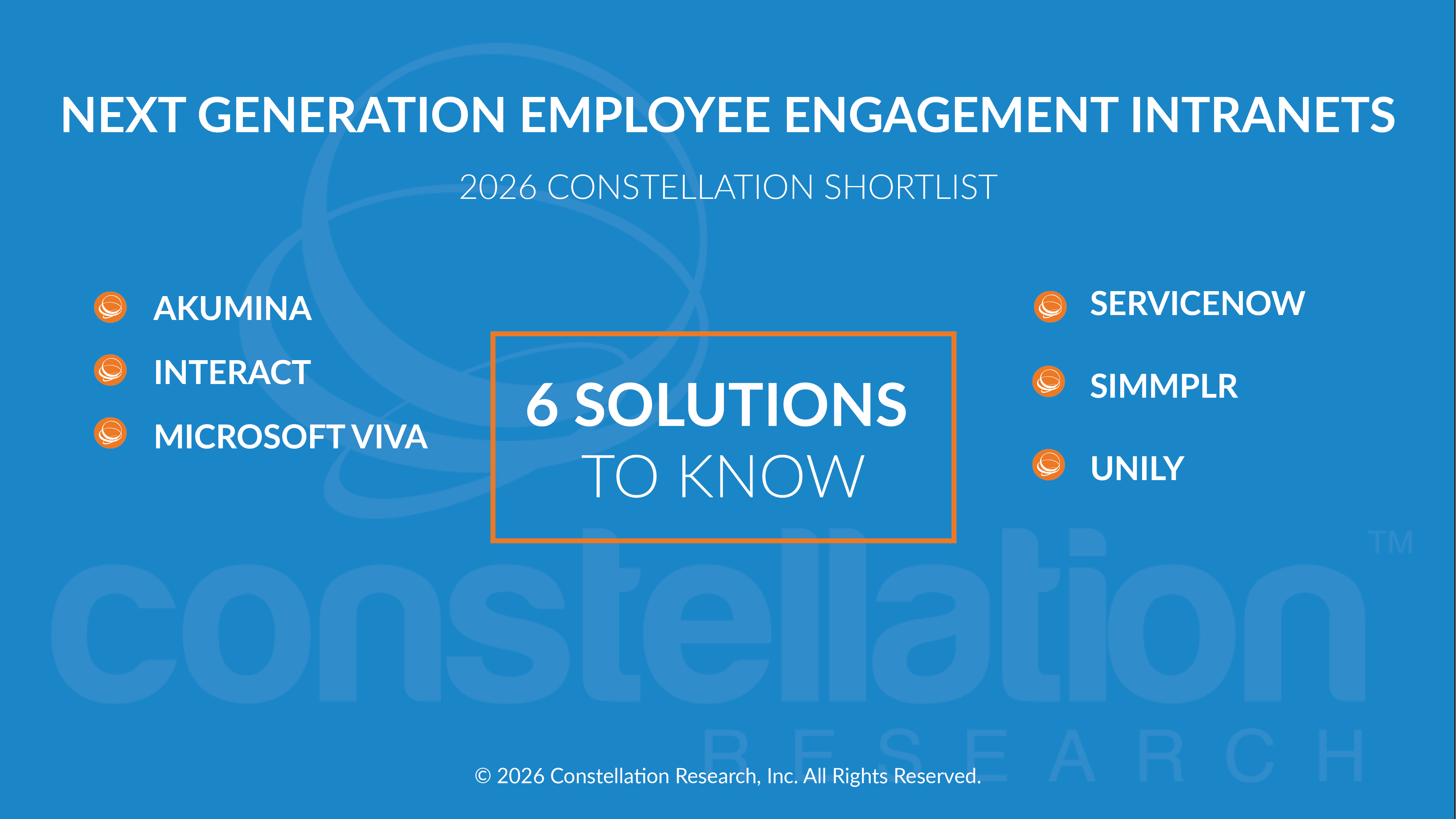
Constellation evaluates more than a dozen solutions categorized in this market. This Constellation ShortList is determined by client inquiries, partner conversations, customer references, vendor selection projects, market share and internal research
- AKUMINA
- INTERACT
- MICROSOFT VIVA
- SERVICENOW
- SIMMPLR
- UNILY
Frequency of Evaluation
Each Constellation ShortList will be updated at least once per year. There could be an update after six months, should the analyst deem it necessary.
Evaluation Services
Constellation clients may work with the analyst and research team to conduct a more thorough discussion of this ShortList. Constellation can also provide guidance in vendor selection and contract negotiation.