



Executive Summary
Observability and AIOps Services focus on helping organizations implement, operate, and optimize tools that provide visibility, intelligence, and operational insight across modern IT environments. As applications become more distributed and dynamic, enterprises increasingly rely on systems integrators and global services providers to design observability architectures, instrument systems, tune AIOps capabilities, and manage day-to-day operational complexity.
These services typically center on deploying and managing observability platforms that collect logs, metrics, traces, and events, alongside AIOps capabilities that reduce alert noise, correlate signals, and support faster incident response. Service providers play a critical role in establishing telemetry standards, integrating tools with ITSM and DevOps workflows, and operationalizing insights for SRE and IT operations teams.
While software vendors are converging toward more autonomous, platform-driven operations, most enterprise programs today remain focused on observability and AIOps as discrete but tightly coupled capabilities. As a result, service engagements continue to emphasize implementation, customization, and managed operations rather than full autonomy. This ShortList reflects that reality, while recognizing that leading service providers are beginning to evolve their offerings to align with emerging Autonomous IT Platforms and AI-assisted operations models. These firms are expected to help clients bridge the gap between today’s tool-centric operations and tomorrow’s more adaptive and automated environments.
Threshold Criteria
Constellation considers the following core and differentiated criteria for Observability and AIOps Services:
Core Capabilities
- Observability platform implementation and integration: Service providers must demonstrate experience implementing and integrating leading observability tools across infrastructure, applications, cloud platforms, and containerized environments.
- Telemetry instrumentation and data management: Support for defining instrumentation standards, managing telemetry pipelines, and ensuring data quality across logs, metrics, traces, and events is required.
- AIOps configuration and tuning: Services should include setup and ongoing tuning of AIOps capabilities such as anomaly detection, alert correlation, and noise reduction.
- Incident and operational workflow integration: Integration of observability and AIOps outputs with ITSM, incident response, and DevOps workflows is essential to ensure insights translate into action.
- Managed observability and AIOps operations: Providers must offer ongoing operational support, including monitoring, platform administration, and continuous optimization of observability and AIOps environments.
Differentiated Capabilities
- Service-centric and SRE-aligned operating models: Support for service mapping, SLIs and SLOs, and SRE-aligned practices that help organizations move beyond infrastructure-level monitoring.
- Advanced correlation and contextual analysis: Ability to incorporate change data, deployment context, service ownership, and historical incidents to improve the relevance of AIOps insights.
- Automation and runbook enablement: Support for designing and integrating runbooks, workflows, and limited automation to accelerate response while maintaining governance.
- Platform-agnostic strategy and advisory: Demonstrated capability to advise clients across multiple observability and AIOps platforms rather than optimizing for a single vendor ecosystem.
-
Forward alignment with emerging autonomous operations: Clear articulation of how observability and AIOps services evolve toward AI-assisted and more autonomous operational models, even if full autonomy is not delivered today.
The Constellation ShortList
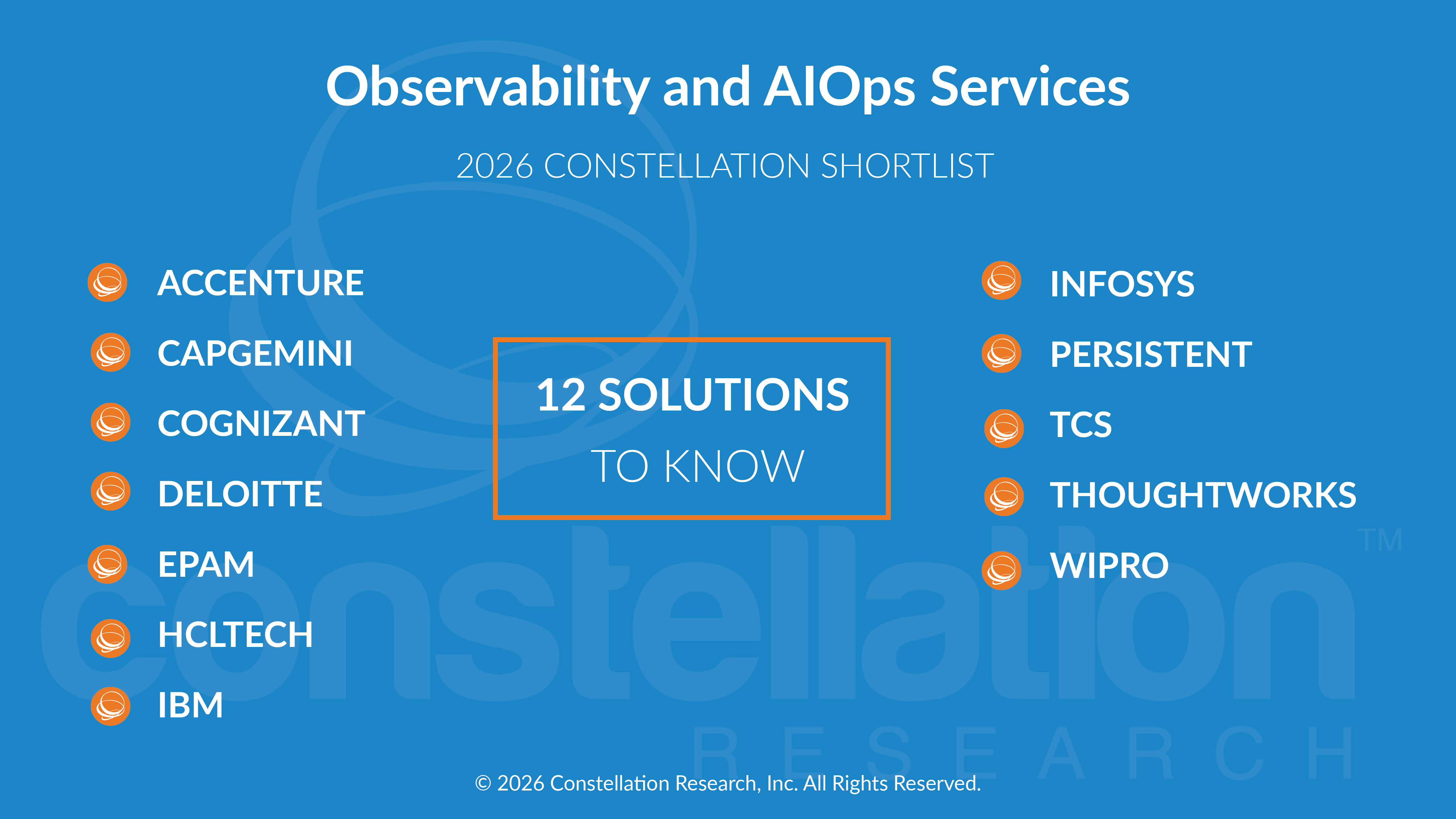
Constellation evaluates more than 35 solutions categorized in this market. This Constellation ShortList is determined by client inquiries, partner conversations, customer references, vendor selection projects, market share, and internal research.
- Accenture
- Capgemini
- Cognizant
- Deloitte
- EPAM
- HCLTech
- IBM
- Infosys
- Persistent
- TCS
- Thoughtworks
- Wipro
Frequency of Evaluation
Each Constellation ShortList will be updated at least once per year. There could be an update after six months if the analyst deems it necessary.
Evaluation Services
Constellation clients may work with the analyst and research team to conduct a more thorough discussion of this Constellation ShortList. Constellation can also provide guidance in vendor selection and contract negotiation.