



Executive Summary
This ShortList evaluates platforms that enable enterprises to define, govern, execute, and continuously improve automated business decisions. Moving beyond the "Productivity Trap" of individual AI copilots, these platforms treat decisions as explicit, reusable "Decision Services" that combine rules, models, and context with runtime governance and accountability to form the foundational building blocks of a Decision-Centric Architecture (DCA).
This shortlist builds on enterprises' investment over the last decade, modernizing data platforms, analytics, and AI, but who struggle with the gap between insight and action. Decision Automation has emerged as the missing layer that blends unified data foundations, shared semantics, and tribal knowledge with runtime policy-as-code to deliver executable decisions that can be trusted to scale across systems, teams, and workflows, with accountability.
In scope are platforms that support the full decision lifecycle: from defining objectives and framing context to autonomous execution, decision routing (human-in/out-of-the-loop controls), and closed-loop learning. They must provide Decision Visibility, tracing the full decision/process logs and traces of how/who/with what data behind the "why" a decision to ensure accountability and trust. Out of scope are standalone analytics tools, task-based RPA, or model development environments that lack an integrated decision execution and outcome-attribution layer.
This 2026 ShortList introduction serves as both an evaluation of current capabilities and a blueprint for CDAOs and architects building the trusted foundations required for the next phase of Agentic AI.
Threshold Criteria
Constellation considers the following criteria for these solutions:
- Capability to bundle business rules, ML models, and GenAI into "Decision Services" accessible via standardized APIs.
- Low-/No-code decision service authoring to enable business process owners to define rules, scoring or predictive models, optimization or prioritization logic, and GenAI-based reasoning within a single decision flow.
- Decision lifecycle management across testing, versioning, deployment, and rollback of decision logic without requiring application rewrites.
- Enforcement of policies (safety, limits, ethics guardrails), constraints, and guardrails at decision time, including routing for human-in/on-/out-of-the-loop based upon risk or confidence scores.
- Shared business definitions, ontologies, and relationships ingested and applied (e.g., RAG-enriched context) to ground AI reasoning.
- Decision execution is enabled inside operational workflows, transactions, or applications through APIs, events, or embedded services.
- Generation of human-readable explanations (top factors and logic applied) at the point of decision to build user trust.
- Observability and logging of decision input, specific logic/version used, context (intent, journey state, tribal knowledge heuristics), final outcomes/selected KPIs, overrides, and exceptions to support compliance and improvement.
-
The platform should provide role-based access, full audit trails, and controls suitable for regulated environments.
The Constellation ShortList
Constellation evaluates more than 35 solutions categorized in this market. This Constellation ShortList is determined by client inquiries, partner conversations, customer references, vendor selection projects, market share, and internal research.
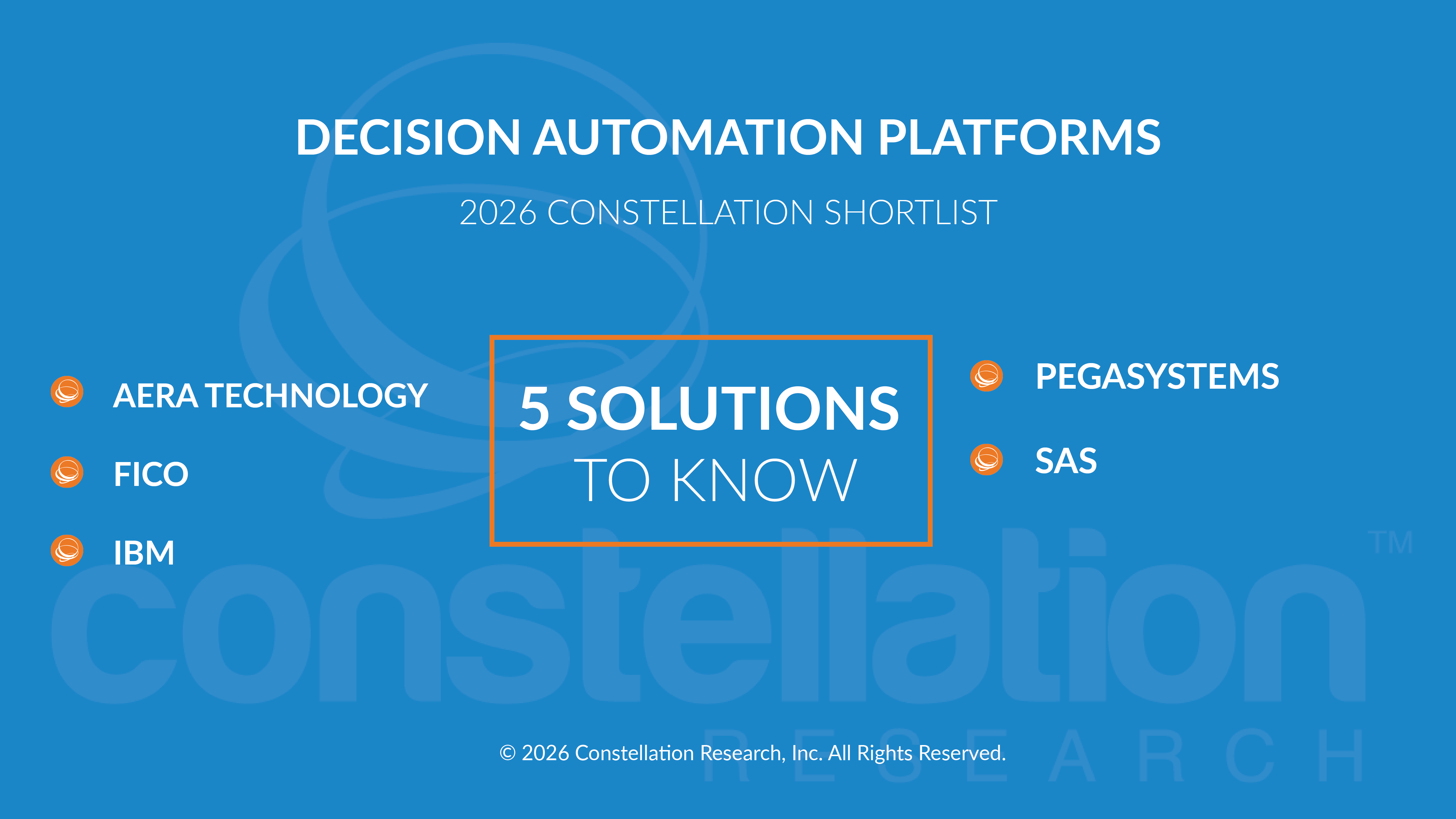
- Aera Technology
- FICO
- IBM
- Pegasystems
- SAS
Frequency of Evaluation
Each Constellation ShortList will be updated at least once per year. There could be an update after six months if the analyst deems it necessary.
Evaluation Services
Constellation clients may work with the analyst and research team to conduct a more thorough discussion of this Constellation ShortList. Constellation can also provide guidance in vendor selection and contract negotiation.