We had the opportunity to attend Microsoft’s combined Ignite and Envision events held in Orlando, taking place from September 24th till 28th2017. It was the first time Microsoft merged the two events, resulting in a conference that was attended by almost 30k people. As usual with Microsoft, analyst, influence and press attendance was massive.
A video shows more than a 1000 words, so if you prefer to watch: (if the video doesn’t show up, check here)
No time to watch – here is the 1 slide condensation (if the slide doesn’t show up, check here):
Want to read on? Here you go: Always tough to pick the takeaways – but here are my Top 3:
Microsoft is serious about Quantum – During Nadella’s keynote, the Microsoft CEO unveiled the vendor’s ambition in the field of quantum computing. Not too specific on what and when will be available hardware wise, but clear enough that Microsoft is serious on the investment. The most tangible parts of the overalls strategy that materialized in Orlando were with Visual Studio and Azure. Microsoft will provide a new programming language to build Quantum applications – and with that position itself early in the Quantum programming race. Likely this will not get enterprises to soon to build them, but the early platform will help Microsoft in research and academia. On the Azure side, Microsoft will provide a simulator for up to 30 Qubits, system wise that would be the largest system / simulated system out there as of now.
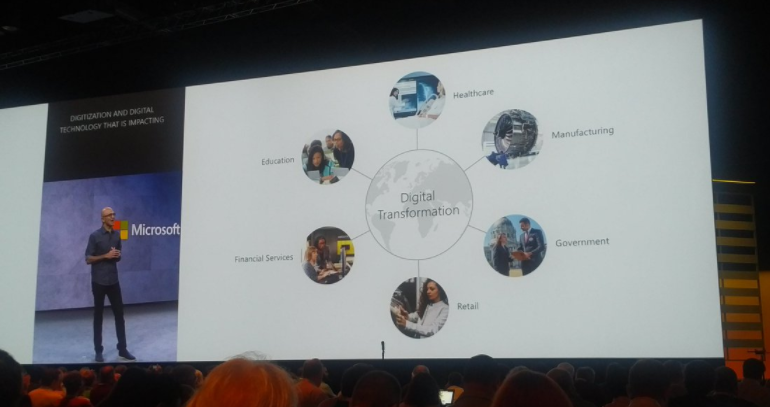
Nadella talks Digital Transformation
Cosmos DB gets air time – Cosmos DB, the former DocumentDB, got a lot of air time in the keynotes. And the database has a lot to offer: Easy setup, admin, data migration, global consistency and now has access to Azure functions to build serverless applications. A key component to consider for global next gen applications, with a strong NoSQL profile.
The three graphs at Microsof
Visual Studio gets a push – Though Ignite and Envision are not developer conferences, there was plenty of attention and airtime for Visual Studio. Not only does Visual Studio support a brand-new programming language for Quantum applications, it’s remains the developer platform for building next generation applications in the Microsoft ecosystem. That means that Microsoft is making it easier for developers to access the interesting innovative technologies of these days – speech recognition and machine learning. The bot framework is now well integrated and makes it easier for developers to build bot / chat based applications. The inherent fear of developers to be left behind, be eclipsed by other functions (e.g. Data Scientists. AI Pros etc.) is being addressed this way. And of course, Microsoft plays the DevOps, CI / CD and now – continuous innovation game. Putting more intelligence (and automation) in the development process will certainly be welcome by developer as well as enterprises. And Microsoft keeps building out capabilities that it has acquired with Xamarin, probably one of the best acquisitions Microsoft has made with a direct impact in developer and enterprise productivity.
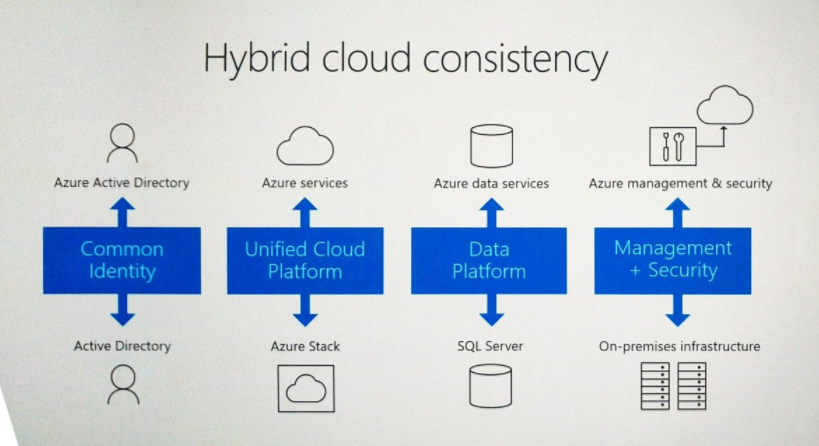
Microsoft Hybrid Cloud Pillars
Azure Stack is now GA - After a pivot from own hardware to partner hardware, Azure stack is now (finally) available for enterprises. The over one-year delay is a proof how complex the traditional architecture and technology roll out in the partner model is. But now Azure stack can be offered (alphabetically) by Cisco, Dell, HP and Lenovo. And with that Microsoft has the partners that are still planning to make substantial revenue on premises, and are grateful for Microsoft to offer Azure Stack. Likewise, are enterprises who still want / need to deploy on premises … with the option to move some or all that load to the (Azure) cloud later.
MyPOV
A good event for Microsoft, that showed Microsoft’s broad push across all its products. Customers will welcome that more pieces fit together (for instance CosmosDB and Azure Functions – even the brand-new ones in this case) and that existing products are strengthened (e.g. Visual Studio). But the even lacked the very big announcements, maybe because Build earlier in this year was announcement rich. Maybe because even the GA of major achievements, like GA of Azure Stack get consumed with continuous talk and announcements. Good to see Microsoft being early and laying a foundation for Quantum computing. This architecture is likely going to be the first computing architecture that will no be deployed in the enterprise - at all possibly. Key for all IaaS providers to have it early in the arsenal, especially given the novelty and challenges of Quantum computing.
On the concern side Microsoft took an even more notable timeout on the Hololens side. And despite making key announcements that matter to customers (for instance support for Kubernetes, Tensorflow, CloudFoundry), these partnerships were all mentioned in the keynotes but not shown in demos (I may have missed them) or announced in roadmaps. Instead a lot of innovation on Docker came to light, e.g. SQL Server 2017 can run in… a Docker container. The biggest challenge enterprises have with Microsoft is the absence of a holistic PaaS strategy. Microsoft has a strong element with Visual Studio, components with Flow and others, but needs to tie it all together to compete with the other PaaS offerings out there. On the flipside, Microsoft is solving massive problems when it comes to synthesizing the three graphs it has now - the Microsoft, Office and LinkedIn graphs. That takes time to sort out properly.
But for now – substantial progress – it cannot always be fireworks. Product development takes time and sometimes event schedules and product cycles don’t align. The good news is – customers are waiting and genuinely excited about the progress that Microsoft is making. Stay tuned.
Want to learn more? Checkout the Storify collection below (if it doesn’t show up – check here). A Storify of Scott Guthrie's keynote can be found here
Find more coverage on the Constellation Research website here and checkout my magazine on Flipboard and my YouTube channel here.
Vice President and Principal Analyst
Constellation Research
Holger Mueller is VP and Principal Analyst for Constellation Research for the fundamental enablers of the cloud, IaaS, PaaS and next generation Applications, with forays up the tech stack into BigData and Analytics, HR Tech, and sometimes SaaS. Holger provides strategy and counsel to key clients, including Chief Information Officers, Chief Technology Officers, Chief Product Officers, Chief HR Officers, investment analysts, venture capitalists, sell-side firms, and technology buyers.
Coverage Areas:
Future of Work
Tech Optimization & Innovation
Background:
Before joining Constellation Research, Mueller was VP of Products for NorthgateArinso, a KKR company. There, he led the transformation of products to the cloud and laid the foundation for new Business Process as a…...