


Constellation ShortList™ Integration Platform as a Service (IPaaS)

Executive Summary
IPaaS continues its evolution from traditional connectivity and efficiency for cloud-based integration into a broader execution platform that orchestrates workflows across applications, APIs, events, and data. These platforms support a transition toward composable architectures, allowing organizations to automate multi-step processes, respond to real-time events, and establish the governed reuse of digital assets. IPaaS platforms are now evaluated on their ability to activate business outcomes, accelerating time-to-action while maintaining operational control through reusability, observability, security, and governance.
On the cutting edge, iPaaS leaders prioritize Decision Velocity capabilities to accelerate time-to-action through advanced readiness (event hooks, APIs, workflow activation), a foundation for governance and execution context required to safely automate decisions across systems (policies, approvals, audit trails), and operational reliability (observability, exception handling, replay) to enable automation today and agentic execution tomorrow.
Threshold Criteria
An effective IPaaS is accessed and managed in the cloud and addresses both data-integration and application- integration scenarios.
- An IPaaS should support ease of use with drag-and-drop or point-and-click functionality. It should minimize manual coding and encourage repeatability and reuse through prebuilt connectors for popular data sources and data targets; ready-to-run parsing, filtering, and data-transformation options; and prebuilt templates or connectors for integrating popular cloud-based and on-premises applications.
- An IPaaS should address the publication and management of APIs, which are essential for business-to-business and emerging Internet of Things (IoT) integration scenarios.
- Augmented features powered by machine learning, artificial intelligence (AI), and generative AI are rapidly emerging and should be on the short-term roadmap.
- Workflow and process automation are must-have capabilities in a modern IPaaS.
- Modern integration increasingly demands both real-time (streaming) and batch-oriented scenarios. Therefore, an IPaaS should address a range of latency requirements.
-
A modern IPaaS should address event-based architecture needs, including asynchronous communications, support for decoupled services, and real-time processing.
The Constellation ShortList
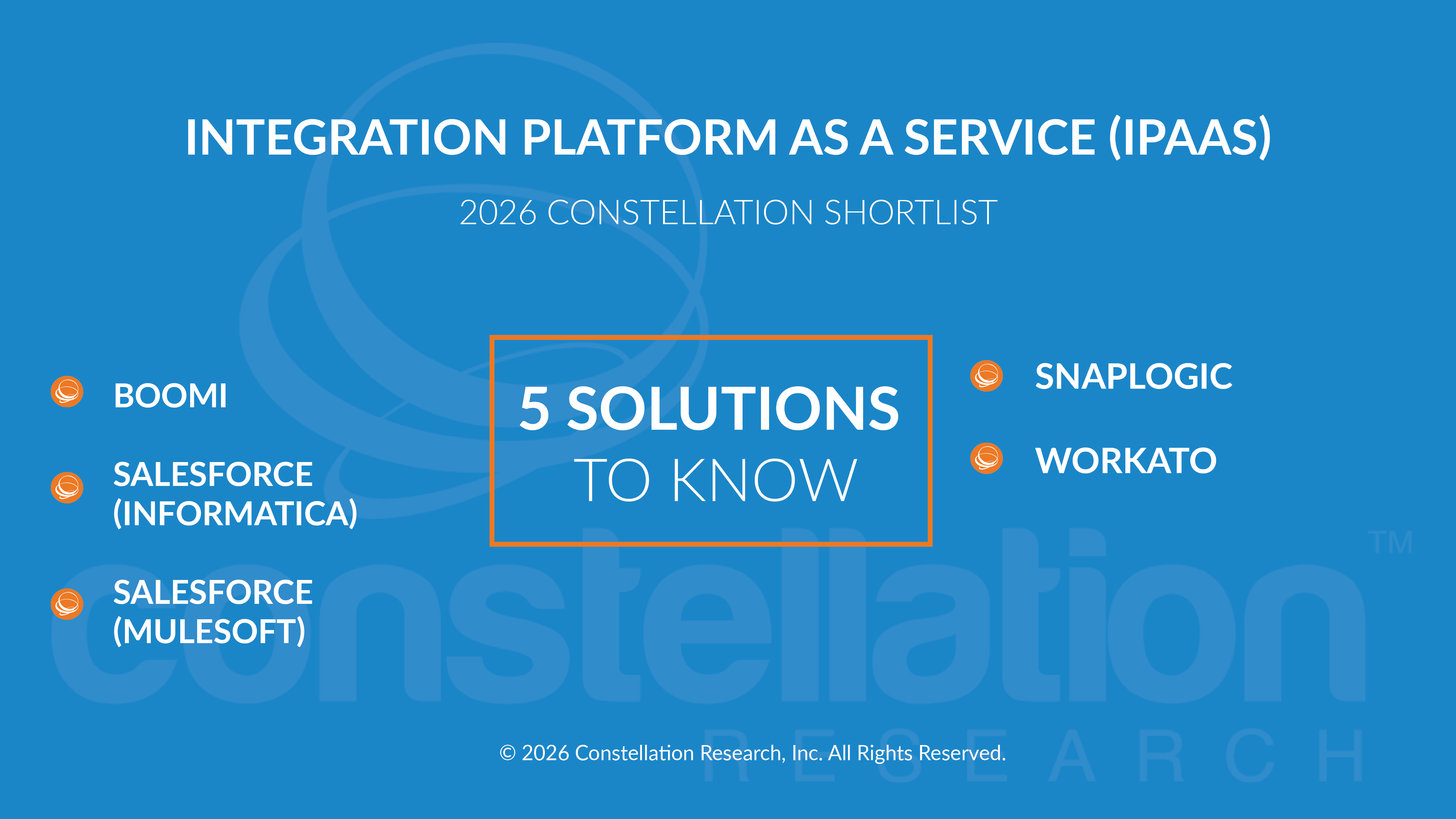
Constellation evaluates more than 25 solutions categorized in this market. This Constellation ShortList is determined by client inquiries, partner conversations, customer references, vendor selection projects, market share, and internal research.
- BOOMI
- SALESFORCE (INFORMATICA)
- SALESFORCE (MULESOFT)
- SNAPLOGIC
- WORKATO
Frequency of Evaluation
Each Constellation ShortList is updated at least once per year. Updates may occur after six months if deemed necessary.
Evaluation Services
Constellation clients can work with the analyst and the research team to conduct a more thorough discussion of this ShortList. Constellation can also provide guidance in vendor selection and contract negotiation.