


IBM overhauls FlashSystem with AI, proprietary memory, SLA focus
IBM revamped its FlashSystem storage portfolio with new systems, a 5th generation FlashCore Module, embedded AI capabilities via FlashSystem.ai and features that can detect ransomware, adapt and meet service level agreements.
Sam Werner, General Manager of IBM Storage, said IBM has been working on the portfolio updates for years and the mission was to use AI to improve productivity. Werner said that AI workloads require mission critical uptime and the speed of solid-state drives.
"These are the storage products where our clients their most mission critical workloads. This is where databases run, where the core business applications like ERP run," said Werner. "These are the systems that have to always be online if there's ever a problem with your primary flash storage business operations cannot continue. So, the number one most important thing when it comes to storage like this is the operational resiliency."
IBM's FlashSystem launch lands as storage has become even more strategic given AI workloads. Storage vendors are enjoying a boom market on multiple levels. IBM's FlashSystem competes in the high-performance storage market that includes Pure Storage, known for its Evergreen subscription model, NetApp, Dell and HPE.
Werner said price performance is also critical, but the FlashSystem portfolio is designed to meld hardware and a set of agentic AI powered data services that include storage management, monitoring and the ability to diagnose issues and remediate issues before they happen.
"We're taking a new agentic approach to storage management, and what we're seeing from these new capabilities is we can reduce storage management efforts up to 90%," said Werner, who noted one goal was to "support and amplify the expertise of storage admins.
The AI-driven capabilities in FlashSystem.ai include:
- Context aware security that tracks all of the interactions happening on a storage array. FlashSystem.ai looks at how interactions of the user, host and applications change as well as patterns over time.
- Anomaly detection so intelligence can be forwarded to storage and IT admins to take corrective actions against something like a ransomware attack. Werner said IBM can detect a ransomware attack on its storage in under a minute guaranteed.
- Dynamic compliance across FlashSystem to enforce real-time service level agreements and policies.
- Tools to optimize the balance of workloads across storage arrays and remediate problems before they are detected. IBM can make proactive recommendations to maintain performance, documentation for compliance and SLAs and generate operational reasoning behind all decisions.
Add it up and IBM FlashSystem is operating as a platform that revolves around SLAs and AI-driven optimization and automation, compliance and security.
The hardware
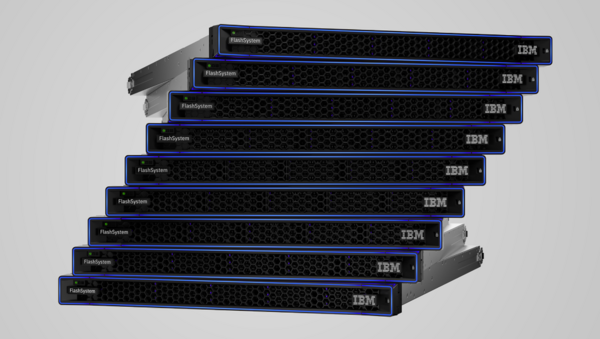
IBM's hardware strategy is to offer FlashSystem options for entry-level, mid-range and high-end systems. The systems including FlashSystem 5600, FlashSystem 7600 and FlashSystem 9600 are powered by the 5th-Gen IBM FlashCore Module. IBM is unique in that it builds its own flash drives.
The 5th-Gen FlashCore Module has more density with 105TB and proprietary memory integration of SLC and QLC memory to maintain performance and endurance. FlashCore can enable 3.4 PT raw in a single 2U system (9600).
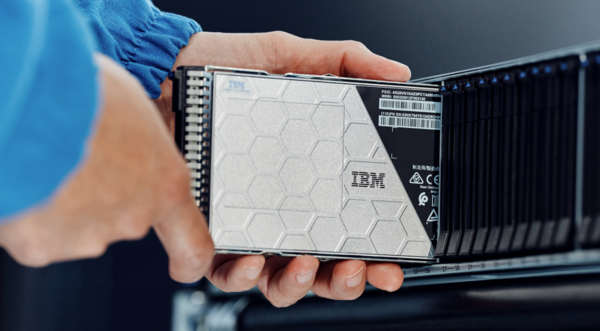
Werner said IBM's proprietary approach to its FlashSystem memory gives the portfolio lower costs on price, performance and durability.
According to IBM, the combination of data efficiency and placement, AI and memory approach can reduce operating expenses by 57%.
Werner also indicated that since IBM has supply chain advantages it has been able to secure memory and supplies. He noted that vendors have been raising prices, but IBM plans on remaining "a price leader in the industry throughout the year" and reduce costs for customers.
- Seagate: Agentic AI, video to fuel storage demand spike
- Memory price surge may crimp on-premise AI, data center deployments
Here's the breakdown:
- IBM FlashSystem 5600 has up to 2.5 PBe of capacity in 1U package. The 5600 is for edge locations, remote offices and small data centers.
- IBM FlashSystem 7600 has up to 7.2 PB3 in 2U system and up to 4.3M IOPs. the 7600 is for large virtualized environments, analytics and consolidated applications.
- IBM FlashSystem 9600 is for mission critical workloads with up to 11.8 PBe of capacity in a 2U system with up to 6.3M IOPs. The 9600 is designed for banking systems, ERP and AI applications.
According to IBM, FlashSystem reduces storage footprint by 40% to 75%.
The big picture
Werner and other IBM executives said the FlashSystem overhaul is aimed at taking a new approach.
Storage has typically revolved around monolithic systems that have leaf-spine connectivity and manual processes. Today, a disaggregated approach that's organized into a fabric is needed to revolve around SLAs and AI-driven management.
Storage SLAs can cover up time, backup schedules and other chores. FlashSystem.ai manages workload placement across a fleet and acts before SLAs are violated not after.
Werner said:
"If you buy a certain size flash system with a certain amount of capacity, you should expect a certain amount of IO and a certain amount of data reduction. Those would be my service level agreements to my client. Then the storage team, the IT operations team, has service level agreements they deliver to their clients in terms of IO performance and cost. So, it's extremely important for an IT team to be able to deliver on those service level agreements with our dynamic agentic AI within these systems."
IBM is also looking to amplify and in some cases replicate what an experienced storage administrator would do. When a ticket is created in provisioning storage, IBM sets up replication and snapshots and recommends how to complete the work and do it.
The AI agent built into FlashSystem will also be able to interact with other agents to create tickets and provide status updates.
Larry Dignan is Editor in Chief of Constellation Insights at Constellation Research, where he leads editorial coverage focused on enterprise technology, digital transformation, and emerging trends shaping the future of business. He oversees research-driven news, analysis, interviews, and event coverage designed to help technology buyers and vendors navigate complex markets with clarity and context. ...
Read morePublished
Author
