


SAP posts strong Q3 on cloud growth
SAP posted third quarter revenue growth of 13%, cloud revenue growth of 26% and crossed the €10 billion quarterly revenue mark for the first time.
The ERP and cloud software giant reported third quarter net profit of €2.27 billion, or €1.96 a share, on revenue of €10.3 billion. Cloud revenue in the quarter was €6.67 billion. Most of that sum was SAP's cloud ERP suite.
CEO Christian Klein said the third quarter was strong and its Joule AI efforts are gaining traction. "Our Autonomous Enterprise strategy is not just resonating, it is being adopted. Our customers are investing in the technology behind it – from the cloud and data foundation to our Business AI. They see that Joule Work makes the business case for their transformation more attractive than ever," said Klein.
Recent headlines:
- SAP highlights its autonomous enterprise, Joule agent vision, acquires TechWolf
- SAP CEO Klein: Our AI agents want to solve the complex business processes
A few items worth noting in the third quarter:
- SAP said cloud revenue growth was "positively impacted by several quarter-specific effects, mainly a multi-quarter revenue catch-up from customers returning from financial distress."
- The third quarter had a revenue bump of €49 million from the acquisitions of Reltio, Dremio and Prior Labs.
- SAP said it acquired more than 25 million shares as of Sept. 30 due to a new share repurchase program outlined in January.
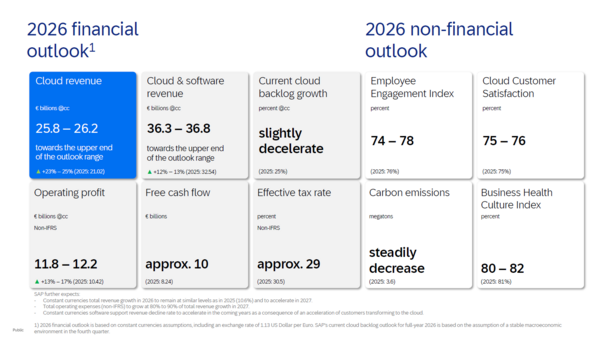
As for the outlook, SAP said it expects to generate cloud revenue toward "the upper end of the outlook range of €25.8 billion to 26.2 billion at constant currencies, up 23% to 25% from a year ago at constant currencies for 2026. Cloud and software revenue for the year will be about €36.3 billion to €36.8 billion for 2026 in constant currencies.
SAP reiterated its outlook for adjusted operating profit as well as €10 billion free cash flow for 2026.
Here's a look at what SAP executives said on the earnings call:
- CFO Dominik Asam said the fourth quarter is critical, but there are economic concerns. "We continue to believe that we are well positioned to accelerate total revenue growth in 2027. While we are committed to this goal, I would like to take a moment to provide some additional context to help you better understand our path forward," said Asam. "The fourth quarter accounts for around 50% of our annual bookings volume. Given the continued political and macroeconomic uncertainty we face today, this could weigh on Q4 bookings and as a result, our 2027 trajectory."
- SAP is betting on services and integrators. "As we mentioned in the first quarter of this year, and as you can see in the 5% decline, we want to leverage services more intentionally to promote the adoption of our AI solutions and build critical mass. This strategy has served SAP well to date. And as we are seeing positive return on investment, we will continue to double down on delivering even stronger adoption support to our cloud and AI customers, which will likely put more downward pressure on billable hours and services revenue also next year," said Asam. "In fact, we believe that in knowledge worker industries, business models, which solely rely on selling more hours to customers will be more and more challenged by AI, enable lower cost, more scalable and nevertheless, higher-margin alternatives. So further portfolio adaptation in services is a necessity."
- "If I look at the current macro backdrop, it is not so great. You have seen the oil price going up. Luckily, the conflicts in the Middle East have not really resulted in massive disruptions of supply chains, but a huge pressure on pricing of many of the commodities that are relevant for the globe," said Asam. "Interest rates have gone up, and we have all seen long-term correlation analysis that when interest rates reach like 5% plus, and they have reached that in the U.S. now, these interest rates start to develop teeth. It is probably reasonable to not assume that the macro is super conducive in Q4."
- Klein said SAP is routing models more. "We are now checking every agent use case, we are shipping also on what is the best model and not only from a performance, from an outcome perspective, but also from a price perspective. And we are just at the beginning. So we are switching the models now more often. And we see also that we have an increasing share of open-weight models. By the way, not only for what we ship to our customers, but also what we do internally," said Klein.
Larry Dignan is Editor in Chief of Constellation Insights at Constellation Research, where he leads editorial coverage focused on enterprise technology, digital transformation, and emerging trends shaping the future of business. He oversees research-driven news, analysis, interviews, and event coverage designed to help technology buyers and vendors navigate complex markets with clarity and context. ...
Read morePublished
Author
