


PCs and workstations get their AI inference moment
AI PCs and workstations are starting to have their AI inference moment with HP, Dell Technologies and Lenovo all seeing strong demand. Simply put, edge devices are starting to matter as companies aim to keep token costs down.
Earnings results from HP, Dell Technologies and Lenovo are showing stronger PC sales. Units may be down in some cases, but premium configurations and profits are up.
HP's Bruce Broussard, interim CEO, spent much of the company's second quarter earnings call talking about PCs and how customers were seeing them as a key node for AI workloads. HP reported better-than-expected second quarter earnings of 49 cents a share on revenue of $14.4 billion, up 9% from a year ago. Non-GAAP earnings were 86 cents a share. Consumer and commercial PC sales delivered double-digit growth.
"Rising cloud costs associated with agentic AI, along with latency, privacy, and security considerations are driving demand for AI workloads at the edge. As a result, customers are building AI at the edge using smaller, open source and proprietary models with more capable hardware and secure software layers," said Broussard.
Broussard added that AI infrastructure will be increasingly hybrid as enterprises leverage edge computing for AI inferencing to keep token costs in check. At HP Imagine, the company launched a series of next-gen AI PCs and workstations for AI. HP's Z workstations and AI stations are designed "to develop, run inference, and scale AI workloads, providing greater control over token costs."
Dell Technologies' Chief Operating Officer Jeff Clarke said PC demand is strong as traditional infrastructure takes on more AI inference workloads.
"Customers are upgrading their edge. They're upgrading the infrastructure. They're looking for more capable PCs as Agentic workloads make their way to the edge," said Clarke, who noted how Dell Technologies World featured a bevy of workstations and PCs for AI model workloads on premises.
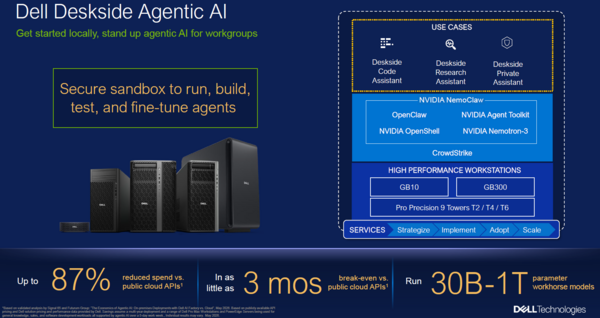
Clarke said CPUs are in again. Demand for Dell goes beyond the GPU. "There are more AI opportunities from a CPU perspective, traditional server and the PC," said Clarke.
HP said that AI PC shipments were 44% of the total in the second quarter, up from 35% the previous quarter. HP has benefited from an upgrade cycle to Windows 11, but most of the customer base has refreshed. The new wave of PC demand appears to be related to AI.
Ketan Patel, President of HP's Personal Systems unit, said on the company's earnings call that customers are using both AI PCs and workstations capable of running models locally. That demand means that AI PCs are going to be a larger part of HP's shipment mix, likely 60% to 70% next year.
"In both short run and long run, as a lot of customers are moving workloads to the edge with rising cost of excess AI, that's a great opportunity, which is structurally available to us for AI at the edge," said Patel.
Larry Dignan is Editor in Chief of Constellation Insights at Constellation Research, where he leads editorial coverage focused on enterprise technology, digital transformation, and emerging trends shaping the future of business. He oversees research-driven news, analysis, interviews, and event coverage designed to help technology buyers and vendors navigate complex markets with clarity and context. ...
Read morePublished
Author
