


Nvidia makes case AI factories, its stack are enduring capital assets
Nvidia is making the case that its AI factories are productive, durable and fungible to position them as an asset class that will drive returns for investors. What remains to be seen is whether Wall Street will buy the argument completely.
In a blog, Nvidia made the point that its platform and stack has a long lifespan and can drive returns. The goal here is to keep the AI capital flywheel rolling.
It'll have to play the long game here since higher interest rates and a flood of AI-related debt means Nvidia will have to prove it. That said, Nvidia's older chips are productive, hyperscalers and neoclouds like CoreWeave and Nebius have raised prices in select areas. There’s strong demand and cloud hyperscalers also have pricing power.
The counter to Nvidia’s take is that the AI giant is a master of circular financing. How this debate plays out will be critical for AI development as well as the broader economy in the US. Are GPUs an asset class? Will Nvidia’s AI stack prove to be productive well beyond the typical five- to six-year depreciation cycle for most data center gear? What’s the argument for enterprises and tokens, which are a cost? Will the revenue growth justify the expense and debt laid out by hyperscalers and neoclouds? Are tokens really revenue? What happens if either Anthropic or OpenAI face plant financially?
These questions don’t have answers yet. One thing is clear: AI is one massive leveraged bet and the capital markets aren’t completely bought in to Nvidia’s argument.
A Nvidia September deck aimed at the capital markets is worth a read. Key slides include:
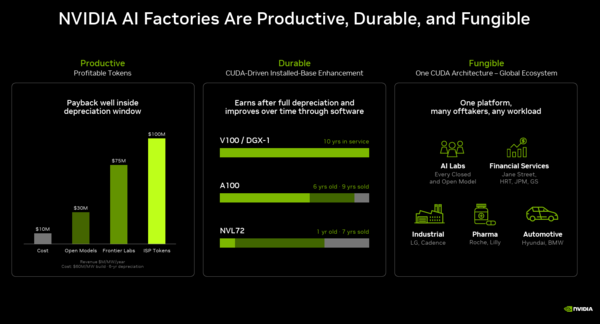
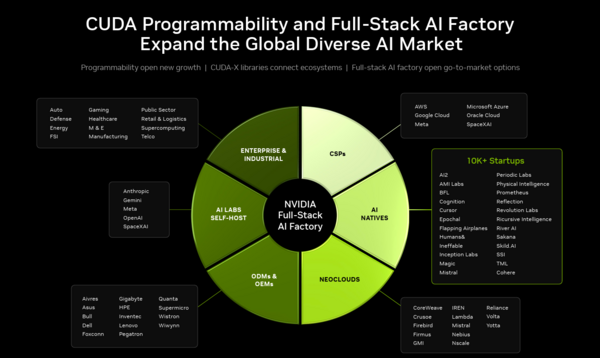
My take on the Nvidia as an asset class theme goes like this:
- The case will take time to prove and Nvidia is playing a long game. Nvidia's AI factories first have to get through a full, typical depreciation cycle. The AI boom is only a few years old, so the hardware hasn’t yet been through a normalized demand cycle. We don’t know what a “normal” demand cycle for AI looks like right now. Should older chips continue to retain value and command meaningful prices over the next few years Nvidia has a case. But the GPU as asset class argument is novel for now.
- Investors need to assess the value of the whole facility over time not just the GPUs. There’s a lot more to determining the value of an AI factory beyond the Nvidia stack. There’s the building, power, land and other infrastructure. The wild card from a valuation perspective is the Nvidia stack and that’ll play out over time.
- Neoclouds and AI labs are wild cards as customers given short operating histories, losses and balance sheets. The question that plagues the entire industry is this: What happens if OpenAI and Anthropic can’t meet their commitments?
- The token-to-revenue storyline differs by customer. The token to revenue argument applies to hyperscalers and neoclouds. For the rest of us, tokens represent costs and most likely inefficiency. Nvidia’s argument will get a lot stronger when on-prem AI factories deliver breakthroughs and revenue growth for multiple companies in multiple industries. Should enterprise AI drive business outcomes at scale, Nvidia will have an easier case to make to the capital markets.
- Capital market conditions matter as does the economy. Interest rates are spiking globally so now there's a larger hurdle rate. AI doesn’t exist in a vacuum and should the capital markets go risk off in a hurry we’ll be testing Nvidia’s argument.
More Nvidia:
- Nvidia launches Open Agent Safety Platform to secure AI agents
- Nvidia’s Nemotron hit enterprise AI inflection point
- Nvidia's supply chain integrates Palantir
- Nvidia’s $12.93 billion Hugging Face acquisition validates open weight models
- Nvidia projects $432 billion annual revenue run rate on Q2 surge
Larry Dignan is Editor in Chief of Constellation Insights at Constellation Research, where he leads editorial coverage focused on enterprise technology, digital transformation, and emerging trends shaping the future of business. He oversees research-driven news, analysis, interviews, and event coverage designed to help technology buyers and vendors navigate complex markets with clarity and context. ...
Read morePublished
Author
