


Goldman Sachs Q2: The AI takeaways for the top, and bottom lines
Goldman Sachs' stellar second quarter results provided a multi-layer view of AI's impact on revenue growth and productivity. Executives laid out a nuanced view of the AI boom.
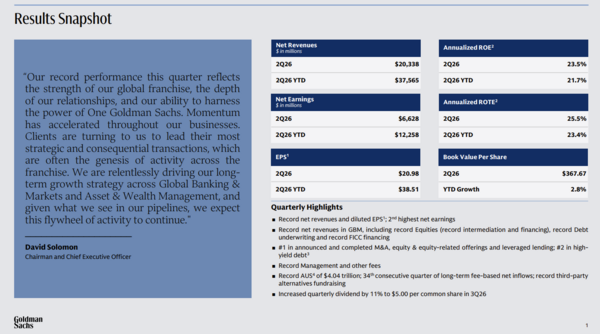
So far, that AI boom is benefiting Goldman Sachs. The company reported second quarter earnings of $6.63 billion on revenue of $20.24 billion. Goldman Sachs delivered record revenue and its diluted earnings per share of $20.98 were the second highest on record.
Goldman Sachs has view of AI has both top and bottom line implications. Goldman Sachs is often the lead on mergers, acquisitions and IPOs so it has a first row seat for the AI infrastructure buildout. And like other enterprises, Goldman Sachs sees AI as a way to transform its business, optimize and drive efficiency.
Here's a look at the AI takeaways from Goldman Sachs second quarter from CEO David Solomon and CFO Denis Coleman.
The AI infrastructure boom will ebb and flow, but investment is expanding. Goldman Sachs would know. It was the lead underwriter for the SpaceX IPO, led Alphabet's equity raise and advised on the merger of Dominion Energy and NextEra Energy, which was largely about powering data centers.
Solomon said:
"All the indicators we have are that we are in the relative early innings of a very significant AI build-out cycle. Now we all know because we've all been around for a long time that these things don't go in a straight line and they can ebb and flow. And I'm not smart enough to tell you whether or not there can be the recalibrations in the short term, sometime in the next 6 months, the next 18 months."
The AI infrastructure boom is viewed through a 3-year to 5-year lens at Goldman Sachs. Solomon added:
"When you look over a 3-year period or a 5-year period, we're investing in long-term growth to support this, and we're going to continue to be very consistent about that. We see lots of opportunities to deploy capital to our clients to finance this infrastructure build-out. We're very disciplined about the returns we expect for deploying that capital. It feels like that will continue, but I know that it won't be a straight line, and there'll be bumps and there'll be recalibrations because there's a lot of uncertainty around how not only is the infrastructure going to be built, but once the infrastructure is built, how enterprises will buy that infrastructure, how it will be priced, how greater efficiencies will come from chips and then the pricing ultimately of the technology."
- JPMorgan Chase, Goldman Sachs on Anthropic's Mythos, AI cyber risks
- Goldman Sachs eyes next AI transformation from position of strength
- Big bank CEOs, CFOs riff on state of AI exuberance
Is this an AI bubble? Solomon said the second quarter was "obviously a very robust quarter for IPOs" but volume was still below the 10-year average. Solomon said it's important to look to history and compare investment cycles, but the AI investment cycle has different characteristics. In terms of Goldman Sachs, Solomon said the firm is much bigger, more diverse and has more earnings engines than the previous significant investment cycles.
Solomon said:
"The firm and the earnings are more diverse, more sustainable. Could this ebb and flow? Absolutely. And it will, as it has in any other cycle. I think that's one of the lessons that we can take when you have these accelerations. Ultimately, you will have a recalibration, a reset, a drawdown and then a further acceleration. That's what the path generally looks like. But we're doing it off a much more diverse, much more significant base. And as we manage the firm, that's something we're thinking carefully about."
Goldman also said the AI infrastructure boom was also global and includes Asia as well as US.
Coleman added:
"We are in the middle of an AI CapEx super cycle where there are demands on financing into every single financing instrument in every region of the world and across every single industry."
AI is seen as human labor enhancement and relationships are the secret sauce. Solomon said that AI won't change the reality that Goldman Sachs is a relationship business. "Just as we are helping clients navigate this period of change, we are also implementing learnings within our own firm. There has been much debate around the broader implications of AI on the workforce. While it will change how work gets done, it will not replace what matters most in driving our business, our extraordinary people," said Solomon. "We see AI as a transformational technology that expands the capabilities of our best-in-class talent and our capacity to drive commercial impact for our clients."
Goldman Sachs’ communications and technology spending was up 20% in the second quarter compared to a year ago to $635 million. Its compensation and benefits expenses were $6.1 billion, up 30% from a year ago.
Solomon noted that Goldman Sachs has "deep trusted relationships with CEOs and boards" and "we're finding ourselves in discussions earlier and alone without other banks and that allows us to command more of the wallet structurally."
Coleman said:
"We want our world-class people to be more productive and do more for clients. As they become more productive, they may feel less need to replace people that in the ordinary course flow through the system. But right now, it's not a moment for a structural rework of our human capital footprint. It's a moment to invest and utilize this new technology and learn how to deploy it in the best possible way for our people and our clients."
Internal AI usage. Goldman Sachs sees AI as the glue that'll connect its various units, create a data flywheel and drive revenue. "One of the greatest benefits from our launching our 3.0 initiative is that we have galvanized the entire firm to understand that making efforts to scale our company and build more resilient, more automated platforms that can help us capture the significant growth in client activity," said Coleman. "We're developing marginal levels of revenue production and not growing our human capital footprint quite the same way, but recognizing instead that we need to have sort of the quality of capabilities and technology to scale."
Coleman said productivity is just the start and most of the returns are in engineering. He added that it's early.
The AI ROI flywheel is about data. Coleman said Goldman Sachs wants to move beyond table stakes to leveraging its data. He said:
"One of the easiest places to generate benefits are what I would refer to as table stakes. They're sort of necessary responsible process improvements that a leading international corporation should integrate into their firm. And then the question becomes how do you harness the combined capability of your natural talent that you have in your organization, your engineering talent, the data that you have as an organization? Goldman Sachs has an enormous amount of highly differentiated data that we have collected and curated over many years. And we put that all together with the extraction and analytic capabilities of these new technologies and put that in the hands of our world-class talent, and they should be able to continue to offer clients better, faster, more insightful pieces of advice and analysis to continue to make Goldman Sachs the kind of place that clients want to call first when thinking about their most important transactions."
Larry Dignan is Editor in Chief of Constellation Insights at Constellation Research, where he leads editorial coverage focused on enterprise technology, digital transformation, and emerging trends shaping the future of business. He oversees research-driven news, analysis, interviews, and event coverage designed to help technology buyers and vendors navigate complex markets with clarity and context. ...
Read morePublished
Author
