


Data ontology: A kinder, gentler form of lock-in
Enterprise vendor CEOs are increasingly talking about ontology and leaders need to pay attention because it may just be a gentler form of lock-in.
Now ontology isn't exactly a sexy term. It's a key ingredient to the metadata and knowledge graph layer that'll give AI agents important context and meaning. If you've been paying attention to Palantir for a few years you would have heard CEO Alex Karp talk about ontology a lot.
For the uninitiated, ontology is like dictionary entry for your data values: what each one means, what's the origin, and how you use it. The ontology is only relevant to each data model and is unique to the enterprise. Vendors can't create it or own it, but do provide the tools to manage it.
On the surface, the run on ontology speak appeared to be more Palantir envy just like the forward deployed engineer craze. Palantir considers ontology to be the secret sauce of its success. Palantir Ontology transforms raw enterprise data and transforms it into a set of semantic objects, business logic and governed actions.

But when you start adding up the ontology mentions among enterprise software vendors you're IT buyer Spidey sense should kick in.
At the SAP Connect conference, CEO Christian Klein noted the importance of ontology. Speaking to analysts, Klein said SAP's deep ERP data, process knowhow and ontology was the differentiator. APIs and model context protocol (MCP) are just tale stacks. "The intelligence comes with the ontology," said Klein.
The subtext: Leave SAP and you'll lose your intelligence. Klein's promise is that SAP will harmonize data and build a semantic and ontology layer without requiring customers to rewrite data strategies.
SAP also plans to integrate with your third party data too. Klein riff about ontology was a follow-up to what he said at a Goldman Sachs conference in September.
"We don't want to give away our crown jewels, our semantics, but we want to make sure that our agents also understand non-SAP data. That the ontology layer, the semantic layer, you can build it with Palantir, but with SAP, you get a lot of that out of the box," said Klein.
You can expect more ontology talk this month. October is apparently ERP month with SAP, Workday and Oracle conferences.
Oracle on its first quarter earnings call touted its AI Data Platform, which automate the creation of enterprise ontology.
The flurry of ontology mentions in the most recent quarter started to pick up and it's a good bet that the third quarter earnings reports will feature more. Everyone is starting to sound a little like Databricks and Snowflake these days.
If ontology is becoming that important to vendors there's only one takeaway to know: You need to keep control of it for your enterprise. Ontology is a key ingredient to metadata, which is needed to enable AI inference. These boring things like ontology, taxonomy and metadata give AI agents context and meaning.
Now ontology is a soft form of lock-in because you can have data portability and operational dependencies. Vendors are betting that AI has increased the value of the semantic layer and ontology and you'll be too lazy to do anything about it. The vendors will be right about this profound laziness in many cases. But if you want your company to control its fate and avoid lock in you need to own your data and the ontologies that go with it.
Vendors all have an opinionated view of your data, but it makes sense to have an architecture that preserves your data neutrality. Enterprises need to avoid owning the data and renting the systems that give it meaning for AI.
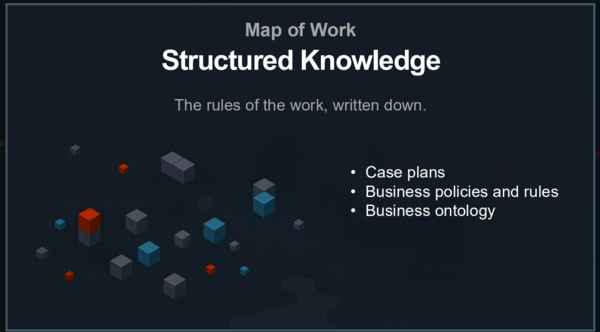
UiPath pitched a neutral ontology view on its investor day. The company said its offerings give you an ontology that builds a description for business objects that enable AI. Daniel Dines, CEO of UiPath, noted the business ontology is really about integration to create a map of work.
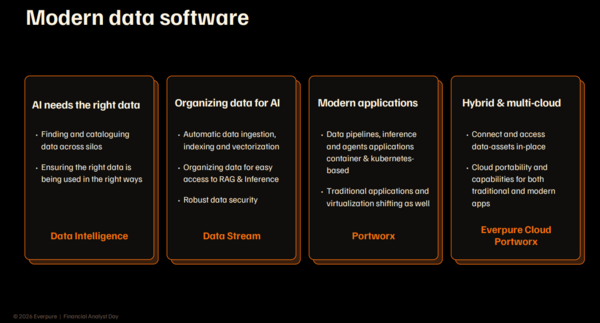
This reality was mentioned on Everpure's investor day. Everpure is formerly known as Pure Storage. Yes, a storage vendor may be a key ontology play.
Prakash Darji, VP and general manager of Everpure's digital experience business unit, said every vendor has a different flavor of leverage over your data. Oracle has database leverage. Databricks and Snowflake come from the analytics side. Salesforce and SAP have applications as leverage over your data.
Darji added:
"Most of them have largely not come from solving the problem needed for AI today. So all of them are trying to build capabilities, bring your data to me, and I will do an ontology, and I'll graph all things in my ecosystem. Philosophically, we're approaching the problem very differently. We're saying, no, your data is not going to go into one of those ecosystems. Your data will go and be in multiple places. So ontology and the knowledge graph needs to be in middleware above the layer."
Constellation Research Chief Distiller Esteban Kolsky said:
"I find it refreshing that the discussions we had in the late 1990s and early 2000s around knowledge management continue, with deep evolutionary tracks, unabated as we move forward with enterprise AI. After all, data and knowledge are different sides of the same coin, and the knowledge we earned back then is what enabled us to reach the attention white paper in 2017, and subsequent evolutions into this 9th generation of AI."
A few themes to note going forward:
- Own your business definitions, identifiers, relationships and policy specifications.
- Separate business meaning from vendor implementations.
- Keep critical logic reproducible and company controlled.
- Track your vendor concentration and dependencies for critical workflows, definitions and agents.
- Leverage open semantic standards to preserve definitions and mappings.
Larry Dignan is Editor in Chief of Constellation Insights at Constellation Research, where he leads editorial coverage focused on enterprise technology, digital transformation, and emerging trends shaping the future of business. He oversees research-driven news, analysis, interviews, and event coverage designed to help technology buyers and vendors navigate complex markets with clarity and context. ...
Read morePublished
Author
