


Databricks targets transactional data, customer data use cases, context, AI agent expansion
Databricks is aiming to be the bridge between AI agents and enterprise data as it steps up its game to meld transactional and analytical data while providing context, control and choice.
At Databricks Summit, the company moved to position itself as the most open platform to avoid all the flavors of lock-in, including models, clouds and data platforms. Databricks Summit follows Snowflake's annual conference and the two platforms are dueling to be the AI and data layer of choice.
Here's a look at what Databricks' broad themes.
- Upgrading the data stack. Databricks announced Lakehouse RT, a new format called Lake Transactional/Analytics Processing (LTAP) that blends transactional and analytics data, and Lakebase Disaster Recovery and Vector Search.
- Context. Databricks said its platform now provides context for all agents with new offerings including Genie Ontology, Omniagent OSS, Unity AI Gateway and Agent Bricks powered by Omniagent OSS.
- Agents to connect all data to automate work. Databricks overhauled its Genie family of agents to build agents and apps, automate flows and automate management.
- Use case efforts. Databricks rolled out new offerings with Agentic Marketing and Agentic Security.
Here's a look at what Databricks specifically announced at Databricks Summit.
Lakehouse RT. The company announced Lakehouse RT, which is aimed at agent-generated workloads such as SQL and high-concurrency and non-deterministic loops. According to Databricks, Lakehouse RT is designed to consolidate separate real-time serving stacks into Lakehouse, which will simplify governance and lower costs.
In a nutshell, Lakehouse RT is the new real-time variant of the company's core analytics architecture. Lakehouse RT is also powered by a new engine called Raiden that delivers millisecond performance at scale.

LTAP. Databricks outlined LTAP, a new category of unified transactional and analytic data. LTAP uses Lakebase for transactions, Lakehouse for analytics and features one open copy of the data. Databricks said LTAP's goal is to eliminate extract, transfer and load table syncing, duplicate copies and data silos and formats.
Databricks CEO Ali Ghodsi said:
“For decades, complicated data infrastructure was a tax that teams were forced to pay. Then agents arrived. In a matter of months, organizations effectively doubled their workforce, just not with humans. Agents write code, make calls, and run loops at a pace human teams never could. The infrastructure that powered the last era of computing is now the bottleneck that no one can afford. LTAP removes it.”
Lakebase cross-cloud disaster recovery. Lakebase's disaster recovery addition is designed for tier-one transactional workloads.
Genie expansion. Databricks expanded its Genie portfolio of agents with context from its Genie Ontology layer. New and expanded Genie products include:
- Genie One, which is a general-purpose AI coworker. In many ways, Genie one is Databricks' answer to Microsoft Copilot, Google Duet and OpenAI Enterprise.
- Genie Agents, which now allows users to build personal and departmental agents.
- Genie App Builder, a low-code enterprise app builder.
- Genie Flow, which is an evolution of Lake Flow Designer.
- Genie Code, which is used for about 60% of new data pipelines on Databricks.
- Genie Zero Ops, which monitors agents operating in the background and fixing issues.
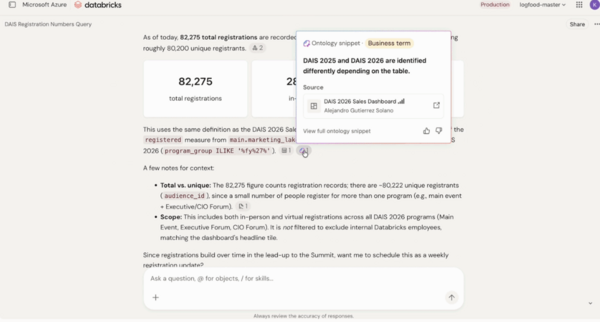
Databricks also rolled out Genie Ontology, which is an effort to combine manual semantics such as Unity Catalog and glossaries with a permission aware ontology. Genie Ontology stores knowledge snipes and ranks them to enrich queries and steer answers and ties together Databricks data, federated SQL sources and MCP connections.
Unity AI Gateway, which becomes the central enforcement plane for all AI usage across humans, agents, coding and business. Databricks is tying together the Unity Catalog, which handles policy definition, with Unity AI Gateway, which will handle enforcement.
With Unity AI Gateway, Databricks is aiming to put itself in the middle of AI budget tracking and cost controls, governance for agents, skills, MCP tools and managed objects and model routing.
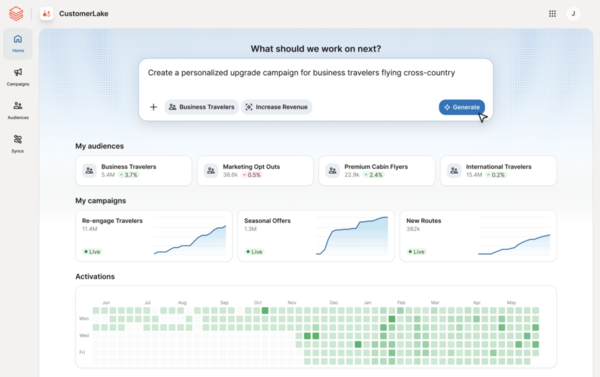
CustomerLake for Marketing. Databricks said its CustomerLake for Marketing is a customer data platform that uses profiling agents to maintain what the company called "golden context" for a customer.
Databricks said CustomerLake is designed for 1:1 marketing and brings personalization to enterprise brands. The bigger picture is Databricks tailoring its platform for use cases and verticals.
In addition, Databricks gave prominent billing to Lake Watch, which was outlined at the RSA Conference and extends the company into security data use cases.
Panther acquisition. Databricks said it has acquired Panther, an AI security operations platform that analyzes data sources, detects threats and investigates alerts with agents.
Panther will bolster Databricks security efforts with more than 100 data integrations and workflows for security operations.
The acquisition will speed up the evolution of Databricks Lakewatch, a security lakehouse that aims to unify business data into one governed platform for agentic detection and response.
Larry Dignan is Editor in Chief of Constellation Insights at Constellation Research, where he leads editorial coverage focused on enterprise technology, digital transformation, and emerging trends shaping the future of business. He oversees research-driven news, analysis, interviews, and event coverage designed to help technology buyers and vendors navigate complex markets with clarity and context. ...
Read morePublished
Author
