


Quantum networking coming into focus
Cisco announced prototype quantum networking software that aims to network quantum computers together more quickly.
The quantum networking software is part of Cisco's plan to create a unified quantum networking software stack. In some ways, Cisco is also validating IonQ's big push into quantum networking via a series of acquisitions.
In a blog post, Vijoy Pandey, Senior Vice President of Cisco's Outshift unit, said it will release three research prototypes next week at its virtual Quantum Summit. The prototypes include a Quantum Compiler, Quantum Alert, which aims to ensure quantum security, and Quantum Sync, a decision coordination app.
Pandey said Cisco is taking a systems approach to quantum network and is "building a full networking stack from the ground up: developing a quantum networking chip, control software including protocols and controllers for managing the network, and quantum networking applications that solve problems in the quantum and classical worlds."
Cisco's quantum software stack has three layers including applications designed for quantum and classical use cases, a control layer with quantum networking protocols and algorithms and a devices layer that'll connect to physical devices.
The Quantum Compiler prototype will be released next week. The compiler is focused on the scale out of circuits across multiple processors in a quantum data center. The big takeaway is that Cisco's quantum compiler supports distributed quantum error correction.
Cisco's post landed a few days after IonQ outlined its quantum networking strategy during its investor day and threw some shade at larger rivals such as IBM and Microsoft. During the presentations, IonQ outlined its networking strategy just as much as it talked about quantum computing.
- IonQ acquires Oxford Ionics for $1.07 billion, gets quantum-on-a-chip technology
- IonQ’s plan: Quantum networks extending into space
- IonQ doubles down on quantum networking, names new CEO as it eyes scale
Niccolo de Masi, IonQ's CEO, said the company aims to be the Nvidia of quantum computing and compared its networking acquisitions of Oxford Ionics and Lightsync to Nvidia's purchase of Mellanox. de Masi said "we believe we have a 5-year lead on our technical road map over any competitor."
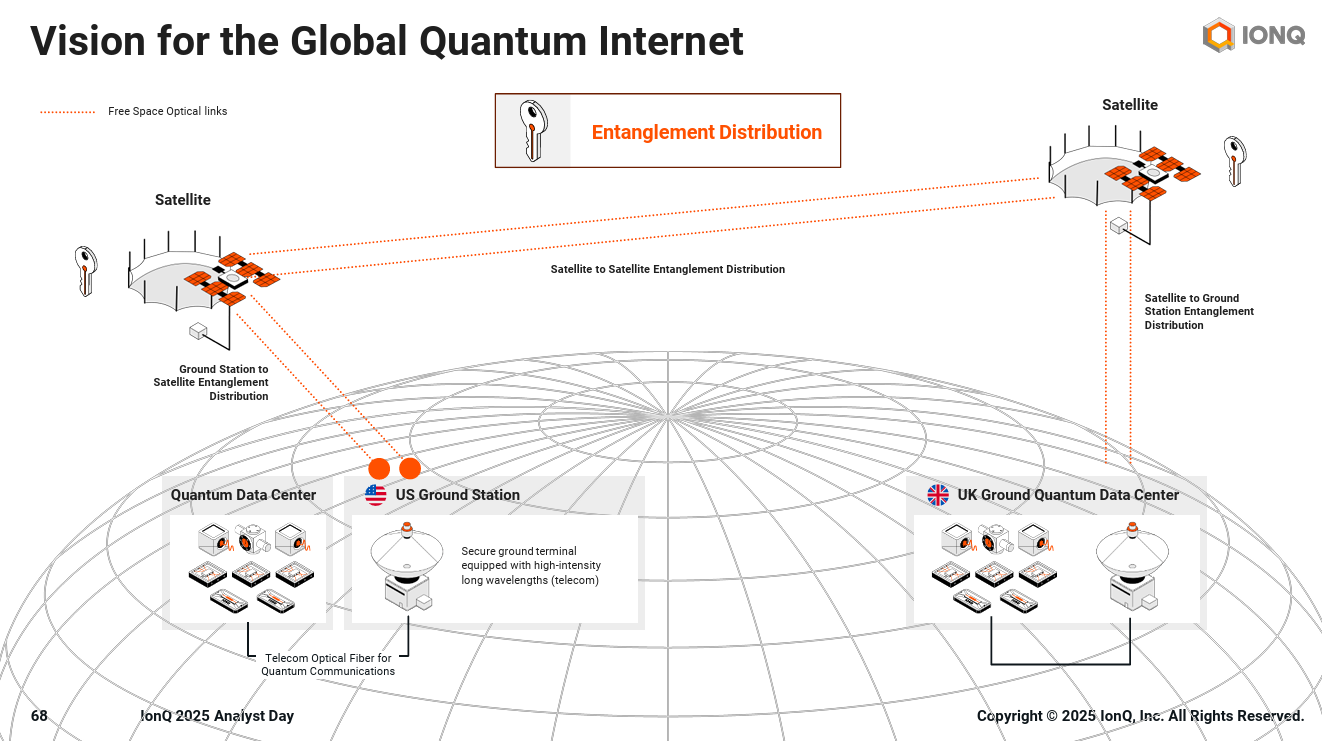
"Quantum distribution and quantum networking is not just something for the future. It's something for today because classical cybersecurity challenges only continue to be nastier," said de Masi, who argued that quantum security is going to need a quantum network. IonQ is even planning a ground to space, space to space and space to ground quantum network.
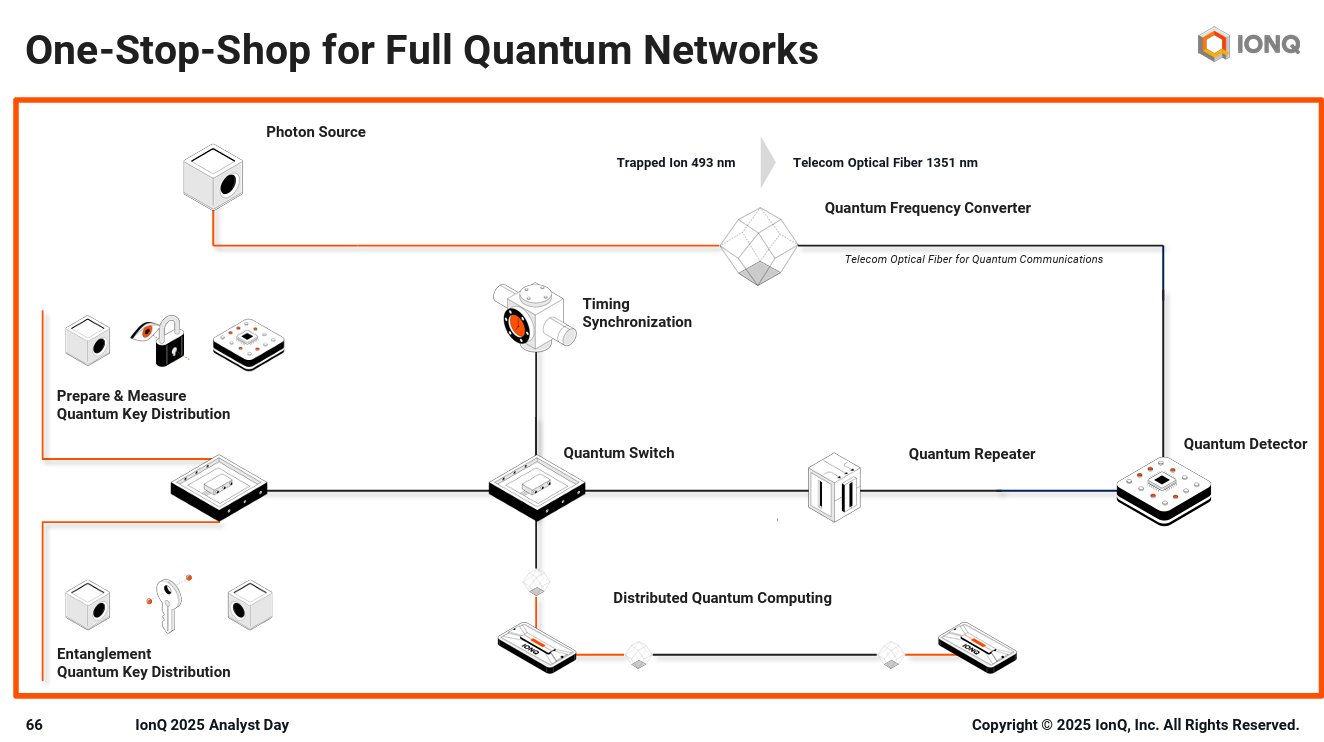
Mihir Bhaskar, IonQ's head of distributed computing and CEO of Lightsync, said quantum networking can scale quantum computing in data centers.
Bhaskar said:
"Quantum computers and networks really synergize. It is one big network, it is one big computer when you're building a data center. And so, with the ability to build and link quantum computers at a fast enough speed, I think coming together between IonQ and Lightsync is really the Nvidia Mellanox moment that's going to allow us to take the quantum computing technology and enable it to scale."
IonQ's Jordan Shapiro, president and general manager of quantum networking at IonQ, said IonQ's quantum networking gear is interoperable with classical networking gear and that's why it's a one-stop shop for quantum networking. IonQ announced a milestone in quantum networking with the Air Force Research Lab.
"Quantum networks are here. They're already here. They're securing the world's most sensitive data and IonQ is building the foundation for the world's connected data in the future," said Shapiro.
Larry Dignan is Editor in Chief of Constellation Insights at Constellation Research, where he leads editorial coverage focused on enterprise technology, digital transformation, and emerging trends shaping the future of business. He oversees research-driven news, analysis, interviews, and event coverage designed to help technology buyers and vendors navigate complex markets with clarity and context. ...
Read morePublished
Author
