


Lessons from Hawaiian startups
Constraints lead to innovation, ecosystems matter and artificial intelligence can lead remote startups punch above their weight.
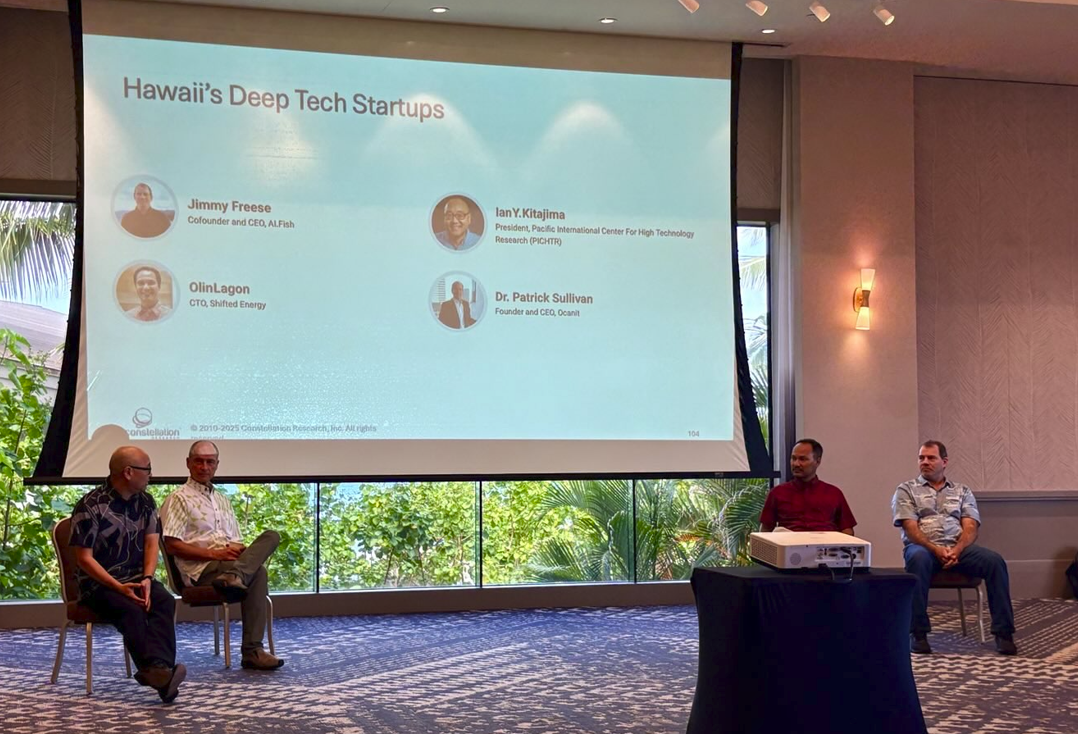
Those are some of the takeaways from a panel at Constellation Research's ARX conference in Honolulu.
The Hawaii startups on the panel included:
- Ian Kitajima, President of Pacific International Center For High Technology Research (PICHTR)
- Olin Lagon, CTO of Shifted Energy
- Dr. Patrick Sullivan, Founder and CEO at Oceanit
- Jimmy Freese, Cofounder and CEO AI.Fish
Here's a look at the takeaways:
Constraints breed innovation. A common theme from the Hawaii leaders was that you can innovate with constraints. In fact, constraints actually cause innovation. "Constraints breed innovation," said Kitajima. He added:
"Hawaii is the most isolated population in the world, but it's super diversified. We have very limited resources. It's extremely expensive with energy costs. Everything is expensive. But in those kinds of environments, innovation happens. My message to you is that in the future the next big companies may come from places like Hawaii and places you're not expecting."
Hawaii has its own constraints for sure. Companies with many resources also try to manufacture constraints by limiting budget and developing flat structures.
David is the disruptor to Goliath. Lagon said the reason constraints matter is because they inspire creativity and that human element to being an underdog. "You read all these disruption stories," said Lagon. "It's the David, right, not the Goliath. Sometimes if you're too over resourced, then you lose that."
The fundamental science to product innovation continuum. Sullivan's company is focused on fundamental science and deep problems and migrating them to products. Sullivan said he has teams within the company focused on parts of the product cycle. Sullivan's blue team is focused on the science and hard problems with social impact. The green team is focused on processes that take an idea to scale.
Sullivan said:
"Going from the blue zone to the Green Zone is not a straight line. Going from one zone to the next is treacherous journey. It's really difficult. To get a product to market, you got to really shift gears."
Co-development. Sullivan said Oceanit works with universities, governments and large developments. This approach is even more critical given the funding crunch at universities. "University funding pipeline is starting to thin out so we've created a co-development model," said Sullivan. "We build a pipeline based on fundamental science.
Talent challenges with a smaller market. Freese said one of his biggest challenges for his company is finding people to fill roles. Freese's company is using computer vision and AI improve fishery management and ocean conservation and finding expertise in machine learning and AI is a challenge.
However, generative AI and AI agents can fill that void through automation.
Grow an ecosystem. Sullivan said Hawaii has an innovative culture but lacks capital--even though Mark Zuckerberg, Larry Ellison and Marc Benioff--own big chunks of the state. Hawaii also has government ties with the military. "It is a naturally innovative community by any stretch. We excel in innovation, but confidence in ourselves becomes an issue in policy, education and investment," said Sullivan. "What we're trying to do with social engineering is develop talent and create an environment for capital. All of the business CEOs and local businesses have to become part of the solution."
Larry Dignan is Editor in Chief of Constellation Insights at Constellation Research, where he leads editorial coverage focused on enterprise technology, digital transformation, and emerging trends shaping the future of business. He oversees research-driven news, analysis, interviews, and event coverage designed to help technology buyers and vendors navigate complex markets with clarity and context. ...
Read morePublished
Author
