New Report: Five Lead-to-Order Agentic Use Cases Growth Leaders MUST be Using Now
If your growth organization is still only using AI to summarize sales calls or draft basic emails, you’re missing out on potentially exponential productivity and margin gains.
In my latest Best Practices report, The Five Lead-to-Order Agentic Use Cases You Need to Be Using Now, I unpack a massive shift happening across revenue teams. We are officially moving out of the era of passive AI "assistants" and entering the era of agentic AI: autonomous systems designed to perceive data across your tech stack, plan multi-step workflows, execute actions, and adapt to real-time feedback with minimal human intervention.
For growth leaders, this isn't just about incremental productivity; it’s about a structural transformation in how you generate revenue, protect deal margins, and drive Customer Lifetime Value (CLTV).
What’s Inside the Report? A High-Level Overview
In this report, I break down the five critical areas across the Lead-to-Order (L2O) funnel where early adopters are seeing the highest measurable ROI:
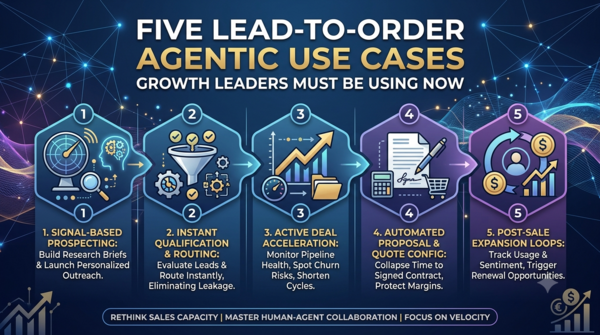
- Signal-Based Prospecting: How autonomous agents monitor real-time buying signals to build research briefs and launch hyper-personalized outreach at scale.
- Instant Qualification & Intelligent Routing: How always-on agents evaluate leads against complex frameworks (like BANT or MEDDIC) and route them instantly, eliminating funnel leakage.
- Active Deal Acceleration: How deal-monitoring agents continuously evaluate pipeline health, spot quiet churn risks, and automate next steps to shorten cycle times.
- Automated Proposal & Quote Configuration: How collapsing the time between "verbal yes" and "signed contract" protects margins and maintains sales momentum.
- Post-Sale Expansion Loops: How post-sale agents track product usage and sentiment to trigger expansion and renewal opportunities, turning revenue generation into a continuous engine.
Why Growth Leaders Need to Read This Report Now
I wrote this research specifically for C-suite executives, Chief Revenue Officers, and revenue operations leaders who need to cut through the vendor hype and build a practical, future-proof AI strategy.
Here is why you should dive into the full document:
- Rethink Your Sales Capacity Models: Learn how agentic tools allow your teams to multiply outbound pipeline output and handle larger deal volumes without requiring proportional headcount growth.
- Master Human-Agent Collaboration: I outline practical implementation maturity markers for each stage, showing you exactly where to let agents handle administrative orchestration and where to keep your human talent focused on high-stakes, relationship-building moments.
- Focus on Velocity, Not Just Conversions: Discover how compressing stage-to-stage cycle times across your entire funnel creates a compounding advantage over slower competitors.
The Bottom Line
The transition to agentic revenue operations isn't a distant horizon, t’s happening right now. Leaders who treat agentic AI as a core strategic architecture rather than a collection of point solutions will establish durable competitive advantages in pipeline efficiency and revenue predictability. If you're ready to modernize your go-to-market engine, read the report and take away some best practices today.
Martin Schneider has had a unique career that has spanned both analyst and marketing practitioner roles, focused on high technology and related industries. The unifying factor has always been both a keen analysis of go-to-market trends, while also having achieved success as a marketing leader. Schneider started his career as a journalist covering B2B technologies, and quickly transitioned into a leading analyst covering application software for the 451 Group in NYC, where he specialized in CRM, marketing automation, and business intelligence/analytics technologies. After analyzing various go-to-market strategies of dozens of technology vendors, Schneider made the move to the vendor side, where he led successful go-to-market teams for several startups and established tech providers,…...
Read morePublished
Author