


IBM delivers strong Q3, sees 4% to 5% revenue growth in 2026
IBM delivered third quarter revenue growth of 5% as the company recovered from a rocky second quarter outing.
The company reported third quarter net income of $2.19 billion, or $2.30 a share, on revenue of $17.1 billion. Non-GAAP earnings in the third quarter were $2.95 a share, 8 cents a share ahead of Wall Street estimates.
CEO Arvind Krishna said "disciplined execution throughout the quarter drove accelerated revenue growth and strong free cash flow. Our clients are now deploying super intelligence in ways that transform entire operating models, instead of simply addressing narrow or novel problems."
Krishna added that the company continues to expect 2026 revenue growth of 4% to 5% with an increase of free cash flow of more than $1 billion.
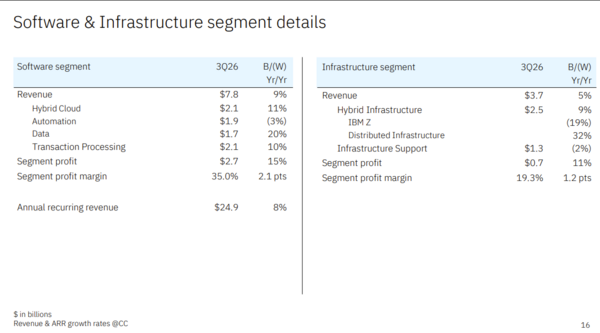
By unit IBM said software revenue was up 8% with flat consulting revenue. Infrastructure revenue was up 4%.
IBM CFO James Kavanaugh said IBM is using AI inside the company to boost productivity and cash flow.
By the numbers:
- Software revenue in the third quarter was $7.8 billion, up 8%, with Red Hat and hybrid cloud up 11%. Data was up 19% and transaction processing was up 9%.
- Consulting revenue was $5.3 billion.
- Infrastructure revenue of $3.7 billion was driven by hybrid and distributed infrastructure. IBM Z revenue was down 20%.
- Kavanaugh said Confluent and HashiCorp, two recent acquisitions that expanded IBM's AI and software footprint are performing well. "Data grew 20%, driven by another strong performance from Confluent with bookings growth of about 20%. Transaction Processing grew 10% in the quarter, driven by demand for this mission-critical software and strong execution against our pipeline. HashiCorp continues to perform well, growing bookings across all geographies and accelerating revenue growth sequentially," he said.
- Red Hat's OpenShift now has $2.4 billion in annual recurring revenue. Krishna said: "Customer spending priorities to leverage AI remain strong. But as you begin to leverage it, how does the average customer get value? They have to rewrite an application. They have to modernize an existing application. That tends to be a tailwind for Red Hat I expect that to carry on for a long time. Then, the moment they get to OpenShift. And I think we are at the very beginning of this cycle. How do I unlock the data from all of the enterprise data that I need to power that AI application? Remember, 90% of enterprise data is not on the cloud. It's very much inside the enterprise. So Confluent tends to be a tailwind."
- IBM had a record quarter for storage with "broad-based demand across Flash, Fusion, Tape and IBM Z storage," said Kavanaugh.
- 85% of IBM's mainframe customers are maintaining or growing capacity.
Speaking on the third quarter earnings call, Krishna was upbeat about IBM's software business, hardware and quantum computing. Takeaways include:
- "Sovereign AI is definitely becoming a much larger conversation. While we have talked about it for the last 1.5 years, I would not tell you that in '24, it had much traction. In '25, a few people began to pay some attention. And in '26 it is now beginning to pick up," said Krishna.
- "Red Hat again grew 11 percent, with bookings growth accelerating back to the high teens. OpenShift ARR growth accelerated reinforcing our conviction that we remain in the early stages of a long-term application modernization cycle," said Krishna.
- Mainframe deals that slipped in the second quarter closed in the third quarter "validating our view that softness in the second quarter reflected timing rather than underlying demand," said Krishna. "Z17 continued the strongest innovation cycle in the platform's history, generating more than a billion dollars of incremental revenue over six quarters compared with prior programs."
- Krishna said the smaller IBM Z systems are also selling well and was the best selling mid-range system in nearly two decades.
- IBM's AI offering rests on four platforms: Confluent, watsonx (including Bob and Orchestrate), HashiCorp/Apptio and Red Hat. "Deploying more models or building more agents will not be enough. The advantage will belong to a company that can operate AI securely, efficiently, and sustainably across the enterprise," said Krishna. "As AI scales, clients ask two questions: What will it cost, and who controls it?"
- "This year, IBM Quantum has signed 16 enterprise engagements across industries including automotive, aerospace, telecommunications, financial services, and manufacturing," said Krishna, who added that IBM will provide more details Dec. 10 during its Quantum Day.
Larry Dignan is Editor in Chief of Constellation Insights at Constellation Research, where he leads editorial coverage focused on enterprise technology, digital transformation, and emerging trends shaping the future of business. He oversees research-driven news, analysis, interviews, and event coverage designed to help technology buyers and vendors navigate complex markets with clarity and context. ...
Read morePublished
Author
